

Russian convoy mystery unsolved
Ukraine alleges weapons transport
Advertisement
Read this article for free:
or
Already have an account? Log in here »
To continue reading, please subscribe:
Monthly Digital Subscription
$1 per week for 24 weeks*
- Enjoy unlimited reading on winnipegfreepress.com
- Read the E-Edition, our digital replica newspaper
- Access News Break, our award-winning app
- Play interactive puzzles
*Billed as $4.00 plus GST every four weeks. After 24 weeks, price increases to the regular rate of $19.95 plus GST every four weeks. Offer available to new and qualified returning subscribers only. Cancel any time.
Monthly Digital Subscription
$4.99/week*
- Enjoy unlimited reading on winnipegfreepress.com
- Read the E-Edition, our digital replica newspaper
- Access News Break, our award-winning app
- Play interactive puzzles
*Billed as $19.95 plus GST every four weeks. Cancel any time.
To continue reading, please subscribe:
Add Free Press access to your Brandon Sun subscription for only an additional
$1 for the first 4 weeks*
*Your next subscription payment will increase by $1.00 and you will be charged $16.99 plus GST for four weeks. After four weeks, your payment will increase to $23.99 plus GST every four weeks.
Read unlimited articles for free today:
or
Already have an account? Log in here »
Hey there, time traveller!
This article was published 24/08/2014 (4241 days ago), so information in it may no longer be current.
KyiV, Ukraine — The Russian aid convoy was a mystery from the start.
There were more than 200 trucks, all painted white and covered with matching tarps, with little known about the contents. For 10 days, the convoy sat on the border with Ukraine, barred from entering, as foreign officials speculated on whether it was really carrying food for civilians in war-torn cities or was secreting weapons to the pro-Russian rebels fighting there.
On Saturday, a day after the convoy crossed the Ukrainian border without permission, the trucks returned to Russia, leaving a trail of questions behind.
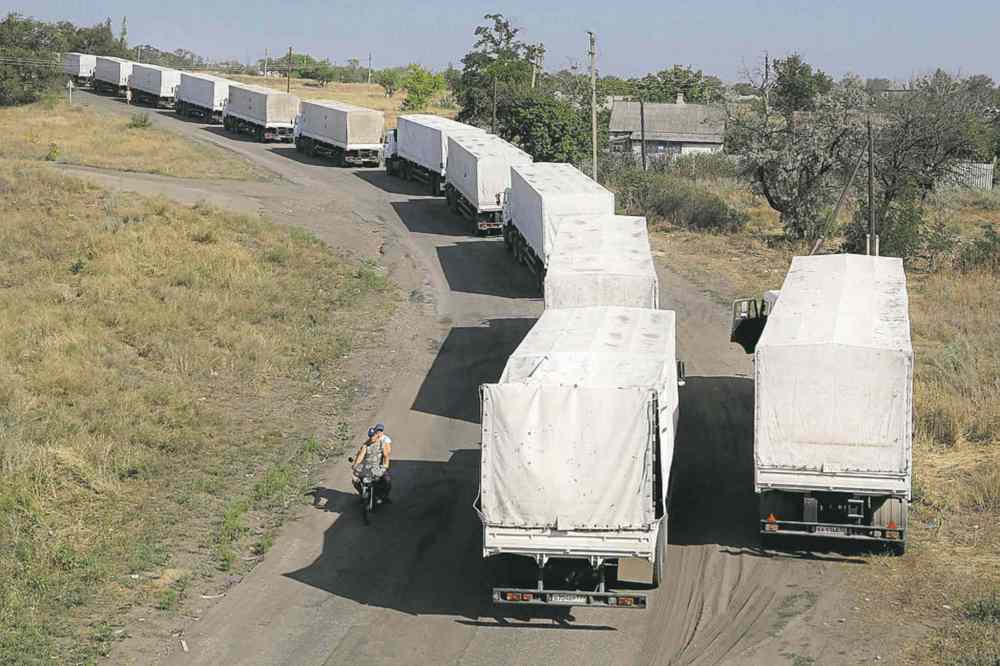
What had the Russian truck convoy done in Ukraine? And how would Ukraine respond to what it called a “direct invasion”? A Ukrainian military spokesman added to the intrigue by saying that, before going home, the Russians had loaded their vehicles with sophisticated Ukrainian-made military equipment, including aircraft trackers. He offered no proof.
One thing that was clear Saturday was that the incident had widened the diplomatic divide between Russia and the West, just days before Russian President Vladimir Putin is scheduled to meet Ukrainian President Petro Poroshenko at a regional summit in Minsk, Belarus.
The convoy inspired a wave of international accusations that Russia had violated Ukraine’s sovereignty and international law — and raised questions about whether Russia might stage similar crossings in the future, given the apparent success of this one.
On a visit Saturday to Ukraine, German Chancellor Angela Merkel stressed respect for Ukraine’s territorial integrity was paramount in resolving the crisis.
“We need a peaceful solution, and we don’t want an open border that allows weapons to pass from Russia to Ukraine,” she said.
The conflict continued to grind on Saturday in eastern Ukraine, where rebels hunkered down in the cities of Donetsk and Luhansk, even as their territory shrinks in the face of a Ukrainian offensive. Desperate citizens said they were keeping to their basements and doing without enough food and water.
Three people were killed Saturday in shelling in Donetsk. A day earlier, violence in Luhansk claimed the life of Lithuania’s honorary consul in that city, Mykola Zelenec, authorities said. Zelenec was kidnapped and “brutally killed” by rebels, Lithuania’s foreign minister tweeted.
Russian television showed footage of workers on trucks in the aid convoy unloading sacks of grain and other food Friday in Luhansk.
But Ukrainian officials say they still don’t know what was in the trucks.
“There is no information about what was brought here, where it was unloaded and what was being done to the unloaded cargo,” Ukrainian military spokesman Andriy Lysenko said Saturday.
“There is no information about what was brought here, where it was unloaded and what was being done to the unloaded cargo”
— Ukrainian military spokesman Andriy Lysenko
Only a portion of the convoy’s 220 or so vehicles were actually searched by Ukrainian authorities, since they crossed the border in an area controlled by rebels.
Lysenko said trucks had crossed back into Russia Saturday morning after being packed with Ukrainian-made equipment used to produce an advanced aircraft-tracking system, as well as ammunition for small arms.
Russia’s defence sector, which has been hurt by European sanctions, has long been dependent on industries in Ukraine to provide parts for everything from planes to missiles.
Ukrainian officials had threatened a military response if the convoy tried to force its way into the country. But Ukrainian forces opted not to fire on it, and Lysenko said Ukraine would be continuing to pursue a diplomatic solution to the crisis rather than a military one.
Poroshenko, appearing at a news conference with Merkel Saturday, derided the Russian aid convoy as supplying “so-called assistance” and said it had “invaded the territory of Ukraine, violating all regulations of the international law.”
The Russian convoy had idled outside the Izvaryne border crossing to Luhansk, which is controlled by pro-Russian separatists, for more than a week as government ministers tried to hammer out a deal to move in food, water and emergency supplies. Ukrainian authorities had said they would allow in the convoy if it was accompanied by International Committee of the Red Cross officials. But on Friday, Russian authorities decided to move in without permission.
Western officials had expressed suspicions that the trucks were bringing in arms to replenish the rebels’ supplies.
Russia’s Foreign Ministry has denied such allegations and maintained it acted lawfully. It said in a statement Saturday that it was “firmly guided by international legal principles of humanity and the protection of the civilian population from the effects of war.”
Merkel’s visit was her first to Ukraine since demonstrations by pro-European protesters forced the resignation in February of President Viktor Yanukovych, an ally of Moscow’s. Her trip was intended as a show of support for Poroshenko by Europe’s most powerful leader and carried added clout because of her country’s important economic ties with Russia.
Merkel had told Putin in an earlier telephone conversation that she had “great concern” over the convoy. The Russian president informed Merkel that “explicit delays from the side of Kyiv” forced Russia to send the convoy across the border and that any further delay would have been “unacceptable.”
In recent days, new reports of shelling from Russia into Ukraine has alarmed NATO officials. NATO Secretary General Anders Fogh Rasmussen said that Russian artillery support had been used against Ukrainian troops from inside the country and across the border — the alliance’s sharpest criticism of Russia’s involvement in Ukraine to date.
The Russian Foreign Ministry dismissed the charge of cross-border shelling, calling it a “fable” and a “lie.”
The ministry hinted in a statement Saturday that the country planned to send more humanitarian aid.
“Our assistance is still in demand,” it said.
— The Washington Post