

Quenching a thirst
Experts tackle one of the world's most worrisome problems -- scarcity of water
Advertisement
Read this article for free:
or
Already have an account? Log in here »
To continue reading, please subscribe:
Monthly Digital Subscription
$1 per week for 24 weeks*
- Enjoy unlimited reading on winnipegfreepress.com
- Read the E-Edition, our digital replica newspaper
- Access News Break, our award-winning app
- Play interactive puzzles
*Billed as $4.00 plus GST every four weeks. After 24 weeks, price increases to the regular rate of $19.95 plus GST every four weeks. Offer available to new and qualified returning subscribers only. Cancel any time.
Monthly Digital Subscription
$4.99/week*
- Enjoy unlimited reading on winnipegfreepress.com
- Read the E-Edition, our digital replica newspaper
- Access News Break, our award-winning app
- Play interactive puzzles
*Billed as $19.95 plus GST every four weeks. Cancel any time.
To continue reading, please subscribe:
Add Free Press access to your Brandon Sun subscription for only an additional
$1 for the first 4 weeks*
- Enjoy unlimited reading on winnipegfreepress.com
- Read the E-Edition, our digital replica newspaper
- Access News Break, our award-winning app
- Play interactive puzzles
*Your next Brandon Sun subscription payment will increase by $1.00 and you will be charged $17.95 plus GST for four weeks. After four weeks, your payment will increase to $24.95 plus GST every four weeks.
Read unlimited articles for free today:
or
Already have an account? Log in here »
Hey there, time traveller!
This article was published 17/01/2015 (4135 days ago), so information in it may no longer be current.
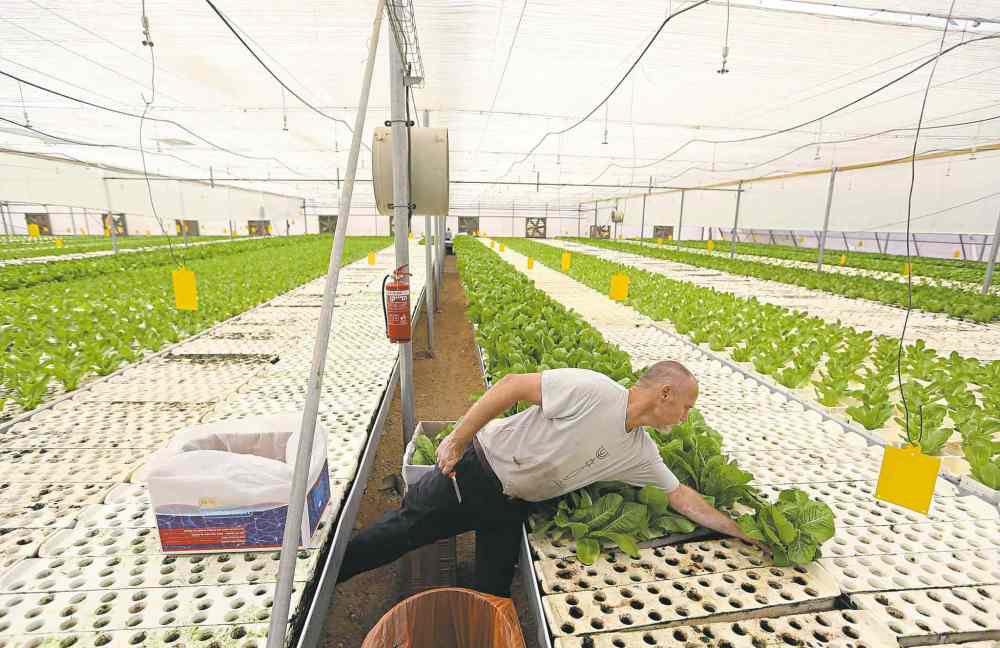
SAMAR, Israel — The Arava desert, a salty wasteland dotted with tufts of scrub, gets only about an inch of rain each year. And yet cows lazily low at dairy farms that collectively produce nearly eight million gallons of milk annually. Orange bell peppers flourish in a long swath of greenhouses that skirts the Jordanian border. Kibbutzim with vineyards somehow manage to churn out shiraz and sauvignon blanc, unfazed by the desert sun.
The clusters of farms and wineries in the Arava are a testament to Israel’s acumen in water technology. One of the most parched places on Earth has found a way to beat water woes once so severe that Israel’s national mood rose and fell with the changing level of the Sea of Galilee, one of their most critical water sources.
That expertise helps explain why the University of Chicago sought out Israel’s Ben-Gurion University to help tackle one of the world’s most worrisome problems — water scarcity.
In decades past, oil used to be the commodity that shaped geopolitics, and at times, ignited wars. In coming years, water will be the commodity with that kind of clout.
Water scarcity is a crisis that has begun to have palpable, disturbing implications for much of the globe. By 2030, nearly half of the world’s population will be living in regions saddled with severe water stress, the UN projects. During the last decade, the number of violent confrontations over water issues has risen fourfold, according to the Pacific Institute, a California think-tank that studies global water scarcity.
The University of Chicago is tackling water scarcity because it believes it has a novel approach to the problem — relying on engineering at a molecular level to produce breakthroughs.
“There are shortages of water from the First World to the Third World,” said Steve Sibener, one of the University of Chicago scientists leading the research. “If you look at California, it has been a particularly dry year, and you can see how the whole (U.S.) west and southwest can have boom and bust cycles that are likely to get worse. If you move onto the Middle East and Africa, you understand that water is precious — it’s like gold. It’s the issue of the day.”
In laboratories in Chicago and the Israeli desert, scientists are crafting radical new approaches that may one day rejuvenate the world’s water-starved regions. One project uses a common inkjet printer to apply layers of chemicals to a water filter to repel bacteria and keep the filter clog-free. Another turns radioactive isotopes into tracking devices to trace water movement through aquifers, a development that could lead to the discovery of vast new strata of groundwater. Still another effort strives to create filtering membranes that operate on a molecular level, using electrically charged, cilia-like hairs to repel filter-fouling microbes. The goal is to complete research by the latter part of 2015.
The University of Chicago brings to the collaboration its expertise in molecular engineering, while Ben-Gurion brings its experience of transforming water research into real-life applications in a water-starved nation.
Three-quarters of the world is covered by water, but less than three per cent is fresh water. More than 3.4 million people die each year of diseases related to the lack of safe drinking water such as diarrhea — nine out of 10 of those deaths occur in developing countries. Water scarcity affects at least 700 million people in 43 countries, UN figures show. By 2025, the number of people living in areas without enough water will rise to 1.8 billion people, the UN states. Areas with annual water supplies below 1,000 cubic metres per person are regarded as water-scarce.
The quest to ensure reliable sources of drinking water has stoked discord among nations for millennia — and still does today.
In the Nile Valley, tension has ramped up over a dam the Ethiopians are building that would dramatically cut back the amount of water Egypt gets from the Nile for irrigation and drinking water purposes. In South Asia, the Pakistani government for years has accused India of building hydroelectric dams in the Indus Valley that rob Pakistan of water it needs for farm fields and human consumption.
Water crises aren’t limited to Asia and Africa. In Brazil’s largest city, S£o Paulo, more than half of residents said last fall that they had been hit with water shortages. The drought gripping western U.S. states has robbed that region of 63 trillion gallons of water.
The point man for the University of Chicago is Matthew Tirrell, a professor and founding director of the Institute for Molecular Engineering, who in 2012 approached Ben-Gurion’s Moshe Gottlieb about collaborating on water research.
“We need to look for things that are game-changers,” Gottlieb said. “We want to attack the issue at the molecular level. We want to take our expertise in nanotechnology, and put it to use in water-related problems.”
Since its independence in 1948, Israel has had to find ways to build its society and economy in one of the most water-starved places on the planet. Its game plan for surmounting water scarcity had several pillars. It built a water supply line known as the national water carrier that transported water from the Sea of Galilee to the rest of the country, including the barren wastelands of the Negev and Arava deserts. It ingrained water conservation deep in the population’s mindset — for years, Israelis rationed their water use, and even as young children, they were taught to conserve.
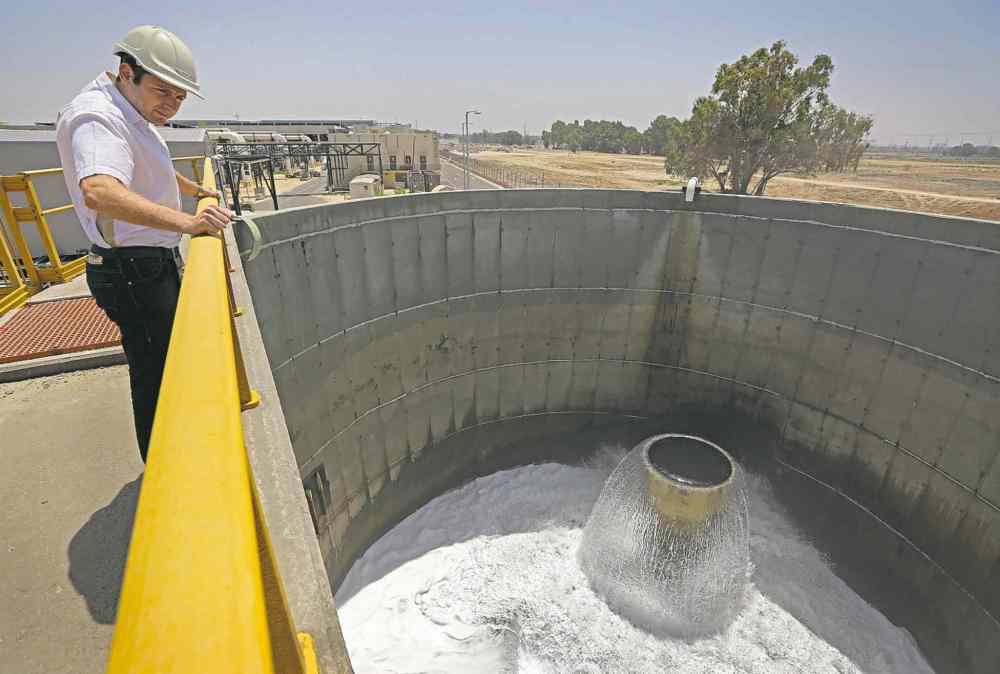
The most significant initiative was Israel’s embracing of desalination technology. Israel built its first plant at Ashkelon on the Mediterranean coast in 2005 and now has five plants. Together, the plants produce 500 million cubic metres of water each year, about half of the country’s drinking water needs. In desalination, water is drawn out of the sea and then pumped through a series of filters to separate the brine and yield fresh water. Once desalinated, the water tastes like ordinary tap water.
“Desalination gives you the power to control your supply,” said Udi Tirosh, business development director at IDE Technologies, an Israeli corporation that builds and operates desalination plants in Israel and around the world. “Up until a few decades ago, you were waiting for rain or digging a well. Now that you can desalinate, it’s game-changing. You can produce efficient water from the sea, which is important because rivers can dry out, and lakes and aquifers can dry out. This is what happened in Israel.”
There are more than 17,000 desalination plants in 150 countries, and expanded use of the technology could drastically ratchet up water supplies for water-starved nations. But desalination isn’t problem-free. The bane of desalination plants is bio-fouling, the buildup of microbes on filter surfaces. It makes an already costly approach to creating drinking water even costlier.
A portion of the Ben-Gurion/University of Chicago research targets the world’s increasing reliance on desalination. The goal, Tirrell said, is to create new technology that solves the problem of bio-fouling, and in doing so, make desalination more practical across the globe. To that end, Tirrell and his Israeli counterparts are creating new strand-like molecules less than one-10,000 of the diameter of a human hair, and attaching those strands to the surface of a desalination filter. The strands are electrically charged both positively and negatively, and that combination repels bacteria.
At Ben-Gurion’s Sede Boker campus in the heart of the Negev desert, biological chemist Christopher Arnusch is relying on an everyday office mainstay — the inkjet printer — to help improve water filtration. Arnusch has found a way to use the printers to apply anti-bacterial coatings to filters, a breakthrough that allows scientists to economically affix the right mix of chemicals to sheets of filters a meter wide.
Another Ben-Gurion scientist, Eilon Adar, has a very different mission — finding new sources of water.
With technology developed at Argonne National Laboratory outside Chicago, Adar and his team use naturally occurring radioactive isotopes to track the movement of groundwater through aquifers as deep as a mile below the surface, relying on a laser device to detect the number of krypton isotopes in a water sample. Krypton isotopes are used because they begin to decay once they move from surface water to underground strata. The number of isotopes found tells scientists how long the water has been underground. With that information, they can plot the oldest to youngest samples on a map and determine the water’s flow through the aquifer, and ultimately the aquifer’s size and characteristics.
Adar says the research has an intriguing practical application — finding water in the bedrock beneath the world’s deserts.
“You cannot sustain a growing population with diminishing amounts of water. So we move into arid and semi-arid basins. …And we all know that, under deserts around the world, there are huge groundwater reservoirs,” Adar says.
— Chicago Tribune