

Red light, green light… green light
Adaptive traffic controls aim to end congestion nightmare
Advertisement
Read this article for free:
or
Already have an account? Log in here »
To continue reading, please subscribe:

Digital Subscription
One year of digital access for only $205*
- Enjoy unlimited reading on winnipegfreepress.com
- Read the E-Edition, our digital replica newspaper
- Access News Break, our award-winning app
- Play interactive puzzles
*First annual payment billed as $205.00 + GST for one year. This annual subscription will automatically renew at $233.00 + GST every 52 weeks (10% off the regular annual price of $259.35). Offer available to new and qualified returning subscribers only. Cancel any time.
To continue reading, please subscribe:
Add Free Press access to your Brandon Sun subscription for only an additional
$1 for the first 4 weeks*
- Enjoy unlimited reading on winnipegfreepress.com
- Read the E-Edition, our digital replica newspaper
- Access News Break, our award-winning app
- Play interactive puzzles
*Your next Brandon Sun subscription payment will increase by $1.00 and you will be charged $17.95 plus GST for four weeks. After four weeks, your payment will increase to $24.95 plus GST every four weeks.
Read unlimited articles for free today:
or
Already have an account? Log in here »
Hey there, time traveller!
This article was published 21/03/2015 (4136 days ago), so information in it may no longer be current.
WASHINGTON — You’re stuck in traffic, waiting for the signal to turn green. When it finally does, you inch forward, as several cars up ahead of you make it through the intersection. Then the light turns red, and you hit the brakes again, only to repeat the process.
Most drivers can relate to this frustrating scenario, whether they’re commuting to work or heading to the mall. Now, a growing number of U.S. cities, counties and states are trying to tackle the traffic-congestion nightmare by improving the way lights are synchronized.
They’re using a variety of high-tech tools to prevent backups at intersections and smooth the flow of traffic. Some collect and analyze data to pinpoint problem spots. Others use advanced technology to fix the problem right then and there.
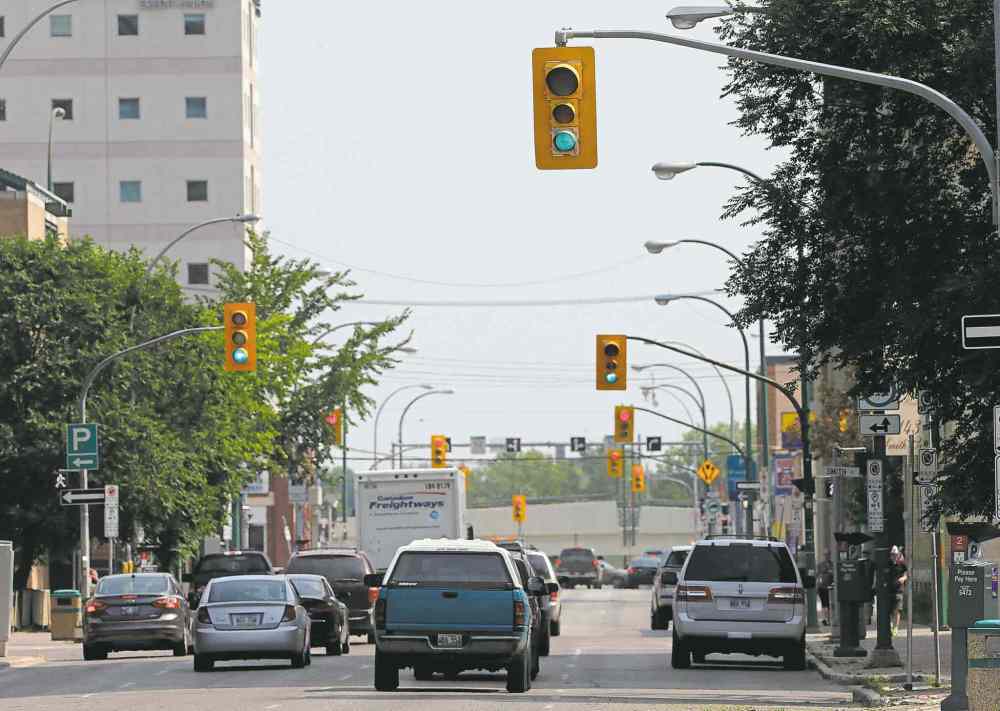
Transportation experts say revamping the way signals work will reduce congestion, save fuel costs, cut down on air pollution and make the roads safer.
“If you’re a driver, it’s good because it’s going to reduce unnecessary delays at the intersection,” said Aleksandar Stevanovic, director of the Laboratory for Adaptive Traffic Operations & Management, a research centre at Florida Atlantic University (FAU). “That cuts down on fuel consumption and also impacts safety. If you have a smooth traffic flow, that potentially will reduce the number of accidents. Every time you make a stop, there’s a chance of a rear-end collision.”
The goal is to figure how signals can accommodate changing traffic patterns, so when a driver approaches one signal that’s turning green, the next one up the road is also green by the time the driver gets there.
A 2012 report by the Texas A&M Transportation Institute, a university-based research agency, estimated that in 2020, the delays caused by traffic congestion in the U.S. will grow to 8.4 billion hours, resulting in the average commuter wasting 45 hours and 95 litres of gas.
Utah, Minnesota and Florida are among the states that are out front in making traffic-signal improvements a priority. So are cities Austin, Portland and Bellevue, Wash.
But many transportation agencies still have a long way to go.
A 2012 report card issued by the National Transportation Operations Coalition, a group of public and private transportation associations, found while states and local governments were making progress managing and operating the nation’s traffic signals, they still faced big challenges, including a lack of funding. The report gave agencies a C grade for signal-timing operations and an F for traffic monitoring and data collection.
Over the past few decades, most transportation agencies have replaced old-fashioned, pre-timed traffic signals that changed at consistent intervals with newer technologies that detect the presence of cars and adjust the green time accordingly. Many use electromagnetic loops in the pavement. When cars drive over the loops, they activate sensors, prompting the light to stay on for a certain period. Often, the timing at intersections only gets reset every three to five years.
In recent years, some local and state agencies have been using more sophisticated equipment to manage the signals. While they still use loops, video cameras and radar to gather data on traffic patterns, they have changed the way they handle that information. Instead of having a traffic engineer set and reset a signal’s timing in a control room, they install “adaptive” systems that use algorithms that work in real time. The signals essentially figure out how much traffic is coming their way and adapt automatically to change their timing.
“The signal may say, ‘Hey, for the last three or four cycles, I’ve got new demand. Maybe I should give it more green time,’ ” said Kevin Balke, a research engineer at the Texas A&M Transportation Institute.
FAU’s Stevanovic said only about three per cent of traffic signals nationwide use adaptive systems. But he noted those numbers have spiked from about 4,500 in 2009 to about 6,500 in 2014. And the number of agencies using them has risen from 30 to about 150.
While the cost of adaptive systems has gone down over the years, it still can be expensive — ranging from US$30,000 to $50,000 per intersection. Stevanovic said the systems are cost-effective in the long run because they can reduce delays anywhere from five to 40 per cent.
Oakland County, Mich., has been a leader in using adaptive signals. It has the second-largest such system in the U.S., said Craig Bryson, spokesman for the Road Commission for Oakland County.
Bryson said his agency installed the system, which it imported from Australia, at its first intersection in 1992, after the community experienced explosive growth and there wasn’t enough money to widen all the roads to accommodate the traffic. Over the years, the county has repeatedly updated the system, which uses video cameras to detect vehicles, as hardware and software have evolved.
Today, 675 out of 1,200 intersections with traffic lights in the agency’s jurisdiction have adaptive signals, and officials hope nearly all eventually will. Bryson said the total investment has been more than $100 million, the bulk of which has come from federal funding.
Studies have shown the system has improved both traffic flow and safety in Oakland County, Bryson says. In Troy, Mich., for example, serious-injury crashes at intersections fell more than 50 per cent.
Bryson said the adaptive technology also is an asset when the area is hit by power outages. In the past, that would mean major traffic backups because all the signals would be out of whack and crews would need to manually reset them. With the adaptive system, signals automatically come back online when power is restored and adjust to current conditions.
Oakland County also is one of a growing number of communities that have started to use a more advanced type of adaptive system in which one signal “talks” to another signal down the pike, telling it how much traffic to expect, so it can make adjustments and be ready.
“The intersection upstream may tell the intersection downstream, ‘I just released a bunch of vehicles heading your way, so get ready for them,’ ” said Texas A&M’s Balke. “What’s unique is they don’t talk to the boss (the centralized computer system), they talk to each other.”
— Stateline.org