

The big, bad Bandidos
They're the world's No. 2 biker gang and are trying harder
Advertisement
Read this article for free:
or
Already have an account? Log in here »
To continue reading, please subscribe:
Monthly Digital Subscription
$1 per week for 24 weeks*
- Enjoy unlimited reading on winnipegfreepress.com
- Read the E-Edition, our digital replica newspaper
- Access News Break, our award-winning app
- Play interactive puzzles
*Billed as $4.00 plus GST every four weeks. After 24 weeks, price increases to the regular rate of $19.95 plus GST every four weeks. Offer available to new and qualified returning subscribers only. Cancel any time.
Monthly Digital Subscription
$4.99/week*
- Enjoy unlimited reading on winnipegfreepress.com
- Read the E-Edition, our digital replica newspaper
- Access News Break, our award-winning app
- Play interactive puzzles
*Billed as $19.95 plus GST every four weeks. Cancel any time.
To continue reading, please subscribe:
Add Free Press access to your Brandon Sun subscription for only an additional
$1 for the first 4 weeks*
*Your next subscription payment will increase by $1.00 and you will be charged $16.99 plus GST for four weeks. After four weeks, your payment will increase to $23.99 plus GST every four weeks.
Read unlimited articles for free today:
or
Already have an account? Log in here »
Hey there, time traveller!
This article was published 23/05/2015 (3975 days ago), so information in it may no longer be current.
The Bandidos motorcycle gang has a saying: “Cut one, we all bleed.”
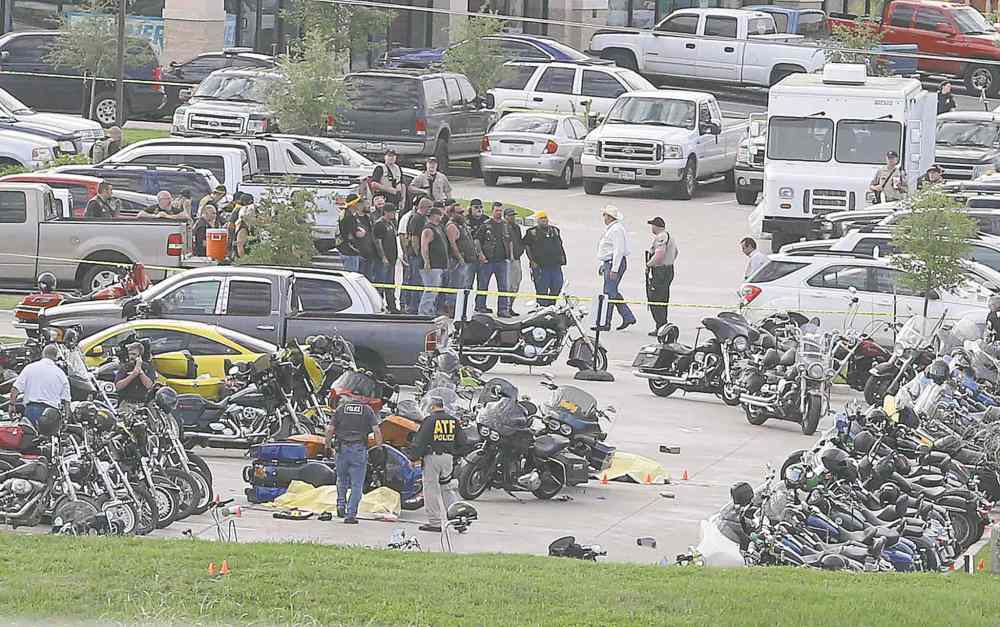
It’s not clear who started the cutting, but there was plenty of bloodshed last Sunday when the Bandidos brutally clashed with members of several other bike gangs at a restaurant in Waco, Texas. A wild shootout in broad daylight left nine bikers dead, 18 wounded and at least three under arrest.
The confrontation began around noon at a Twin Peaks restaurant in a shopping centre and quickly escalated from fisticuffs to all-out war, said Sgt. W. Patrick Swanton, a police spokesman. At one point, as many as 30 gang members were shooting at one another in the restaurant’s parking lot. Police found more than 100 weapons and scores of shell casings.
The shootout is the latest and perhaps goriest chapter in a long history of violence involving motorcycle gangs in America. The Bandidos, like their more popularly known archrivals the Hells Angels, are frequent characters in that blood-soaked book. The group is generally considered the world’s second-largest biker gang, behind the Angels, with as many as 2,500 members in 13 countries, according to the U.S. Department of Justice.
The Bandidos’ story charts the rise of biker gangs from counterculture clubs to fearsome organized-crime organizations and helps to explain why tragedy struck in a city already associated with spectacular violence.
Nowadays, if Americans know anything about motorcycle gangs, it’s probably thanks to Hunter S. Thompson or the hit television show Sons of Anarchy. But long before Thompson’s 1966 book Hell’s Angels, bike gangs were on the rise in the United States.
American bike gangs took root after the Second World War, when thousands of young, disaffected, often war-traumatized men returned to a country they didn’t recognize. Many rejected it.
“Returning veterans used their severance pay to buy motorcycles and party in taverns,” writes James F. Quinn, a professor at the University of North Texas who has studied motorcycle gangs. “Thrill-seeking attracted some returning veterans to choose a saloon-society lifestyle centred around motorcycles. Positive views of military experiences, and the intense camaraderie they bred, also made such a lifestyle attractive. In some cases, combat roles became master statuses for veterans who could not tolerate military discipline but linked their self-image to the small-group camaraderie and risk-taking of military service. Conventional activities offered no acceptable alternatives and these men were threatened with a loss of identity, companionship and security as military involvement ceased.”
There were signs of trouble even before there were any official bike gangs. On the July 4 weekend in 1947, around 4,000 motorcyclists flooded the town of Hollister, Calif., causing havoc. The Hells Angels were founded around a year later. Thompson’s 1966 profile of the Angels came just as they were expanding across the country, stirring dramatic reactions.
“They call themselves Hell’s Angels,” began a 1965 magazine article quoted in Thompson’s book. “They ride, rape and raid like marauding cavalry — and they boast that no police force can break up their criminal motorcycle fraternity.”
The Hells Angels might have been first, but they were far from the only ones. Scores more motorcycle gangs sprung up across America. Many of them, if not all, sought to tap into the American outlaw archetype, as reflected in their rebellious names: the Outlaws, the Pagans, the Warlocks, the Mongols and the Bandidos.
The Bandidos began almost 20 years after the Hells Angels, but the two gangs soon became bitter rivals. According to the motorcycle club’s legend, founder Donald Chambers was bored with other bike clubs. “Chambers started the Bandidos in March 1966, when he was 36 years old and working on the ship docks in Houston,” Skip Hollandsworth wrote in a 2007 profile of the gang. “He told his friends that he was naming his club the Bandidos, in honour of the Mexican bandits who refused to live by anyone’s rules but their own, and he began recruiting his first members not only out of Houston but also out of the biker bars in Corpus Christi, Galveston and San Antonio.
“Don wasn’t looking for people who fit into what he called ‘polite society,’ ” one of the group’s first members told Hollandsworth. “He wanted the bad-ass bikers who cared about nothing except riding full time on their Harley-Davidsons. He wanted bikers who lived only for the open road. No rules, no bullshit, just the open road.”
But as both the Hells Angels and the Bandidos expanded, they grew from free-wheeling counterculture clubs into ruthless organized-crime syndicates, according to academics who study the groups and prosecutors who pursue them in court. “The desire to dominate rivals temporarily decreased the power of the subculture’s core values among many clubs while increasing their reliance on organized criminal activities,” Quinn writes.
“As the extremes of violence used in internecine warfare escalated, however, these activities could no longer be concealed by the milieu’s code of silence. It was only at this point that law enforcement agencies finally began to take these clubs seriously.”
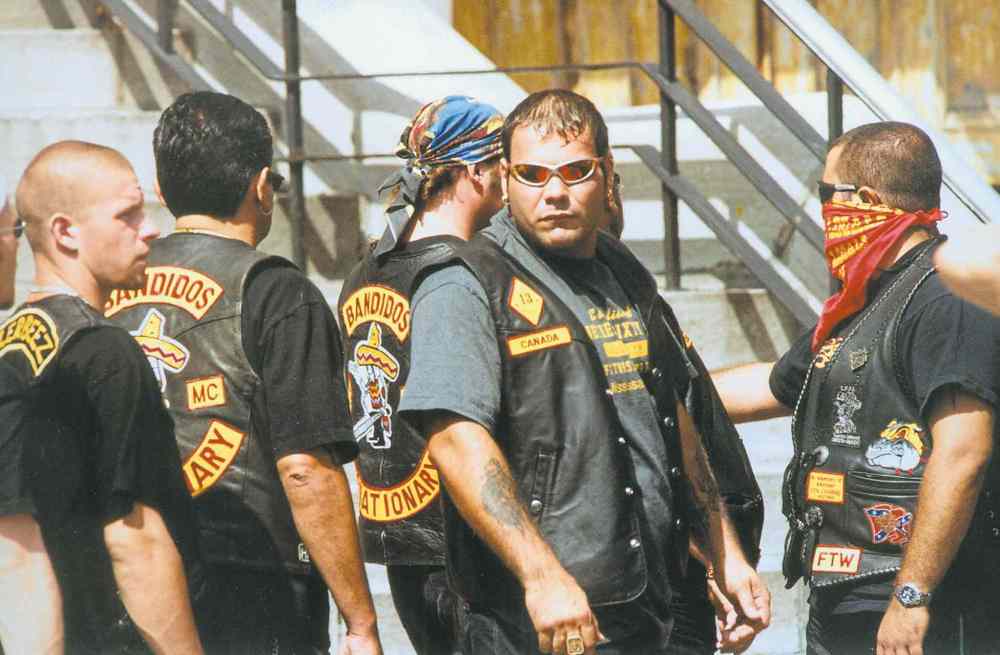
The arrest and incarceration of bike-gang leaders in the ’70s led to what Quinn calls a “retrenchment,” during which a second generation of leaders dialed back the violence and focused on turning bigger profits through better-operating drug and other criminal rackets.
But the past three decades have been shot through with sporadic bike gang battles, often overseas. By the 1980s, both the Bandidos and the Hells Angels had become international organizations. In 1984, a shootout between Bandidos and another gang called the Comancheros killed seven and wounded 28 in Milperra, Australia, near Sydney. The incident became known as the “Milperra massacre.”
In the mid 1990s, a “great Nordic biker war” between the Bandidos and the Hells Angels shook Scandinavia. At least 12 people died and nearly 100 were injured in the three-year skirmish, which featured unprecedented firepower for a gangland rivalry. “These hostilities have involved military ordinance as well as automatic weapons,” Quinn writes. “At one point, the Angels launched a grenade at a jail holding an enemy leader.”
The two bike gangs faced off again in Canada during the late 1990s and 2000s. This time, the conflict — dubbed “the Quebec biker war” — reportedly cost 150 lives. The conflict largely ended in April 2006, when authorities found eight Bandidos members dead in a farmer’s field near Toronto. In 2009, an ex-cop on trial for the assassinations accused Bandidos world president Jeff Pike of ordering the killings. The ex-cop and five others were convicted of the crime. Pike denied the accusation and was never charged.
“I’m just a clean-cut American guy who loves riding his motorcycle,” Pike told Hollandsworth. “You’d be surprised. I’m almost always in bed by 10 p.m.” The Bandidos did not immediately return a request for comment for this article.
But Steve Cook says the clean-cut, fun-loving claim is a charade. Cook is a Kansas City-area cop who says he’s worked undercover in gangs affiliated with the Bandidos.
“These guys are organized crime, but they are also domestic terrorists,” he told the Washington Post. “These guys are heavily involved in methamphetamine, cocaine, marijuana, motorcycle theft. Those are all primary businesses for them. The thing is, these guys want to put on this appearance, ‘Oh we’re just motorcycle enthusiasts and we just like to ride bikes.’ The evidence is quite to the contrary.”
Cook claims most Americans, including many police, don’t take bike gangs seriously enough because “people have allowed themselves to be too romanticized” by the idea of bikers as modern-day bandits.
“They watch their Sons of Anarchy and their little television shows. These guys all seem likable enough: that they are misunderstood, outlaws from the old days, and they ride motorcycles instead of horses,” he said. “Even cops think, ‘Oh, they are just tattooed, long-haired guys who like to ride motorcycles.’ And the reality of it is, they are long-haired tattooed guys who ride motorcycles and sell a hell of a lot of methamphetamine and murder people and steal motorcycles and extort people and beat people up in bars for no reason.”