

‘It is our duty’ to eradicate nuclear bombs
Japanese PM urges peace on Hiroshima anniversary
Advertisement
Read this article for free:
or
Already have an account? Log in here »
To continue reading, please subscribe:

Digital Subscription
One year of digital access for only $205*
- Enjoy unlimited reading on winnipegfreepress.com
- Read the E-Edition, our digital replica newspaper
- Access News Break, our award-winning app
- Play interactive puzzles
*First annual payment billed as $205.00 + GST for one year. This annual subscription will automatically renew at $233.00 + GST every 52 weeks (10% off the regular annual price of $259.35). Offer available to new and qualified returning subscribers only. Cancel any time.
To continue reading, please subscribe:
Add Free Press access to your Brandon Sun subscription for only an additional
$1 for the first 4 weeks*
- Enjoy unlimited reading on winnipegfreepress.com
- Read the E-Edition, our digital replica newspaper
- Access News Break, our award-winning app
- Play interactive puzzles
*Your next Brandon Sun subscription payment will increase by $1.00 and you will be charged $17.95 plus GST for four weeks. After four weeks, your payment will increase to $24.95 plus GST every four weeks.
Read unlimited articles for free today:
or
Already have an account? Log in here »
Hey there, time traveller!
This article was published 07/08/2015 (4062 days ago), so information in it may no longer be current.
TOKYO — Japan’s prime minister called for an end to nuclear warfare Thursday as the country stopped to remember the victims of the atomic bombing of Hiroshima 70 years ago.
At 8:15 a.m. local time, the exact time U.S. forces dropped the uranium bomb on Aug. 6, 1945, tens of thousands who had gathered in the city’s peace park stood in silence to honour the 100,000-plus people who died as a result of that attack. It was the first time a nuclear weapon had been used in war. Three days later, a plutonium bomb was dropped on Nagasaki.
“Seventy years on, I re-emphasize the necessity of world peace,” Prime Minister Shinzo Abe said at the memorial service. “We have to continue our effort to achieve a world without nuclear weapons. It is our responsibility, and it is our duty.”
About 55,000 people from 100 countries attended the ceremony in Hiroshima, including U.S. Ambassador Caroline Kennedy and Rose Gottemoeller, undersecretary of state for arms control. In Tokyo, the U.S. Embassy warned the anniversary was “a traditional day of protests” against the embassy and told American citizens to avoid demonstrations or other large gatherings.
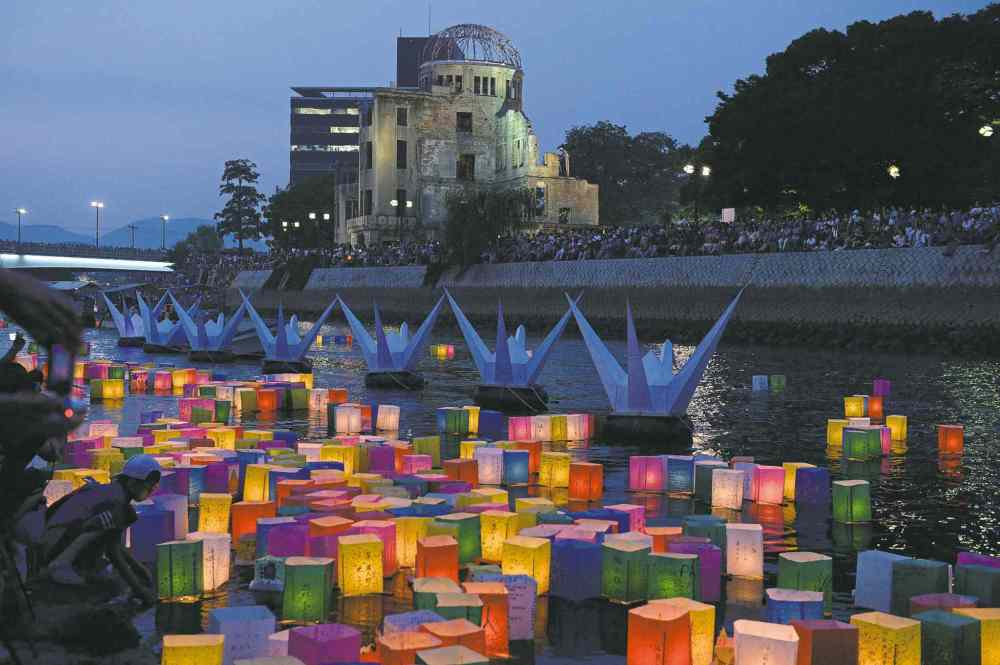
But in Hiroshima, the scene was peaceful. Lanterns floated in the river through Hiroshima overnight, while survivors of the blast were preparing to read poems at the memorial. A Don’t Repeat the War conference was held and choirs performed.
The bombing of Hiroshima, home to a major Japanese military base, flattened the city. The Manhattan Engineer District estimated there were 255,000 people living in Hiroshima before the blast, which it says killed 66,000 people and injured 69,000 more.
But statistics are difficult to ascertain because it was not clear how many people were living in the city during the war, and people died from bomb-related illnesses many years afterward.
Still, the bombings have left a scar on Japan and caused soul-searching among its people about the country’s wartime actions; the majority still support the pacifist constitution that was written for Japan by its American occupiers.
Beyond Thursday’s commemorations, Japanese people, and Japan’s neighbours, are looking ahead to a statement that Abe is set to make Aug. 14, the day before the anniversary of Japan’s surrender in the Second World War. His remarks are expected to be contentious.
Abe’s predecessors apologized for Japan’s wartime actions in their statements on the 50th and 60th anniversaries. Japan, “through its colonial rule and aggression, caused tremendous damage and suffering to the people of many countries, particularly to those of Asian nations,” Tomiichi Murayama said in a “heartfelt” apology in 1995.
But Abe has been vague about what he will say, and most of the members of a panel set up to advise him on his statement say he need not apologize again, the Kyodo news agency reported. That’s because Abe has a “future-oriented” vision, they said.
— The Washington Post
Related Articles
Myths persist about nuclear attack on Japan
Advertisement Advertise With Us