

Few believe truce among Salvadoran gangs will lead to lasting peace
Few believe truce among Salvadoran gangs will lead to lasting peace
Advertisement
Read this article for free:
or
Already have an account? Log in here »
To continue reading, please subscribe:

Digital Subscription
One year of digital access for only $205*
- Enjoy unlimited reading on winnipegfreepress.com
- Read the E-Edition, our digital replica newspaper
- Access News Break, our award-winning app
- Play interactive puzzles
*First annual payment billed as $205.00 + GST for one year. This annual subscription will automatically renew at $233.00 + GST every 52 weeks (10% off the regular annual price of $259.35). Offer available to new and qualified returning subscribers only. Cancel any time.
To continue reading, please subscribe:
Add Free Press access to your Brandon Sun subscription for only an additional
$1 for the first 4 weeks*
- Enjoy unlimited reading on winnipegfreepress.com
- Read the E-Edition, our digital replica newspaper
- Access News Break, our award-winning app
- Play interactive puzzles
*Your next Brandon Sun subscription payment will increase by $1.00 and you will be charged $17.95 plus GST for four weeks. After four weeks, your payment will increase to $24.95 plus GST every four weeks.
Read unlimited articles for free today:
or
Already have an account? Log in here »
Hey there, time traveller!
This article was published 09/04/2016 (3804 days ago), so information in it may no longer be current.
SAN SALVADOR, El Salvador — One of the gangsters, a black bandanna over his mouth and two rosaries around his neck, tapped his clawlike fingernail on the table.
Next to him was a sworn enemy, a man with a black fisherman’s hat pulled down over rainbow-tinted sunglasses.
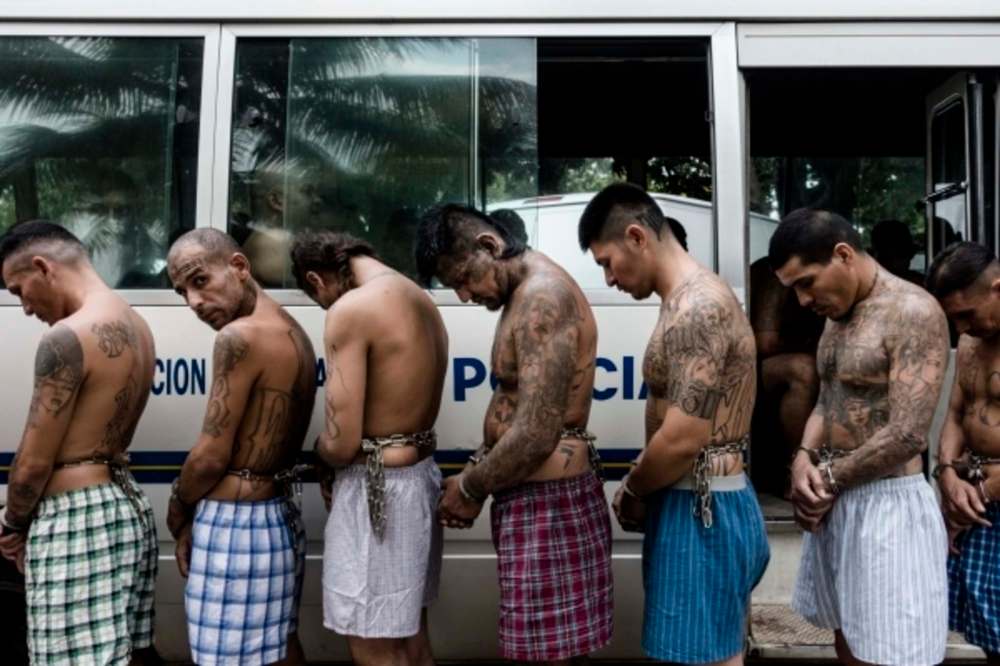
The two rivals, and their tens of thousands of followers in El Salvador’s dominant gangs, have called a halt to their street war with each other and the government. On March 25, Mara Salvatrucha and two factions of the 18th Street gang announced a ceasefire, a respite from the fighting that has made El Salvador one of the world’s deadliest countries.
“We’re not friends,” one of the gangsters, a spokesman for the 18th Street gang, said in a rare interview, alongside a Mara Salvatrucha representative. “But the three gangs are united in this effort to come together to stop the violence that’s assaulting our country.”
Many, though, expect the ceasefire will be temporary, a lull in an ever more chaotic battle, a moment that simply shows the enormous gap that separates these gangs from the government. El Salvador’s ferocious pace of violence, with more than 2,000 murders in the past three months, has exhausted all sides. Dozens of police and their relatives have been hunted down and killed by gangsters, provoking defections from the ranks. The gangsters complain about police running death squads.
Despite the enormous toll on both sides, the administration of President Salvador Sánchez Cerén has remained defiant, vowing to tighten security at prisons and relentlessly pursue gang members.
“The government has said there’s no chance of dialogue with the gangs,” Mauricio Ramírez Landaverde, the minister of security and justice, said.
The Salvadoran gangs are descendants of gangs formed in Los Angeles in the 1980s by immigrants who fled this country’s civil war. Many of their leaders were deported back to El Salvador. The country is now a patchwork of gang-controlled neighbourhoods. Their members extort residents, kill, kidnap, rape and serve as sentries against rival cliques. The gangs and experts who study them estimate their active ranks at 70,000 people, not including the tens of thousands behind bars.
After Sánchez Cerén was elected in 2014, he criticized his predecessor’s decision to negotiate with the gangs and vowed to punish them with the full force of the law. The conflict has steadily escalated.
“I think there is really a fatigue with the war,” said Juan Jose Martinez, an anthropologist who studies Salvadoran gangs.
“This is not like the violence we’ve always had,” he added. “This is a crisis of violence.”
But Sánchez Cerén, a former leftist guerrilla leader during El Salvador’s 12-year civil war, has vowed to intensify the crackdown on the gangs. Following months of police raids, his government plans to transfer hundreds of jailed gang leaders to solitary confinement, and has proposed what it calls “extraordinary measures” to further disrupt gang communications. “With these cruel criminals, it is not possible to have an attitude of tolerance,” he said.
Ramírez Landaverde dismissed the possibility the current pause could stretch into a more durable peace, saying the gang landscape is fragmented with hundreds of small cells and cliques.
“Often it turns out they (gang leaders) don’t have the backing of all the groups, or all of the members,” he said. “Many of them don’t participate, and you can see proof in the streets. They’re killing like nothing happened.”
The streets, however, do seem to have calmed. Over the first six days of the gang ceasefire, initially set for 72 hours but now with no official endpoint, an average of 10 people were slain each day, fewer than half the rate of killing in the first two months this year.
The representatives from Mara Salvatrucha and 18th Street agreed to an interview to discuss their self-imposed ceasefire.
“They have their territory, we have ours,” the Mara Salvatrucha spokesman said. “We are demonstrating to the Salvadoran people, the international community, that we are capable of coming here, stopping this whole wave of violence. We can stop everything.”
Past attempts at ending the gang war have failed. A 2012 truce lasted for two years and then fell apart after the government imposed tighter conditions on jailed gang members.
The current one-sided truce could quickly be followed by more violence, as the gangs seem determined to fight back if the police do not ease up.
“This is kicking the hornet’s nest,” Raul Mijango, a politician and former guerrilla, said of the government’s current approach. “These iron-fisted actions — today it’s total war declared against the gangs — have not been effective against these types of problems. On the contrary, what they’ve always done is increase them.”
Some of the gang members’ statements had a political flavour: they described the government as corrupt and exploitative and labelled members of the administration as hypocrites, former guerrillas who betrayed the poor of El Salvador once they got into power. The gang members cast themselves as benefactors, offering survival in a poor job market.
“If there isn’t work, how are you going to survive? You can’t eat air,” the Mara Salvatrucha spokesman said.
The gangs have also murdered police at an ever-increasing rate — at least 12 this year, plus dozens of their relatives. The growing danger has devastated police morale. Over the past year, a movement has surged among police, who complain about poor pay, insufficient equipment and the risk of dying.
Some doubt the government’s defiance is as strong as it seems. Throughout the conflict, governments have often denounced the gangs publicly while reaching out to them privately. Some experts suspect a covert deal is already in the works between the gangs and the government. Religious leaders are among the only people openly working toward that outcome.
“The whole world is opposed to dialogue,” said Rafael Menjivar Saavedra, a Lutheran pastor who has met with the gang members. “My response to them is, ‘So what’s your alternative?’”
— The Washington Post