

Questions about existence, status, orbit Planet X
Advertisement
Read this article for free:
or
Already have an account? Log in here »
To continue reading, please subscribe:
Monthly Digital Subscription
$1 per week for 24 weeks*
- Enjoy unlimited reading on winnipegfreepress.com
- Read the E-Edition, our digital replica newspaper
- Access News Break, our award-winning app
- Play interactive puzzles
*Billed as $4.00 plus GST every four weeks. After 24 weeks, price increases to the regular rate of $19.95 plus GST every four weeks. Offer available to new and qualified returning subscribers only. Cancel any time.
Monthly Digital Subscription
$4.99/week*
- Enjoy unlimited reading on winnipegfreepress.com
- Read the E-Edition, our digital replica newspaper
- Access News Break, our award-winning app
- Play interactive puzzles
*Billed as $19.95 plus GST every four weeks. Cancel any time.
To continue reading, please subscribe:
Add Free Press access to your Brandon Sun subscription for only an additional
$1 for the first 4 weeks*
*Your next subscription payment will increase by $1.00 and you will be charged $16.99 plus GST for four weeks. After four weeks, your payment will increase to $23.99 plus GST every four weeks.
Read unlimited articles for free today:
or
Already have an account? Log in here »
Hey there, time traveller!
This article was published 28/05/2016 (3524 days ago), so information in it may no longer be current.
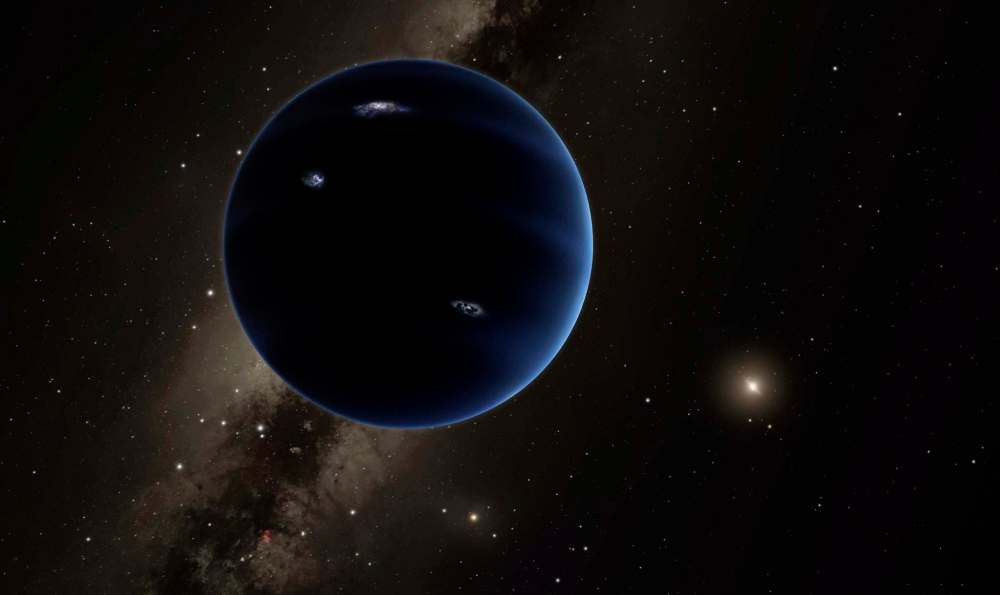
A new mystery planet is in the astronomic news. It is a real mystery. But is it a real planet?
First the mystery: Planet X, as some are calling it, is thought to roam outside the orbit of Pluto (which was recently demoted to dwarf from ninth-planet status). So far no one has seen Planet X. So why do some astronomers think it is there?
Science history is replete with instances of new objects discovered, not by observing them, but by observing their effects. Famously, this kind of evidence turned up the planet Uranus.
Observed anomalies in Neptune’s orbit were explained by predicting the location of an unknown planet whose gravity must be interfering. Uranus was soon seen where it was expected.
Just so with Planet X. If it exists it is a giant planet with a mass at least 10 times that of Earth. It does what other giants such as Jupiter do. With its great gravity it organizes lesser objects. But Planet X is much smaller then Jupiter and roams far reaches of the Solar System in the Kuiper belt, a zone of oversized ice cubes, asteroids, cometary trash and occasional big bodies. These are what it can organize and it is this organizing that reveals its presence.
The details get a little technical. Suffice to say the orbits of too many large objects in the Kuiper belt are too well aligned to make it likely they are random. Two California Institute of Technology planetologists have computed an orbit for a large mystery planet that offers a simple explanation for them. And three McGill University planetary scientists recently showed that several existing infrared telescopes should be able to detect this planet if it’s there.
Astronomers love finding new planets. Look for more news soon.
There’s another story behind this story. It’s no mystery, although it does involve a murder of a kind. Michael Brown is the senior author of the paper that predicts this planet (and calls it a planet!). This is the same Michael Brown who led the charge to kill off Pluto’s planetary status a decade ago.
What was the deficiency that did poor Pluto in? It does meet two of three criteria for planets.
First, it orbits around the sun. So does Planet X. Second, it is big enough for its own gravity to make it spheroidal. And surely so is 10-times-bigger Planet X. But Pluto does not meet the third criterion: its gravity has not cleared the trash out of its Kuiper-belt neighbourhood. And neither has Planet X. Like Pluto, it fails the planet test.
It would be a gross injustice if the astronomical community were to install Planet X as the new ninth planet. Though it is at least 50 times more massive than Pluto, this does not qualify it. We must await the next debate before the International Astronomical Union and trust that interplanetary fairness will prevail.
In the meantime, while searchers close in, it seems likely headlines will keep calling it a planet. Until its fate is decided it needs a proper name.
On behalf of the millions of fans of Frank Herbert’s fantastic Dune sci-fi novels, I would therefore like to make a nomination. Indeed, in Dune-world it already has a name: it’s not X, it’s Ix.
Colin Gillespie is a physicist and author whose most recent book is Time One: Discover How the Universe Began. He writes a weekly web blog Science Seen.