

Colin Powell knew that history would judge him harshly
Advertisement
Read this article for free:
or
Already have an account? Log in here »
To continue reading, please subscribe:

Digital Subscription
One year of digital access for only $205*
- Enjoy unlimited reading on winnipegfreepress.com
- Read the E-Edition, our digital replica newspaper
- Access News Break, our award-winning app
- Play interactive puzzles
*First annual payment billed as $205.00 + GST for one year. This annual subscription will automatically renew at $233.00 + GST every 52 weeks (10% off the regular annual price of $259.35). Offer available to new and qualified returning subscribers only. Cancel any time.
To continue reading, please subscribe:
Add Free Press access to your Brandon Sun subscription for only an additional
$1 for the first 4 weeks*
- Enjoy unlimited reading on winnipegfreepress.com
- Read the E-Edition, our digital replica newspaper
- Access News Break, our award-winning app
- Play interactive puzzles
*Your next Brandon Sun subscription payment will increase by $1.00 and you will be charged $17.95 plus GST for four weeks. After four weeks, your payment will increase to $24.95 plus GST every four weeks.
Read unlimited articles for free today:
or
Already have an account? Log in here »
Hey there, time traveller!
This article was published 18/10/2021 (1812 days ago), so information in it may no longer be current.
WASHINGTON—There was a time when Colin Powell seemed likely to become the first Black president of the United States. It’s an interesting thought, following his death Monday from complications of COVID-19, to imagine the world in which he did.
If he had decided to seek the Republican nomination for the 2000 election, and had won it, how might American history have unfolded? Would that election still have been decided by the Supreme Court? Would the run-up to Sept. 11, 2001 have proceeded differently under Powell as president? Would the aftermath of such a terrorist attack have been different? Would Barack Obama emerge as an apparently transcendent figure? Would Donald Trump then emerge in response?
We’ll never know, of course. Powell abandoned a fledgling campaign and endorsed George W. Bush. Instead of being the first Black president, he became the first Black secretary of state.
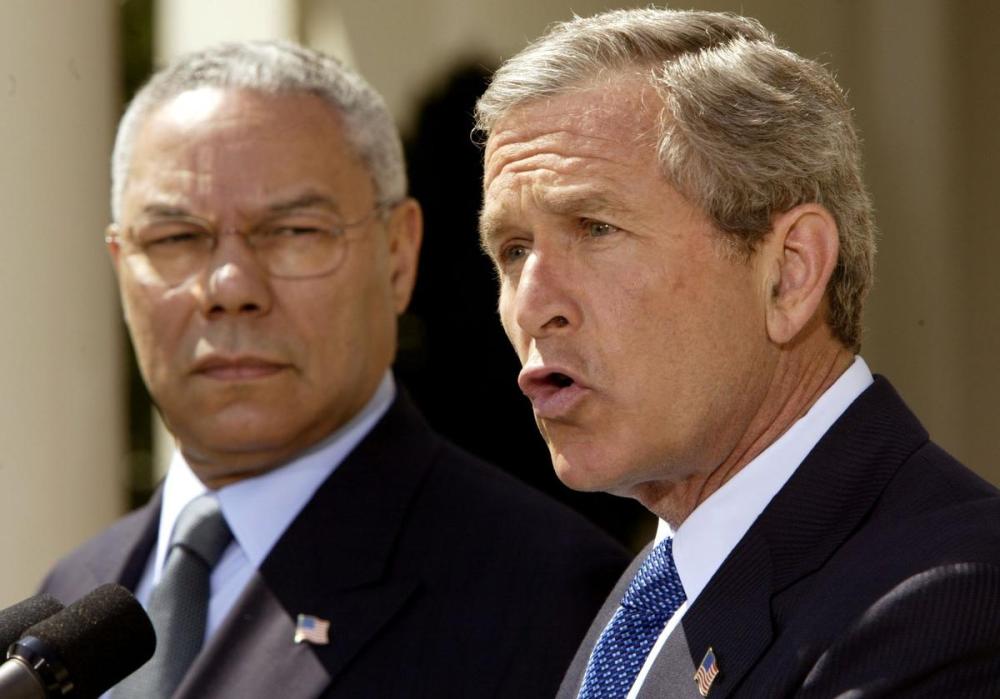
And in that role, he played a key part — one he later considered a “blot” on his record — in shaping the U.S. and the world as it is, rather than as it might have been. He publicly and dramatically lent his considerable personal credibility to a lie, and helped lead the U.S. and the world into two decades of conflict that violated his own “Powell doctrine.” The result was a military quagmire, hundreds of thousands of deaths and irreversible damage to U.S. credibility and world standing.
Powell’s death has been greeted by tributes from many who knew him either privately or as a public figure, for a career distinguished by principle, intelligence and empathy. He was a decorated combat veteran who helped negotiate arms treaties with the Soviet Union and rose to the highest ranks of the military. There, Powell counselled restraint in the use of military power. At least one member of the progressive “squad” in Congress heralded him as an inspiration to young Black politicians.
“Colin Powell was a good man,” President Joe Biden said in his own statement on Powell’s death. “He will be remembered as one of our great Americans.”
But there is also the matter of that speech at the United Nations in 2003.
There is an old joke about what you’ll be remembered for — I’ve heard it told by Paul McCartney and Norm Macdonald, among others — the family-newspaper version of which goes like this: You can cut down a thousand trees and no one calls you a lumberjack, build your own house and no one calls you a carpenter, cook thousands of meals and no one calls you a chef. But if you have carnal relations with one goat …
In 2003, Powell held up a vial of something he claimed might be a biological weapon when he told the UN that it was necessary for the U.S. to go to war with Iraq because that country was harbouring weapons of mass destruction. He did this, it was later reported, despite personal reservations about the case he was making, and after editing the presentation prepared for him to remove what he considered some egregious distortions. Still, he put his own integrity on the line to make the case for war, and persuaded many of his own fellow citizens and much of the world. Nearly all the evidence he presented to make his case turned out to be false.
The rest is history: almost 5,000 deaths among U.S. combat forces and their allies, hundreds of thousands of Iraqis killed, revelations of American-sanctioned abuse and torture, and decades of Middle Eastern instability. Both Obama and Trump campaigned against the fiction and folly that led to that war.
And so, alongside the accolades and tributes, reports of Powell’s death resulted in the term “war criminal” trending on Twitter for hours.
James Fallows, the journalist and one-time speech writer for president Jimmy Carter, noted that unlike most others in the George W. Bush administration, Powell “was unsparingly clear-eyed, and not ‘in denial,’ about damage he ended up doing to the world, and his reputation, with that U.N. speech. Such clarity is rare among public figures.”
Powell’s acknowledgment of his errors came in retirement, during which he again demonstrated many of the qualities included in the cavalcade of tributes to him. He called out racism and Islamophobia in his own Republican party in its attacks on Obama, and later became a sometimes fierce critic of Trump and the direction he had taken that party and the nation.
In many ways and in most instances, Powell really did seem to embody the characteristics we often hope our public figures might aspire to — ones we so seldom see them exhibit. Few of us would like to be judged by our life’s worst decision, and few of us can point to a life in which we never once compromised our principles and lived to regret it. But few of us find ourselves in a position and at a time when such a compromise will have such devastating consequences for so many.
On leaving the Bush administration, Powell “mournfully predicted to others that his obituary’s first paragraph would include his authorship of the U.N. speech,” the New York Times reported last year. He proved right about that.
In the same story, in a discussion of whether he might have prevented the war, he said, “What choice did I have? He’s the president.” The Times report suggests he had a choice: he could have resigned. As in the case of a Powell presidency, we are left to imagine what might have happened if he had made that choice.
Which itself is a lesson to those seeking guidance from Powell’s generally admirable and often inspirational example. The hardest days, when you feel your choices are most limited by circumstance, may be the days when the consequences of your choices are most severe, and the days that the judgment of history will weigh the heaviest.
Edward Keenan is the Star’s Washington Bureau chief. He covers U.S. politics and current affairs. Reach him via email: ekeenan@thestar.ca
Related Articles
Colin Powell dies, exemplary general stained by Iraq claims
Advertisement Advertise With Us
Advertisement Advertise With Us