

Ukrainians’ resilience persists despite new Russian barrage
Advertisement
Read this article for free:
or
Already have an account? Log in here »
To continue reading, please subscribe:

Digital Subscription
One year of digital access for only $205*
- Enjoy unlimited reading on winnipegfreepress.com
- Read the E-Edition, our digital replica newspaper
- Access News Break, our award-winning app
- Play interactive puzzles
*First annual payment billed as $205.00 + GST for one year. This annual subscription will automatically renew at $233.00 + GST every 52 weeks (10% off the regular annual price of $259.35). Offer available to new and qualified returning subscribers only. Cancel any time.
To continue reading, please subscribe:
Add Free Press access to your Brandon Sun subscription for only an additional
$1 for the first 4 weeks*
- Enjoy unlimited reading on winnipegfreepress.com
- Read the E-Edition, our digital replica newspaper
- Access News Break, our award-winning app
- Play interactive puzzles
*Your next Brandon Sun subscription payment will increase by $1.00 and you will be charged $17.95 plus GST for four weeks. After four weeks, your payment will increase to $24.95 plus GST every four weeks.
Read unlimited articles for free today:
or
Already have an account? Log in here »
Hey there, time traveller!
This article was published 17/10/2022 (1440 days ago), so information in it may no longer be current.
KYIV, Ukraine (AP) — When massive, coordinated Russian bombardments shook cities and towns across Ukraine a week ago to trigger a new phase in the Kremlin’s war, one strike left a huge crater in a popular Kyiv children’s playground and ripped open a central intersection.
The next day, traffic flowed over the newly asphalted road, and life in the capital had returned to near normal. The response to Russia’s new wave of attacks was to get back to work, stroll in the warm autumn sun and tend to final harvests from summer vegetable gardens.
A similar scene played out in the central Ukrainian city of Dnipro that day, where city workers repaired a road overnight after it was destroyed by shelling in that coordinated attack.
“We worked all night, gritting our teeth,” wrote Dnipro Mayor Borys Filatov on Facebook the day after the Oct. 10 attack. The post included before and after photos of where the strike had hit and the completed repairs.
“We will restore and rebuild everything. But our hatred will live for centuries,” he said.
Ukrainians’ resilience in the nearly 8-month-old war continues to be unwavering, despite an uptick in attacks that are seen as Russian President Vladimir Putin’s vengeful response to an explosion that damaged a Moscow-built bridge to the Kremlin-annexed Crimean Peninsula on Oct. 8.
Russian missiles and Iranian-made drones struck at least 10 regions across the country two days later, targeting critical infrastructure such as power plants and waterworks in major urban centers. The barrage left 19 dead and more than 100 wounded in the most extensive attacks since the early days after the Russian invasion began on Feb. 24.
On Monday, explosives-laden suicide drones struck Kyiv, setting buildings ablaze and sending residents running for cover. City life quickly resumed, though hours later air raid sirens were triggered again, and metro stations filled up with worried but calm residents.
The strikes were an intensified version of what has been a shift in Russian tactics aimed at making life more difficult for Ukrainians, particularly for those far from the front lines.
But the more the Kremlin threatens to make the upcoming winter intolerable, the more Ukrainians seem to unite in their intent to defeat Putin.
“The enemy can attack our cities, but it won’t be able to break us,” Ukrainian President Volodymyr Zelenskyy said in a social media post.
The government is urging a national reduction of energy consumption and, in some regions, implementing rolling blackouts as repairs are done to damaged power stations and facilities.
Ukrenergo, the state energy company, reported that on Oct. 15, residents of the Kyiv region had reduced their daily average electricity consumption by 7%, allowing the utility to avoid forced blackouts.
“This is a direct result of the fact that Ukrainians deliberately limited the use of electrical appliances in the evening hours,” the company said in a Facebook post Sunday.
Danylo, 20, a student in Kyiv, said he has reduced his electricity use at home “because we understand that this is a way to protect ourselves from complete loss.”
Danylo, who declined to give his last name, added: “Now, it is a trend to work for a common victory,” he said.
Similar resilience also can be seen emerging from the devastation and ruins along the front lines in eastern and southern Ukraine.
After retreating from eastern regions like Kharkiv, Russia has focused its strikes on Zaporizhzhia, Mykolaiv and surrounding towns nearly every night as a Ukrainian counteroffensive makes steady gains in the partially occupied southern flank.
Of all the Ukrainian areas that have paid a high price in the war, the Saltivka neighborhood on the northeastern edge of Kharkiv, the country’s second-largest city, has borne some of the greatest burdens.
The area’s residential blocks were once home to about a third of Kharkiv’s 1.4 million residents. But as Russian forces launched the invasion, they swept in to reach the neighborhood’s edge and pummeled it with rockets and artillery. Dozens were killed.
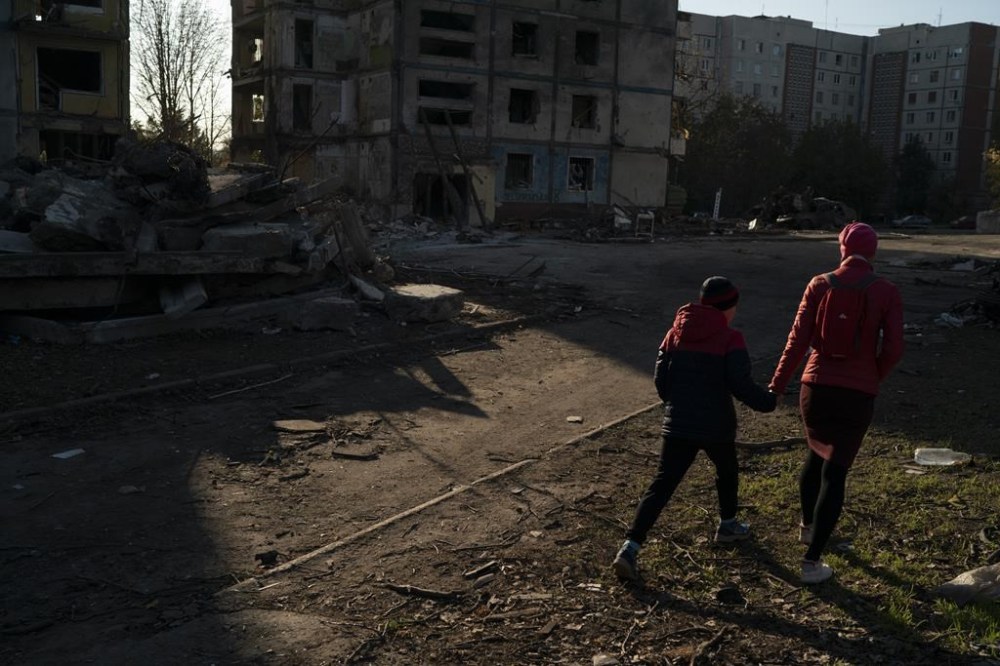
Saltivka, especially its northern reaches, was pounded for months until scarcely a building remained without major damage, leaving vast swaths of the area virtually uninhabitable. Tens of thousands were forced to flee.
Those who remained wander now like ghosts among the charred skeletons of what was once one of Ukraine’s largest residential areas. Despite what they’ve lost, many say they are unwilling to compromise with Russia to stop the fighting.
“Without victory, there is no Ukraine,” said Hryhorii Ivanovich, 67, as he applied rebuilt a brick wall on his balcony that was destroyed by a Russian rocket, along with the front half of his living room. “There is no compromise, only Ukrainian victory.”
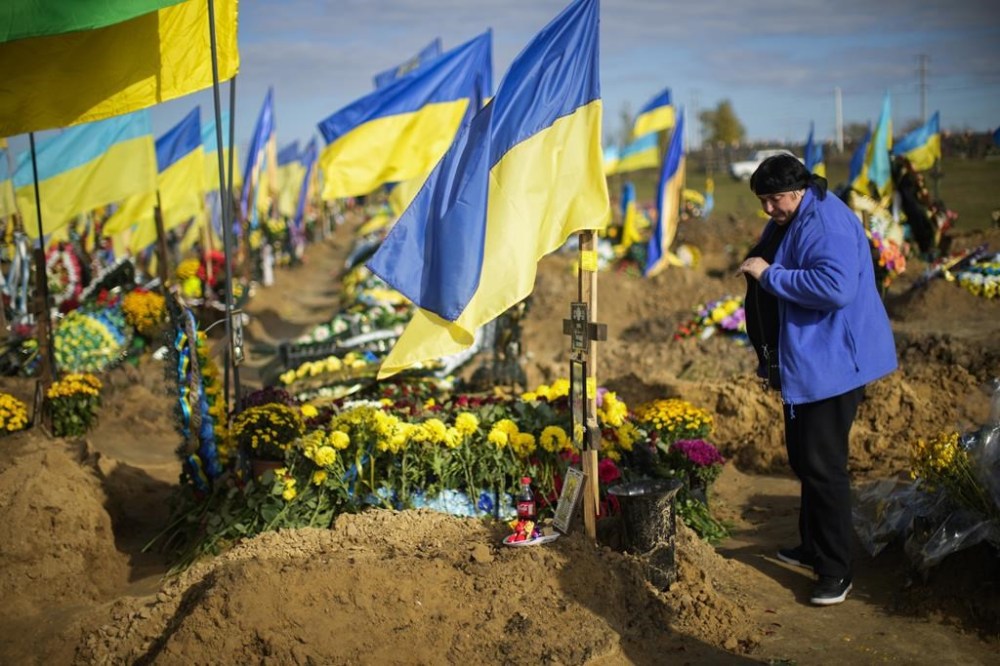
Maintaining such resolve, however, is more difficult for those who have lost a loved one in the war.
Lyubov Mamedova, whose son was killed this month by a Russian land mine, said he had enthusiastically signed up to fight at the beginning of the war, certain that Ukraine would defeat the invaders.
Mamedova, between fits of tears, said Ukraine must continue to protect its freedom, something she said was important to her son.
“We will fight,” she said. “He always said, ‘Victory is ours.’”
While many Ukrainians remain steadfast in their determination to drive Russia out by military means, some believe a political solution must be sought to end the bloodshed.
Oleh Postavnychyi, 39, was filling water bottles from a public faucet in a courtyard near his home in Saltivka, where he’s remained since the war began despite his apartment being significantly damaged.
A diplomatic solution needed to be reached to halt the violence, Postavnychyi said, but not one that cedes any Ukrainian lands.
“We need to find some compromise because neither (the Russians) nor us need this war,” he said. “Normal people shouldn’t suffer … but we can’t give them our territories. These are our territories. They were conquered not only by our great-grandfathers but our great-great-grandfathers.”
___
Spike reported from Kharkiv, Ukraine.
__
Follow AP’s coverage of the war at https://apnews.com/hub/russia-ukraine
Related Articles
Suicide drones strike fear in Ukraine's capital, killing 4
Advertisement Advertise With Us
Advertisement Advertise With Us