

Seattle, feds seek to end most oversight of city’s police
Advertisement
Read this article for free:
or
Already have an account? Log in here »
To continue reading, please subscribe:
Digital Subscription
One year of digital access for only $1.44 a week*
- Enjoy unlimited reading on winnipegfreepress.com
- Read the E-Edition, our digital replica newspaper
- Access News Break, our award-winning app
- Play interactive puzzles
*Billed as $5.77 plus GST every four weeks. After 52 weeks, price increases to the regular rate of $19.95 plus GST every four weeks. Offer available to new and qualified returning subscribers only. Cancel any time.
To continue reading, please subscribe:
Add Free Press access to your Brandon Sun subscription for only an additional
$1 for the first 4 weeks*
- Enjoy unlimited reading on winnipegfreepress.com
- Read the E-Edition, our digital replica newspaper
- Access News Break, our award-winning app
- Play interactive puzzles
*Your next Brandon Sun subscription payment will increase by $1.00 and you will be charged $17.95 plus GST for four weeks. After four weeks, your payment will increase to $24.95 plus GST every four weeks.
Read unlimited articles for free today:
or
Already have an account? Log in here »
Hey there, time traveller!
This article was published 28/03/2023 (1305 days ago), so information in it may no longer be current.
SEATTLE (AP) — The U.S. Justice Department and Seattle officials asked a judge Tuesday to end most federal oversight of the city’s police department, saying its sustained, decade-long reform efforts are a model for other cities whose law enforcement agencies face federal civil rights investigations.
Seattle has overhauled virtually all aspects of its police department since DOJ investigators in 2011 found officers were too quick to use force and too often escalated encounters to the point where force was necessary.
Since then, officials say, the use of serious force is down 60% and the department has new systems for dealing with people in crisis, responding to complaints of biased policing, supervising officers and identifying any who get physical too often.
Both sides asked U.S. District Judge James Robart to terminate their 2012 settlement agreement, known as a consent decree, which gave the court oversight of reform efforts.
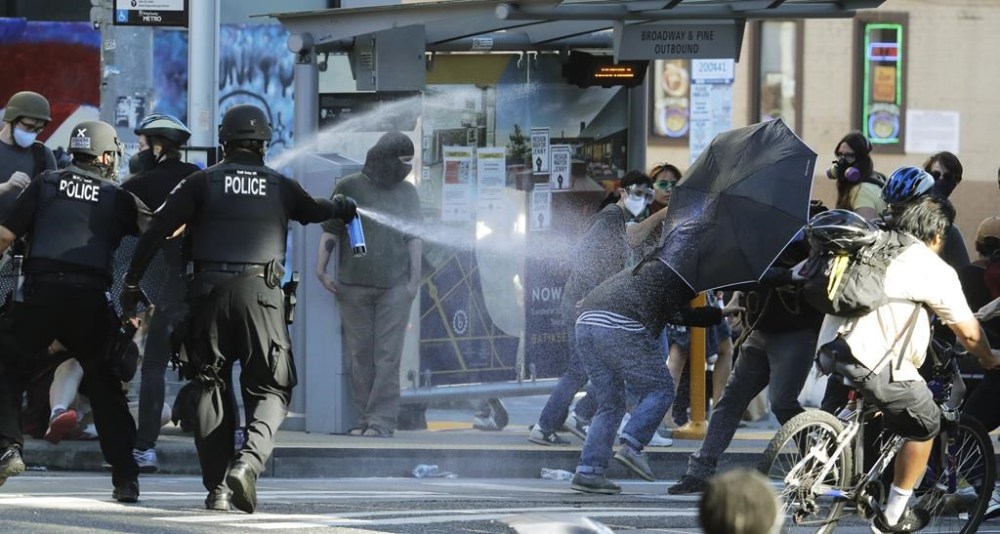
However they agree that more work remains to be done in two key areas — police accountability and crowd control, especially following the department’s violent and heavily criticized response to racial justice protests in 2020. Robart would continue to oversee reform work related to those topics under a new agreement.
“Seattle stands as a model for the kind of change and reform that can be achieved when communities, police departments and cities come together to repair and address systemic misconduct,” Assistant Attorney General Kristen Clarke of the DOJ’s Civil Rights Division, told a news conference in Seattle.
Seattle has spent about $200 million on its efforts, including the cost of new policies, database systems and other expenses.
Tuesday’s announcement served to highlight a way forward for city, county and state law enforcement agencies around the country that have found themselves under Justice Department scrutiny. Such investigations are often unwelcome due to the expense of making reforms and because the efforts can drag on for a decade or more.
Earlier this month the department found that police in Louisville, Kentucky, have engaged in a pattern of violating constitutional rights and discrimination against the Black community following an investigation prompted by the fatal police shooting of Breonna Taylor. It also announced a new review of the police in Memphis, Tennessee, following the beating death of Tyre Nichols.
Federal civil rights investigations are also underway involving police agencies in Minneapolis, Phoenix, Lousiana and New York.
Meanwhile court-enforced oversight remains in effect in other jurisdictions such as Oakland, California, where police have been under federal oversight for two decades. Last month the department lost its seventh chief in as many years over the alleged cover-up of an officer’s misconduct.
Seattle Mayor Bruce Harrell said the money the city has devoted to police reform has been well spent.
“We look at it as an investment in our city — keeping everyone safe, keeping our businesses safe,” he said. “It was an emotional investment for many of us as well. … We made these investments, and it’s paying off.”
The judge has found that Seattle has not complied with the consent decree’s terms on officer accountability. He cited the case of Adley Shepherd, a former officer who was fired for punching a handcuffed, inebriated woman during a 2014 arrest, breaking a bone in her face.
Then-Police Chief Kathleen O’Toole fired Shepherd, but a disciplinary review board reinstated him before a state appeals court ultimately upheld the dismissal.
Robart said an accountability system that allows a review board to overturn a police chief’s decision in such a case was not consistent with the city’s obligations under the consent decree.
The Justice Department launched its Seattle investigation in response to calls from the American Civil Liberties Union of Washington and other groups outraged over uses of force by officers — most notably the fatal 2010 shooting of Native American woodcarver John T. Williams, who had crossed the street in front of a police cruiser while carrying a small knife.
Enoka Herat, an attorney with the ACLU chapter who focuses on policing and immigration, said that while some data shows improvement by the department, other statistics reveal continued problems, including that Seattle police are four times more likely stop Black people than white people and nearly six times as likely to stop Native Americans.
“This is not a ‘mission accomplished’ moment,” Herat said. “Whatever the court decides, we’ll continue to be watching to make sure Seattle police continue engaging in constitutional policing and that officers are held accountable.”