

Tribe, US officials reach deal to save Colorado River water
Advertisement
Read this article for free:
or
Already have an account? Log in here »
To continue reading, please subscribe:

Digital Subscription
One year of digital access for only $205*
- Enjoy unlimited reading on winnipegfreepress.com
- Read the E-Edition, our digital replica newspaper
- Access News Break, our award-winning app
- Play interactive puzzles
*First annual payment billed as $205.00 + GST for one year. This annual subscription will automatically renew at $233.00 + GST every 52 weeks (10% off the regular annual price of $259.35). Offer available to new and qualified returning subscribers only. Cancel any time.
To continue reading, please subscribe:
Add Free Press access to your Brandon Sun subscription for only an additional
$1 for the first 4 weeks*
- Enjoy unlimited reading on winnipegfreepress.com
- Read the E-Edition, our digital replica newspaper
- Access News Break, our award-winning app
- Play interactive puzzles
*Your next Brandon Sun subscription payment will increase by $1.00 and you will be charged $17.95 plus GST for four weeks. After four weeks, your payment will increase to $24.95 plus GST every four weeks.
Read unlimited articles for free today:
or
Already have an account? Log in here »
Hey there, time traveller!
This article was published 06/04/2023 (1266 days ago), so information in it may no longer be current.
PHOENIX (AP) — A Native American tribe in Arizona reached a deal Thursday with the U.S. government not to use some of its Colorado River water rights in return for $150 million and funding for a pipeline project.
The $233 million pact with the Gila River Indian Community, announced in Phoenix, was hailed as an example of the kind of cooperation needed to rescue a river crucial to a massive agricultural industry and essential to more than 40 million people in seven Western U.S. states and Mexico. Officials termed it “compensated conservation.”
It’s part of a broader effort to get states that rely on the Colorado River to substantially lessen their water use amid an ongoing drought that has dramatically dried up reservoirs including Lake Mead behind Hoover Dam.
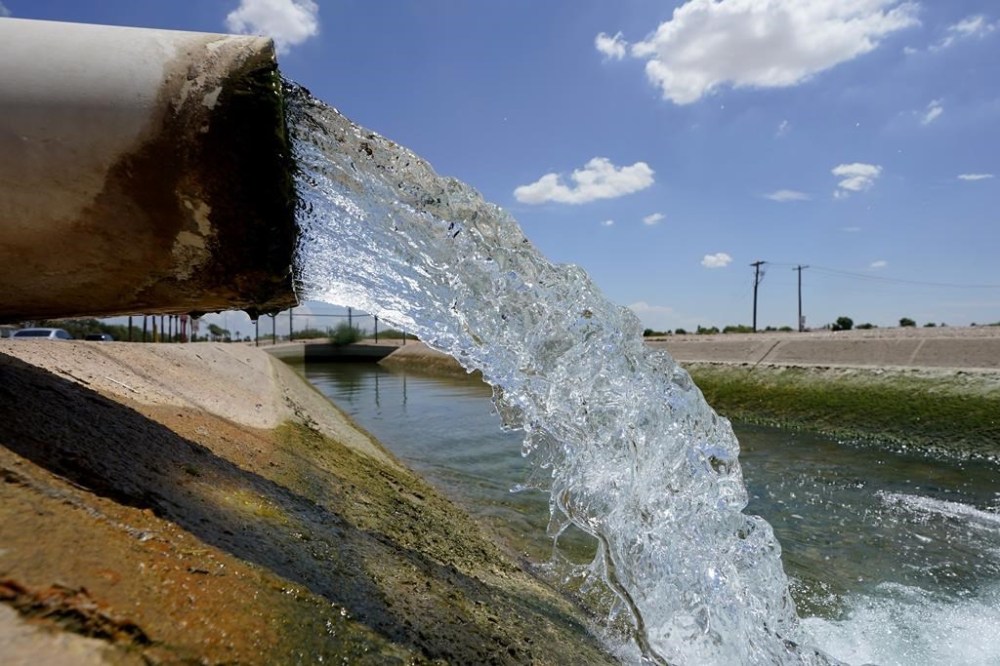
“Today’s announcements and our partnerships with tribes like the Gila River Indian Community prove that tribes are a key part of the solutions,” Deputy U.S. Secretary of the Interior Tommy Beaudreau said. “We don’t have any more important partners in this effort than in Indian Country.”
The federal government previously promised to use some $4 billion for drought relief, and Colorado River users have submitted proposals to get some of that money through actions like leaving fields unplanted. Some cities are ripping up thirsty decorative grass, and tribes and major water agencies have left some water in key reservoirs — either voluntarily or by mandate.
Beyond the Gila River announcement, the Interior Department has shared few details about how it plans to divvy up the rest of the $4 billion, including how much will go to agricultural interests in the mammoth Imperial Irrigation District in California.
In total, the Biden administration plans to spend about $15.4 billion approved by Congress for infrastructure improvements and inflation reductions for drought-related projects across the West, according to a government fact sheet released with Thursday’s announcement.
The Gila River tribe will get $83 million for the pipeline project to reuse about 20,000 acre-feet (25 million cubic meters) of water per year, and $50 million per year over three years not to use 125,000 acre-feet (154 million cubic meters) per year of water currently stored at Lake Mead. The latter is part of a broader effort to get Colorado River water users to substantially lower their water use.
An acre-foot of water is enough to cover an acre of land 1 foot deep (1,233 cubic meters), or about enough to serve two average households per year.
Gila River Indian Community Gov. Stephen Roe Lewis also pointed in a statement to a third pact providing a federal grant for a solar-covered canal project.
“These three agreements, taken together, represent a future of how we can work together to confront the urgency of this moment,” Lewis said, “… to find, foster and fund innovative solutions that will have a long-term impact for the Colorado River.”
Thursday’s announcement comes days before the Bureau of Reclamation, the federal agency that controls water flows on the river, is expected to outline plans for all seven Colorado River basin states — Arizona, California, Nevada, Colorado, Utah, New Mexico and Wyoming — to use less water.
The states, together, are allocated 15 million acre-feet (18.5 billion cubic meters) per year, and Mexico is allocated another 1.5 million acre-feet (1.9 billion cubic meters). U.S. Bureau of Reclamation Commissioner Camille Touton called on the states last year to collectively cut up to 4 million acre-feet (4.9 billion cubic meters) of use, but the number has proven elusive.
The Gila River tribe, by comparison, is allocated 653,000 acre-feet (805 million cubic meters) per year. It committed to give up about one-fifth of its allocation until 2025.
In all, 22 of 30 federally recognized tribes in the Colorado River basin have recognized rights to 3.2 million acre-feet (3.9 billion cubic meters) annually, or up to 26% of the basin’s current annual flow, according to a 2021 policy paper by the Getches-Wilkinson Center for Natural Resources, Energy and the Environment at the University of Colorado.
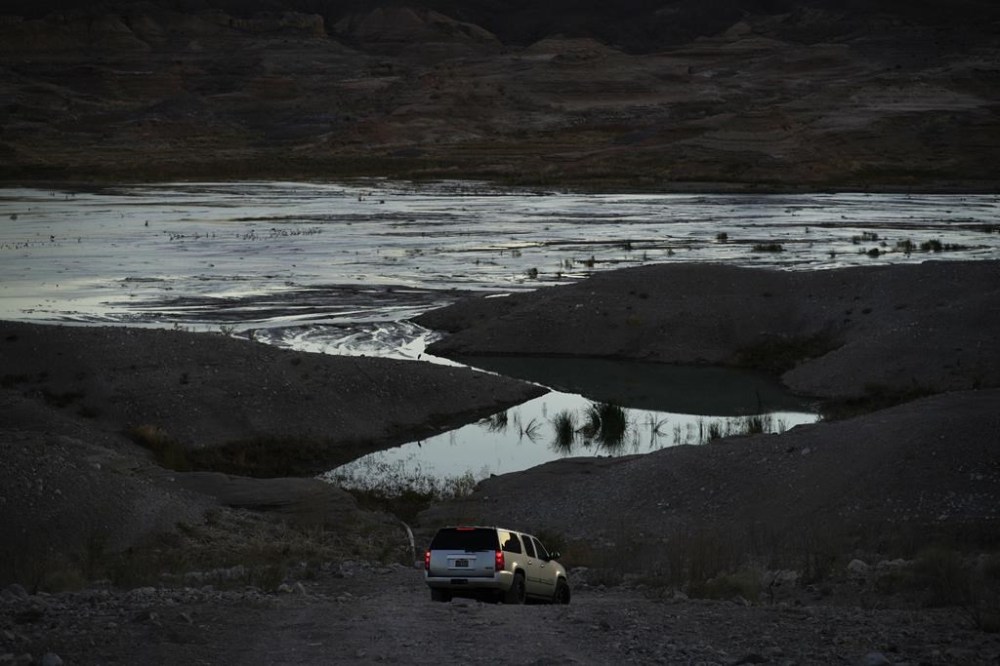
Data shows the river flow was overestimated 100 years ago, and has decreased due to drought since 2000, to about 12.4 million acre-feet (15.3 billion cubic meters) per year, the center’s study said.
Officials said an exceptional series of wet winter storms that have swept from the Pacific Ocean into California and the West this year will not be enough to break a megadrought that scientists call the worst in 1,200 years. The dry spell has led to concerns that hydropower plants could go dry and water deliveries could stop for farms that grow crops for the rest of the nation.
“Despite recent heavy rain and snow, the historic 23-year drought has led to record low water levels at Lake Powell and Lake Mead,” the Interior Department said in its fact sheet.
The announcement in Phoenix was part of a series of appearances by Biden administration officials, including one on Wednesday outlining plans to spend $585 million for 83 projects including dams, canals and water systems in 11 states. That announcement was made at the Imperial Dam in Yuma, Arizona, which is slated to receive more than $8 million.
Officials also said $36 million promised under Reclamation’s Lower Colorado River Basin System Conservation and Efficiency Program will go to California’s Coachella Valley. The main water district in that region promised to conserve 30,000 acre-feet (37 million cubic meters) of water in Lake Mead.
Another $20 million was pledged toward water storage projects in Utah and California, including at the Salton Sea, a drying inland lake formed when the Colorado River flooded in 1905.
Combined, Lake Mead on the Nevada-Arizona state line and Lake Powell formed by Glen Canyon Dam on the Arizona-Utah line were at 92% capacity in 1999. Today, they are at less than 30%.
____
Ritter reported from Las Vegas.