

UN: 3,300 Afghan staff stay home over Taliban ban on women
Advertisement
Read this article for free:
or
Already have an account? Log in here »
To continue reading, please subscribe:

Digital Subscription
One year of digital access for only $205*
- Enjoy unlimited reading on winnipegfreepress.com
- Read the E-Edition, our digital replica newspaper
- Access News Break, our award-winning app
- Play interactive puzzles
*First annual payment billed as $205.00 + GST for one year. This annual subscription will automatically renew at $233.00 + GST every 52 weeks (10% off the regular annual price of $259.35). Offer available to new and qualified returning subscribers only. Cancel any time.
To continue reading, please subscribe:
Add Free Press access to your Brandon Sun subscription for only an additional
$1 for the first 4 weeks*
- Enjoy unlimited reading on winnipegfreepress.com
- Read the E-Edition, our digital replica newspaper
- Access News Break, our award-winning app
- Play interactive puzzles
*Your next Brandon Sun subscription payment will increase by $1.00 and you will be charged $17.95 plus GST for four weeks. After four weeks, your payment will increase to $24.95 plus GST every four weeks.
Read unlimited articles for free today:
or
Already have an account? Log in here »
Hey there, time traveller!
This article was published 06/04/2023 (1269 days ago), so information in it may no longer be current.
UNITED NATIONS (AP) — The United Nations said the 3,330 Afghan men and women it employs stayed home for a second day Thursday to protest the Taliban’s ban on U.N. female staff working in the country as it continued to press for the decision to be reversed.
The U.N. Security Council held an emergency meeting on the Taliban’s action and pushed its calls for the ban to be overturned.
U.N. spokesman Stephane Dujarric reiterated the U.N.’s insistence that all U.N. staff are needed to deliver life-saving aid to millions and stressed again that “Afghan women will not be replaced by men.” He also said the United Nations doesn’t want to get into a situation where it replaces Afghan women with international women, who are not banned from working in the country.
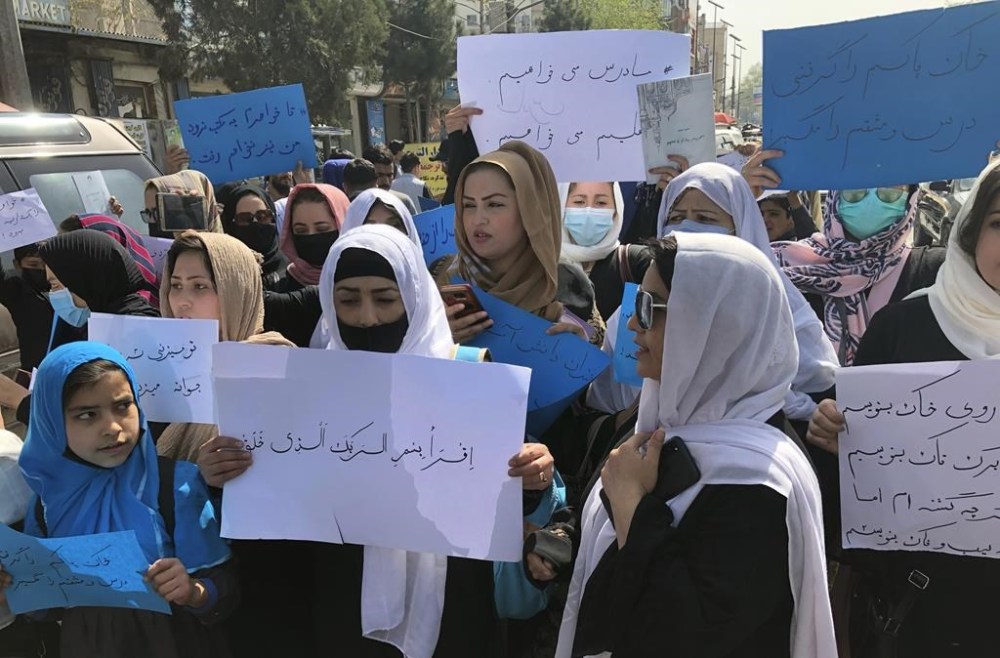
He explained that culturally it is always better to have nationals from a country delivering aid to their local population. The U.N. has a staff of about 3,900 in Afghanistan, including approximately 3,300 Afghans and 600 international personnel. The total also includes 600 Afghan women and 200 women from other countries.
At the closed U.N. Security Council meeting on the Taliban ban, members were briefed by the secretary-general’s special representative for Afghanistan, Roza Otunbayeva, who led talks Wednesday with the Taliban’s foreign minister, Amir Khan Muttaqi, to call for a reversal of its decision.
Russia’s U.N. Ambassador Vassily Nebenzia, the current council president, told reporters afterward that “everybody was appalled by the decision the Taliban made.”
“The question is how to approach it, and we agreed to work on a product by the council … that would be useful and balanced,” he said.
U.S. deputy ambassador Robert Wood said the Biden administration sees the ban “basically as another effort by the Taliban to erase Afghan women and girls from society.”
The United Nations on Wednesday called the ban an “unparalleled” violation of women’s rights, unlawful under international law, and unacceptable to the 193-member international organization.
The Taliban decision drew condemnation from the world’s most recognized organizations and on Thursday more than a dozen U.N. experts also demanded the immediate reversal of the countrywide ban on Afghan women working with the United Nations, including the U.N. special investigator on human rights in Afghanistan.
Despite initial promises of a more moderate rule than during its previous stint in power in the 1990s, the Taliban have imposed harsh measures since taking over the country in 2021 as U.S. and NATO forces were pulling out of Afghanistan after two decades of war.
Girls are banned from education beyond sixth grade. Women are barred from working, studying, traveling without a male companion, and even going to parks or gyms. And women must also cover themselves from head to toe. In December, the Taliban banned female workers for humanitarian organizations.
Ramiz Alakbarov, the U.N. deputy special representative and humanitarian coordinator for Afghanistan, said in a statement Thursday that Afghanistan is the world’s largest aid operation, with a record 28.3 million people in need of assistance this year including 20 million facing severe hunger and six million of them “one step away from famine.”
The United Nations appealed for $4.6 billion to provide humanitarian aid for Afghanistan in 2023 but the appeal is less than 5% funded, receiving only $213 million which makes it the lowest funded U.N. aid operation globally, he said.
“The world cannot abandon the people of Afghanistan at this precarious moment,” Alakbarov said.