

Afghan religious scholars criticize girls’ education ban
Advertisement
Read this article for free:
or
Already have an account? Log in here »
To continue reading, please subscribe:
Digital Subscription
One year of digital access for only $1.44 a week*
- Enjoy unlimited reading on winnipegfreepress.com
- Read the E-Edition, our digital replica newspaper
- Access News Break, our award-winning app
- Play interactive puzzles
*Billed as $5.77 plus GST every four weeks. After 52 weeks, price increases to the regular rate of $19.95 plus GST every four weeks. Offer available to new and qualified returning subscribers only. Cancel any time.
To continue reading, please subscribe:
Add Free Press access to your Brandon Sun subscription for only an additional
$1 for the first 4 weeks*
- Enjoy unlimited reading on winnipegfreepress.com
- Read the E-Edition, our digital replica newspaper
- Access News Break, our award-winning app
- Play interactive puzzles
*Your next Brandon Sun subscription payment will increase by $1.00 and you will be charged $17.95 plus GST for four weeks. After four weeks, your payment will increase to $24.95 plus GST every four weeks.
Read unlimited articles for free today:
or
Already have an account? Log in here »
Hey there, time traveller!
This article was published 08/04/2023 (1152 days ago), so information in it may no longer be current.
JALALABAD, Afghanistan (AP) — Afghan religious scholars Saturday criticized a ban on female education, as a key Taliban minister warned clerics not to rebel against the government on the controversial issue.
Girls cannot go to school beyond sixth grade in Afghanistan, with the education ban extending to universities. Women are barred from public spaces, including parks, and most forms of employment. Last week, Afghan women were barred from working at the U.N., according to the global body, although the Taliban have yet to make a public announcement.
Authorities present the education restrictions as temporary suspensions rather than bans, but universities and schools reopened in March without their female students.
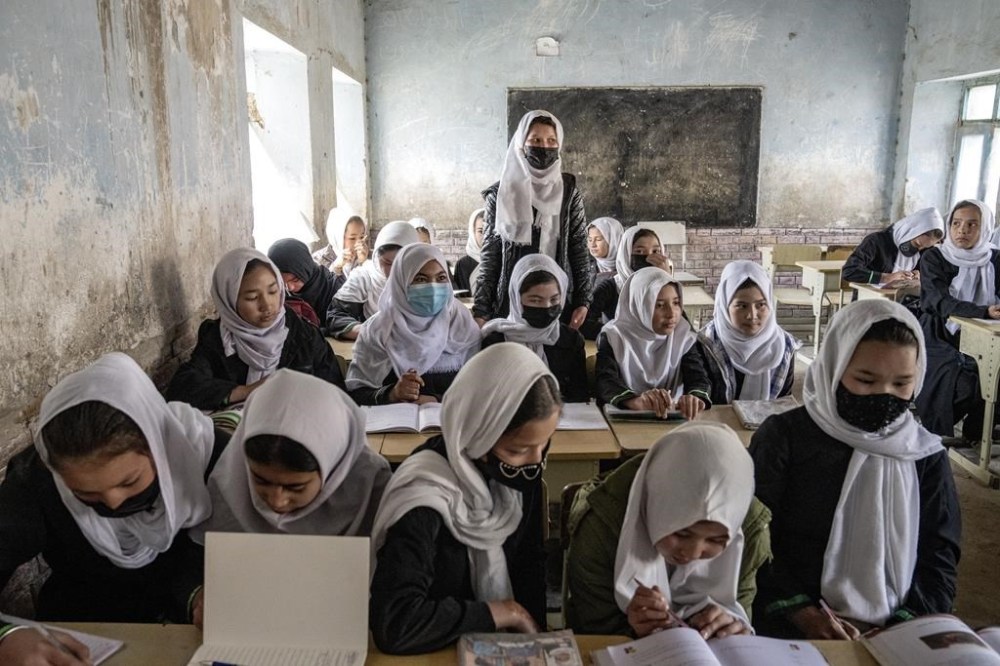
The bans have raised fierce international uproar, increasing the country’s isolation at a time when its economy has collapsed and worsenied a humanitarian crisis.
Two religious scholars who are well-known within Afghanistan said Saturday that authorities should reconsider their decision. Public opposition to Taliban policies is rare, although some Taliban leaders have voiced their disagreement with the decision-making process.
One scholar, Abdul Rahman Abid, said institutions should be permitted to re-admit girls and women through separate classes, hiring female teachers, staggering timetables, and even building new facilities.
Knowledge is obligatory in Islam for men and women, he told The Associated Press, and Islam allows women to study.
“My daughter is absent from school, I am ashamed, I have no answer for my daughter,” he said. “My daughter asks why girls are not allowed to learn in the Islamic system. I have no answer for her.”
He said reform is needed and warned that any delays are at the expense of the global Islamic community and also weakens the government.
Another scholar, who is a member of the Taliban, told the AP there is still time for ministries to solve the problem of girls’ education. Toryali Himat cited ministries comprising the inner circle of the supreme leader, Hibatullah Akhundzada, who is based in Kandahar.
It was on his orders that the government banned girls from classrooms. Himat said there are two types of criticism, one that destroys the system and another that makes corrective criticism.
“Islam has allowed both men and women to learn, but hijab and curriculum should be considered,” said Himat. “Corrective criticism should be given and the Islamic emirate should think about this. Where there is no criticism, there is the possibility of corruption. My personal opinion is that girls should get education up to university level.”
Acting Higher Education Minister Nida Mohammad Nadim said Friday that clerics should not speak against government policy.
He made his remarks after another scholar, Abdul Sami Al Ghaznawi, told students at a religious school that there was no conflict over girls’ education. He said Islamic scripture was clear that girls’ education was acceptable. Al Ghaznawi was not immediately available for comment.
Nadim appeared to target Al Ghaznawi by mentioning “an honorable scholar” at the top of a video statement released on social media.
“You encouraged the people to rebel, so what is the result?” Nadim said. “The result is that rebellion against this (ban) is allowed. If people are encouraged to rebel against the system, will it benefit Muslims?”
The minister was not immediately available for comment. But his spokesman, Hafiz Ziaullah Hashimi, confirmed Nadim’s remarks without giving further details about who they were directed at or the reason behind them.