

USMCA commission to open environmental probe of Mexico train
Advertisement
Read this article for free:
or
Already have an account? Log in here »
To continue reading, please subscribe:

Digital Subscription
One year of digital access for only $205*
- Enjoy unlimited reading on winnipegfreepress.com
- Read the E-Edition, our digital replica newspaper
- Access News Break, our award-winning app
- Play interactive puzzles
*First annual payment billed as $205.00 + GST for one year. This annual subscription will automatically renew at $233.00 + GST every 52 weeks (10% off the regular annual price of $259.35). Offer available to new and qualified returning subscribers only. Cancel any time.
To continue reading, please subscribe:
Add Free Press access to your Brandon Sun subscription for only an additional
$1 for the first 4 weeks*
- Enjoy unlimited reading on winnipegfreepress.com
- Read the E-Edition, our digital replica newspaper
- Access News Break, our award-winning app
- Play interactive puzzles
*Your next Brandon Sun subscription payment will increase by $1.00 and you will be charged $17.95 plus GST for four weeks. After four weeks, your payment will increase to $24.95 plus GST every four weeks.
Read unlimited articles for free today:
or
Already have an account? Log in here »
Hey there, time traveller!
This article was published 26/04/2023 (1262 days ago), so information in it may no longer be current.
MEXICO CITY (AP) — The trilateral Commission for Environmental Cooperation established by the U.S., Mexico and Canada has recommended opening an investigation into Mexico’s multibillion-dollar tourist train project on the Yucatán peninsula.
Environmentalists filed a complaint saying the Maya Train project threatens jungles and limestone caves containing precious fresh water. The caves have also yielded some of the oldest human remains found in North America.
The train is currently being rushed to completion. It is the pet project of Mexican President Andrés Manuel López Obrador, who wants it finished before he leaves office in September 2024.
The trilateral commission was established by the governments of Mexico, the United States and Canada in 1994, and operates under the USMCA free trade agreement.
It has the power to produce fact-finding reports that could be used in trade disputes. It will do so if two of the three countries agree; the U.S. government has always voted to go ahead with such investigations.
The USMCA trade pact requires member countries to enforce their environmental laws, and they could face tariffs or other sanctions if they don’t.
The commission said in a statement late Tuesday that the investigation will look into “the environmental impact assessment procedures for the Maya Train project, including relevant studies and alleged fragmentation of the environmental impact studies, as well as the change in land use authorization.”
The 950-mile (1,500-kilometer) Maya Train line is meant to run in a rough loop around the Yucatán Peninsula, connecting beach resorts and archaeological sites.
Originally projected to cost around $8 billion, the train line now appears likely to rise to $15 billion, and possibly as much as $20 billion. Because no real feasibility studies were done, it is not clear whether the train will draw enough tourists or recoup its costs.
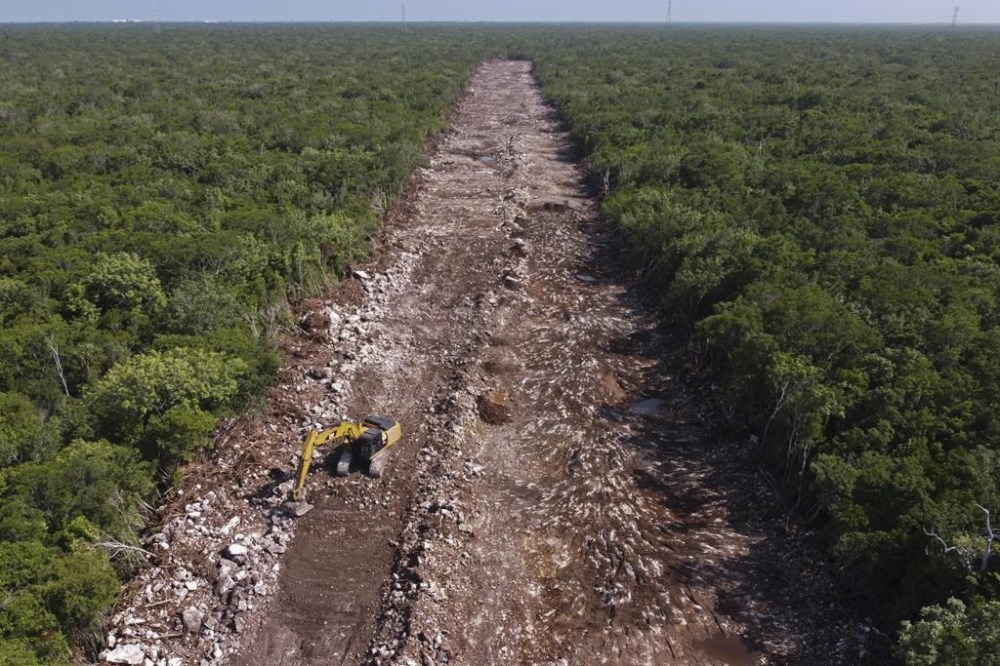
While some stretches of the train line run over existing tracks or alongside existing roads, other parts are being cut through the jungle, including a controversial stretch that cuts a 68-mile (110-kilometer) swath between the resorts of Cancún and Tulúm.
It is the hurried approval and construction on that Cancún -Tulúm stretch that is at the center of the complaint.
Activists say the heavy, high-speed rail project will fragment the coastal jungle and will run often above the roofs of fragile limestone caves known as cenotes, which — because they’re flooded, twisty and often incredibly narrow — can take decades to explore.
Inside those water-filled caves are archaeological sites that have lain undisturbed for millennia, like Naia, the nearly complete skeleton of a young woman who died around 13,000 years ago.
José ‘Pepe’ Urbina, a diver who has explored the caverns for decades, welcomed the investigation of the train project, even though the Mexican government has already started sinking concrete piles into the fragile limestone soil to build the railway.
“This is good news, it comes a little late, but better late than never,” Urbina said. “Let’s see what the Mexican government says or does. The environmental destruction is a reality that their propaganda cannot hide any longer.”
The stretch of track was originally supposed to have been built on elevated tracks above the existing coastal highway that connects the two resorts. But opposition from hotel owners led López Obrador to relocate the train tracks inland, requiring workers to cut a swath through the jungle. The change was made with almost no prior study of its environmental impact.
Archaeologist Octavio del Río, who has spent years exploring the caves, said damage is already being done.
“It is not just on the surface, where the destruction is more evident, but in the underwater archaeological artifacts that are less apparent,” Del Río said. “It is already being subject to destruction by hundreds of enormous columns that are sinking into the ground, affecting the artifacts.”