

Underwater cemetery found off Dry Tortugas National Park
Advertisement
Read this article for free:
or
Already have an account? Log in here »
To continue reading, please subscribe:
Digital Subscription
One year of digital access for only $1.44 a week*
- Enjoy unlimited reading on winnipegfreepress.com
- Read the E-Edition, our digital replica newspaper
- Access News Break, our award-winning app
- Play interactive puzzles
*Billed as $5.77 plus GST every four weeks. After 52 weeks, price increases to the regular rate of $19.95 plus GST every four weeks. Offer available to new and qualified returning subscribers only. Cancel any time.
To continue reading, please subscribe:
Add Free Press access to your Brandon Sun subscription for only an additional
$1 for the first 4 weeks*
- Enjoy unlimited reading on winnipegfreepress.com
- Read the E-Edition, our digital replica newspaper
- Access News Break, our award-winning app
- Play interactive puzzles
*Your next Brandon Sun subscription payment will increase by $1.00 and you will be charged $17.95 plus GST for four weeks. After four weeks, your payment will increase to $24.95 plus GST every four weeks.
Read unlimited articles for free today:
or
Already have an account? Log in here »
Hey there, time traveller!
This article was published 02/05/2023 (1267 days ago), so information in it may no longer be current.
DRY TORTUGAS NATIONAL PARK, Fla. (AP) — Archeologists have found the remains of a 19th century quarantine hospital and cemetery on a submerged island in Florida’s Dry Tortugas National Park in the Gulf of Mexico.
While only one grave has been identified, historical records indicate dozens of people — mostly U.S. soldiers stationed at Fort Jefferson — may have been buried at the site in waters west of Key West, Florida, park officials said in a news release Monday.
A group that included park cultural resources staff, the National Park Service’s Submerged Resources Center, the Southeast Archeological Center, and a University of Miami graduate student, made the discovery during a survey of Fort Jefferson Post Cemetery that began last August.
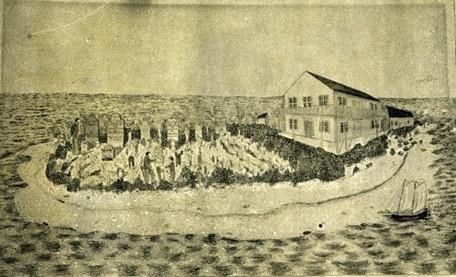
They discovered the grave of John Greer, a laborer who died on Nov. 5, 1861. Officials said they don’t know much about Greer, but his grave was prominently marked with a large slab of greywacke, the same material used to construct the first floor of Fort Jefferson.
“This intriguing find highlights the potential for untold stories in Dry Tortugas National Park, both above and below the water,” said Josh Marano, a maritime archeologist for the South Florida national parks, and the survey’s project director.
He said efforts are continuing to learn more about others buried on the submerged island.
Fort Jefferson was a military prison during the American Civil War, and the surrounding islands became a naval outpost, a lighthouse station, naval hospital, quarantine facility and a site for military training.
The risk of communicable diseases, including outbreaks of the mosquito-borne yellow fever, increased as the fort’s population grew with military personnel, prisoners, enslaved people, support staff and their families.
The fort was abandoned in 1873, but the U.S. Marine Hospital Service occupied it again between 1890 and 1900, and an isolation hospital was set up on a nearby island.
“Although much of the history of Fort Jefferson focuses on the fortification itself and some of its infamous prisoners, we are actively working to tell the stories of the enslaved people, women, children and civilian laborers,” Marano said.