

Justice Dept. settles with New Jersey county over ballot languages, highlighting widespread barrier
Advertisement
Read this article for free:
or
Already have an account? Log in here »
To continue reading, please subscribe:

Digital Subscription
One year of digital access for only $205*
- Enjoy unlimited reading on winnipegfreepress.com
- Read the E-Edition, our digital replica newspaper
- Access News Break, our award-winning app
- Play interactive puzzles
*First annual payment billed as $205.00 + GST for one year. This annual subscription will automatically renew at $233.00 + GST every 52 weeks (10% off the regular annual price of $259.35). Offer available to new and qualified returning subscribers only. Cancel any time.
To continue reading, please subscribe:
Add Free Press access to your Brandon Sun subscription for only an additional
$1 for the first 4 weeks*
- Enjoy unlimited reading on winnipegfreepress.com
- Read the E-Edition, our digital replica newspaper
- Access News Break, our award-winning app
- Play interactive puzzles
*Your next Brandon Sun subscription payment will increase by $1.00 and you will be charged $17.95 plus GST for four weeks. After four weeks, your payment will increase to $24.95 plus GST every four weeks.
Read unlimited articles for free today:
or
Already have an account? Log in here »
Hey there, time traveller!
This article was published 10/05/2023 (1222 days ago), so information in it may no longer be current.
WASHINGTON (AP) — The Justice Department has reached a settlement with a New Jersey county over language barriers for Spanish-speaking voters, emphasizing a growing challenge for certain minority communities nationwide.
The agreement with Union County comes after federal prosecutors filed a lawsuit alleging it failed to make registration and voting notices, forms, instructions and ballots available in Spanish, violating sections of the federal Voting Rights Act.
“We know firsthand how language barriers hurt our community,” said Hector Sanchez Barba, chief executive of Mi Familia Vota, a national group seeking to boost Latino political influence. “Eliminating language barriers is not only legally sound but also the right thing to do to strengthen our democracy.”
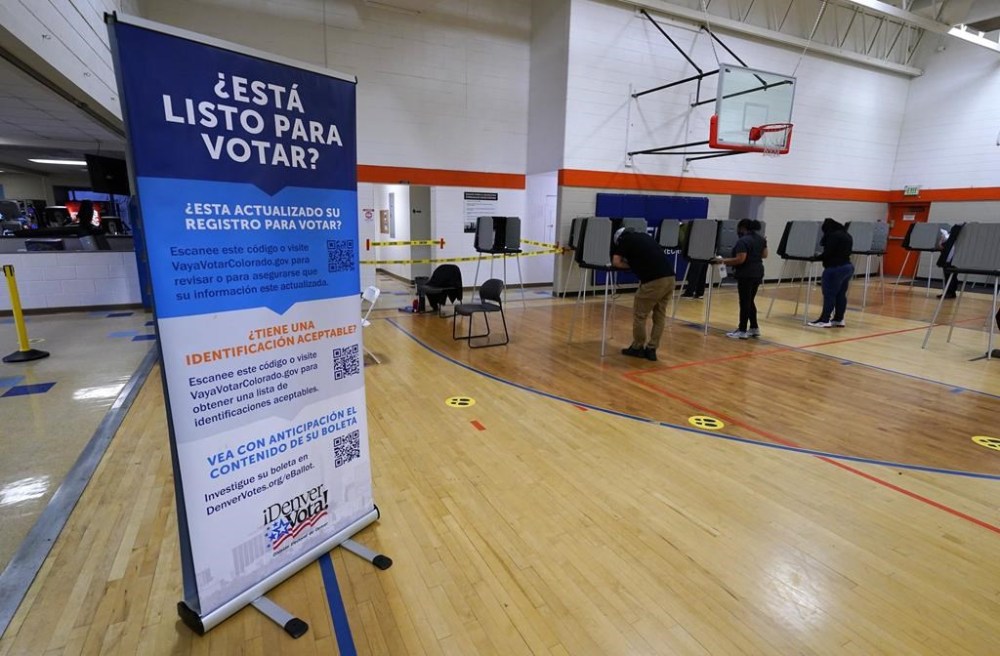
The county, which has nearly 28,000 Spanish-speaking citizens of voting age, will be required to print all election materials in English and Spanish, and ensure that someone is available to assist Spanish-speaking voters in person. It also will have to assist voters with disabilities, who have long been overlooked in the fight for access to the polls.
The consent decree, announced Tuesday, will need approval from a federal judge.
New Jersey is one of several places across the U.S. where language barriers hamper access to the ballot for minority communities, according to voter advocacy groups. Some Asian American and Asian immigrant communities are particularly affected, said Susana Lorenzo-Giguere, the associate director of the Asian American Legal Defense and Education Fund’s Democracy Program.
“Despite a long history in the U.S., Asian Americans still face bias that views them as perpetual foreigners who aren’t ‘real Americans’ and don’t deserve to be a part of the fabric of our democracy,” she said.
Under the federal Voting Rights Act, communities must provide language assistance for voting if more than 5% of the voting-age citizens — or over 10,000 — have limited English proficiency.
It can be harder for Asian-speaking communities to be covered under federal law because there are so many languages to consider, said Bob Sakaniwa, director of policy and advocacy of Asian and Pacific Islander American Vote. Bangladeshi, Cambodian, Chinese, Filipino, Hmong and Vietnamese are just some, he said.
For example, Asian communities make up a significant portion of Mercer, Hudson and Somerset counties in New Jersey, but the populations don’t meet the federal threshold for providing assistance. Arabic-speaking communities also are not reflected in New Jersey’s voting rights legislation, which state advocacy groups are still fighting to change.
Union County did not immediately respond when asked how it intended to implement the consent decree.
The New Jersey agreement underscores the importance of the federal Voting Rights Act, despite the landmark law being undermined by Supreme Court decisions and voting restrictions in Republican-led states. Henal Patel, law and policy director at the New Jersey Institute for Social Justice, said it’s important for local officials to comply with the act and for the federal government to enforce it.
“This is necessary for voters in these areas so that they can cast their ballots with a full understanding of what they’re voting for,” Patel said.