

US Postal Service honors civil rights leader, Ponca tribe Chief Standing Bear, with stamp
Advertisement
Read this article for free:
or
Already have an account? Log in here »
To continue reading, please subscribe:

Digital Subscription
One year of digital access for only $205*
- Enjoy unlimited reading on winnipegfreepress.com
- Read the E-Edition, our digital replica newspaper
- Access News Break, our award-winning app
- Play interactive puzzles
*First annual payment billed as $205.00 + GST for one year. This annual subscription will automatically renew at $233.00 + GST every 52 weeks (10% off the regular annual price of $259.35). Offer available to new and qualified returning subscribers only. Cancel any time.
To continue reading, please subscribe:
Add Free Press access to your Brandon Sun subscription for only an additional
$1 for the first 4 weeks*
- Enjoy unlimited reading on winnipegfreepress.com
- Read the E-Edition, our digital replica newspaper
- Access News Break, our award-winning app
- Play interactive puzzles
*Your next Brandon Sun subscription payment will increase by $1.00 and you will be charged $17.95 plus GST for four weeks. After four weeks, your payment will increase to $24.95 plus GST every four weeks.
Read unlimited articles for free today:
or
Already have an account? Log in here »
Hey there, time traveller!
This article was published 12/05/2023 (1230 days ago), so information in it may no longer be current.
A Ponca tribe chief whose landmark lawsuit in 1879 established that a Native American is a person under the law was honored Friday with the unveiling of a U.S. Postal Service stamp that features his portrait.
The release of the stamp of Chief Standing Bear comes 146 years after the Army forced him and about 700 other members of the Ponca tribe to leave their homeland in northeast Nebraska and walk 600 miles (965 kilometers) to the Indian Territory in Oklahoma. Chief Standing Bear was arrested and imprisoned in Fort Omaha when he and others tried to return. This prompted him to file a lawsuit that led to an 1879 ruling ordering his release and finding that a Native American is a person with a right to life, liberty and the pursuit of happiness.
“For so long people didn’t know his story or the Ponca story — our own trail of tears,” Candace Schmidt, chairwoman of the Ponca Tribe of Nebraska said. “We are finally able to tell his story of perseverance and how we as a tribe are resilient.”
Judi M. gaiashkibos, executive director of the Nebraska Commission on Indian Affairs, called the issuing of a Chief Standing Bear stamp a milestone that she hopes “provokes necessary conversations about race, sovereignty and equality in the United States.”
“It’s remarkable, that the story of Nebraska Native American civil rights leader Chief Standing Bear has progressed from a native man being considered a non-person by the U.S. Government in 1879, to today, being recognized by the Postal Service with a stamp honoring him as an American icon,” gaiashkibos said.
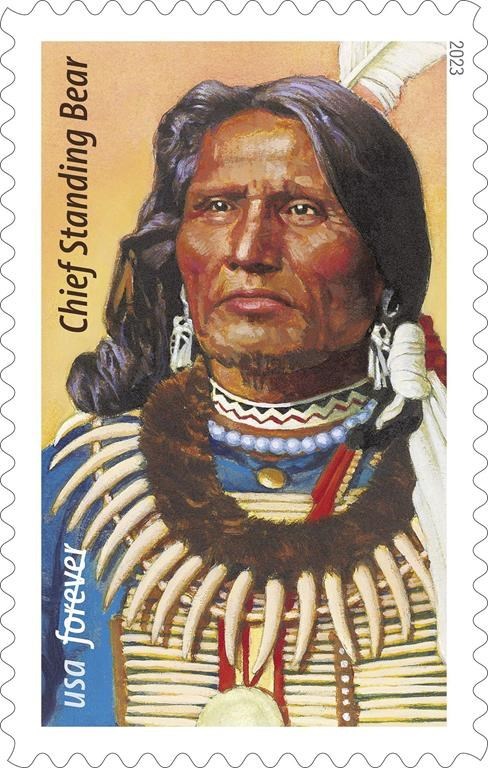
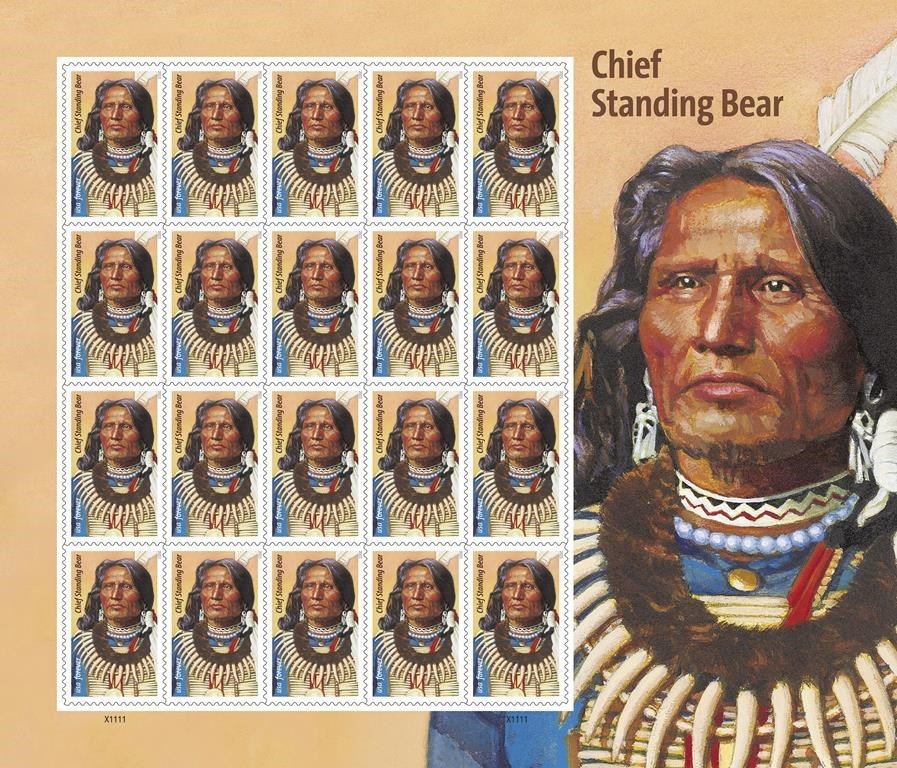
The Postal Service, which released the stamp at a ceremony Friday in Lincoln, Nebraska, has printed 18 million stamps. The stamp features a portrait of Chief Standing Bear by illustrator Thomas Blackshear II, based on a black and white photograph taken in 1877, the Postal Service said.
More than 100 members of the Ponca tribe died during or soon after the forced journey to Oklahoma, including Chief Standing Bear’s only son. It was a desire to have his son buried in their homeland in Nebraska’s Niobrara River Valley that resulted in the return of Chief Standing Bear and 29 others and their subsequent arrest.
According to the National Park Service, two Omaha attorneys represented Chief Standing Bear at a two-day trial before Judge Elmer S. Dundy in U.S. District Court in Omaha. The government appealed Dundy’s ruling that Chief Standing Bear and other arrested members of his tribe were “persons” but the U.S. Supreme Court refused to hear the case.
The Ponca members were freed and returned to their old reservation along the Niobrara River, where Chief Standing Bear died in 1908.
A congressional investigation later determined the government wrongly gave away the Ponca homeland and removed the tribe, leading to congressional legislation in 1881 that gave some compensation to members of the tribe. In 1924, an issue that arose in the 1879 trial was resolved when Congress approved a law that conferred citizenship on all Native Americans born in the United States.
The federal government terminated the Ponca tribe of Nebraska in 1966 but the tribe regained federal recognition in 1990. Schmidt said the Ponca now has about 5,500 members, operates three health clinic and offers numerous services to members.
“We’re doing really well,” she said.
There is a separate Ponca tribe in Oklahoma.
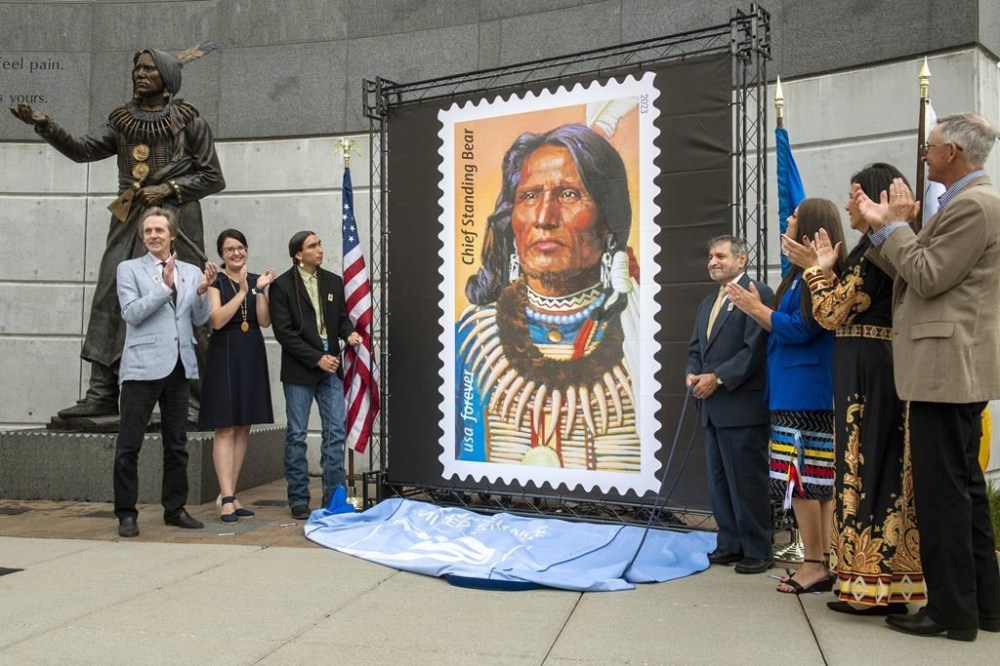
Anton G. Hajjar, vice chairman of the Postal Service Board of Governors, said the post office has been issuing stamps that honor the legacy of great Americans since the 1800s. In issuing the stamp of Chief Standing Bear, Hajjar noted, “It took our country far too long to recognize the humanity in many of its people – including the American Indians who lived in these lands for thousands of years.”
The Postal Service previously has issued stamps honoring Native Americans including Pocahontas, Chief Joseph, Sequoyah, Red Cloud, Sitting Bull and Jim Thorpe.