

Peter Hellyer, prolific writer who chronicled the UAE’s rise over nearly five decades, dies at 75
Advertisement
Read this article for free:
or
Already have an account? Log in here »
To continue reading, please subscribe:

Digital Subscription
One year of digital access for only $205*
- Enjoy unlimited reading on winnipegfreepress.com
- Read the E-Edition, our digital replica newspaper
- Access News Break, our award-winning app
- Play interactive puzzles
*First annual payment billed as $205.00 + GST for one year. This annual subscription will automatically renew at $233.00 + GST every 52 weeks (10% off the regular annual price of $259.35). Offer available to new and qualified returning subscribers only. Cancel any time.
To continue reading, please subscribe:
Add Free Press access to your Brandon Sun subscription for only an additional
$1 for the first 4 weeks*
- Enjoy unlimited reading on winnipegfreepress.com
- Read the E-Edition, our digital replica newspaper
- Access News Break, our award-winning app
- Play interactive puzzles
*Your next Brandon Sun subscription payment will increase by $1.00 and you will be charged $17.95 plus GST for four weeks. After four weeks, your payment will increase to $24.95 plus GST every four weeks.
Read unlimited articles for free today:
or
Already have an account? Log in here »
Hey there, time traveller!
This article was published 03/07/2023 (1177 days ago), so information in it may no longer be current.
DUBAI, United Arab Emirates (AP) — Peter Hellyer, a U.K.-born writer who spent nearly five decades chronicling the history, natural beauty and modern transformation of the United Arab Emirates, has died peacefully at the age of 75, local media reported Monday.
Hellyer, who was granted UAE citizenship and awarded the country’s highest civilian honor, helped found the state-run WAM news agency and established its English service. He also helped establish an archaeological group that uncovered several historical sites.
Sheikh Mohammed bin Zayed Al Nahyan, the president of the UAE, said on Twitter that Hellyer’s dedicated service to UAE over the course of decades had left “notable” marks in the fields of antiquities, the environment and the media.
“With his passing, we lost a model of commitment and giving,” Sheikh Mohammed wrote.
Hellyer came to the UAE in 1975 to make a documentary film about Sheikh Zayed bin Sultan Al Nahyan, Sheikh Mohammed’s father and the founder and first president of the federation of seven sheikhdoms.
He stayed on to chronicle its dramatic rise from a sparsely populated desert nation to an ultra-modern hub of tourism and commerce, home to the futuristic cities of Dubai and Abu Dhabi, and the world’s tallest skyscraper.
Hellyer wrote several articles and books on the country’s rise, including the official history of its vital oil industry, as well as a broader, maritime history of the Gulf nation. He co-founded WAM with the late Palestinian journalist Ibrahim al-Abed and later served as director of external information and research at the National Media Council, a government regulatory body.
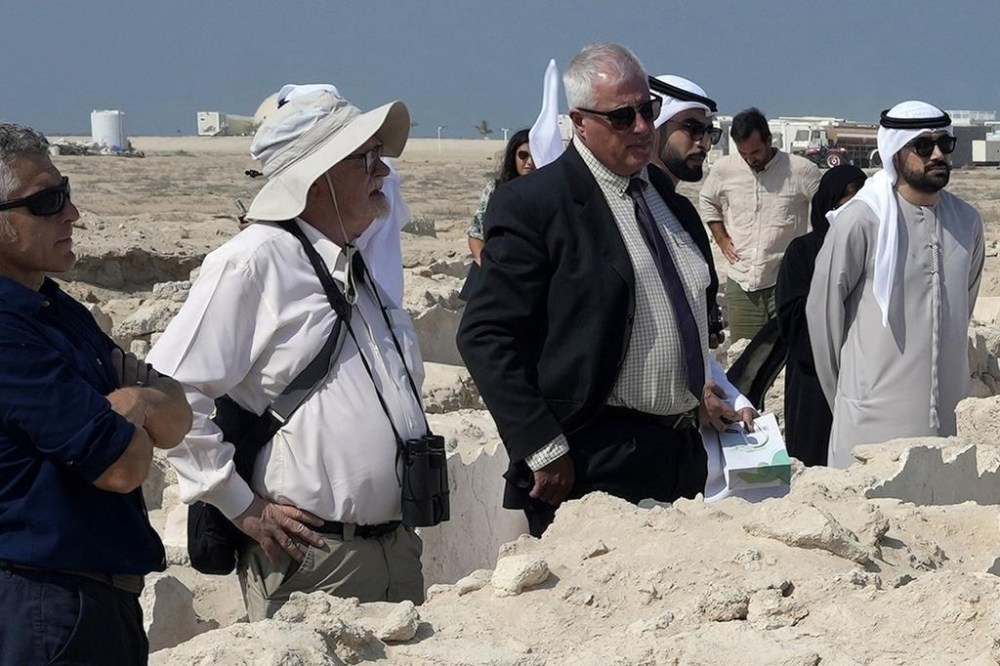
He co-founded and led the Abu Dhabi Islands Archaeology Survey from 1991 to 2006 and was involved in several discoveries shedding light on the history of the Persian Gulf, including a 1,400-year-old Christian monastery unearthed on Sir Bani Yas Island near the border with Saudi Arabia.
He wrote widely on the UAE’s desert ecology. He chaired the Emirates Natural History Group in the early 1990s and launched its journal, Tribulus, at which he was a longtime editor. He also founded a local birdwatching society.
He was awarded the Abu Dhabi Medal in 2013 — the country’s highest civilian honor. Organizers hailed him as “a self-taught jack-of-all-trades” whose “devotion to this land and its people is expressed through his commitment to protecting the country’s fragile ecosystems and history in a time of rapid development.”
He continued writing about the UAE in regular columns for The National, an English-language newspaper founded in 2008 that he had advised in its early years.
The National was among several local media outlets that reported his death. A family member did not immediately respond to a request for comment.
“Peter’s enormous role in documenting the UAE’s past and present cannot be exaggerated,” said Mina Al-Oraibi, the editor-in-chief of The National.
“Peter and his long-time friend, the late Ibrahim Al-Abed, were instrumental in laying the foundations for the UAE’s media scene and never hesitated to advise and support any journalist who reached out to them. We will miss his writings in The National and thank him for his years of contribution.”
In his final column for The National, published last December, he marveled at what he said had been a “golden year” for UAE archaeology. He expressed particular fascination at the recent discovery of artifacts dating back more than 400,000 years, before the emergence of Homo sapiens.
“Most exciting of all?” he wrote. “There’s still much more to learn about the history of this land.”