

US pledges to help Australia manufacture guided missiles by 2025
Advertisement
Read this article for free:
or
Already have an account? Log in here »
To continue reading, please subscribe:

Digital Subscription
One year of digital access for only $205*
- Enjoy unlimited reading on winnipegfreepress.com
- Read the E-Edition, our digital replica newspaper
- Access News Break, our award-winning app
- Play interactive puzzles
*First annual payment billed as $205.00 + GST for one year. This annual subscription will automatically renew at $233.00 + GST every 52 weeks (10% off the regular annual price of $259.35). Offer available to new and qualified returning subscribers only. Cancel any time.
To continue reading, please subscribe:
Add Free Press access to your Brandon Sun subscription for only an additional
$1 for the first 4 weeks*
- Enjoy unlimited reading on winnipegfreepress.com
- Read the E-Edition, our digital replica newspaper
- Access News Break, our award-winning app
- Play interactive puzzles
*Your next Brandon Sun subscription payment will increase by $1.00 and you will be charged $17.95 plus GST for four weeks. After four weeks, your payment will increase to $24.95 plus GST every four weeks.
Read unlimited articles for free today:
or
Already have an account? Log in here »
Hey there, time traveller!
This article was published 29/07/2023 (1160 days ago), so information in it may no longer be current.
CANBERRA, Australia (AP) — The United States will expand its military industrial base by helping Australia manufacture guided missiles and rockets for both countries within two years, the allies announced on Saturday as they ramped up defense cooperation to counter China’s growing influence in the Indo-Pacific.
The new cooperation on guided weapon production follows a trilateral partnership announcement in March that will see Britain provide Australia with a fleet of eight submarines powered by U.S. nuclear technology.
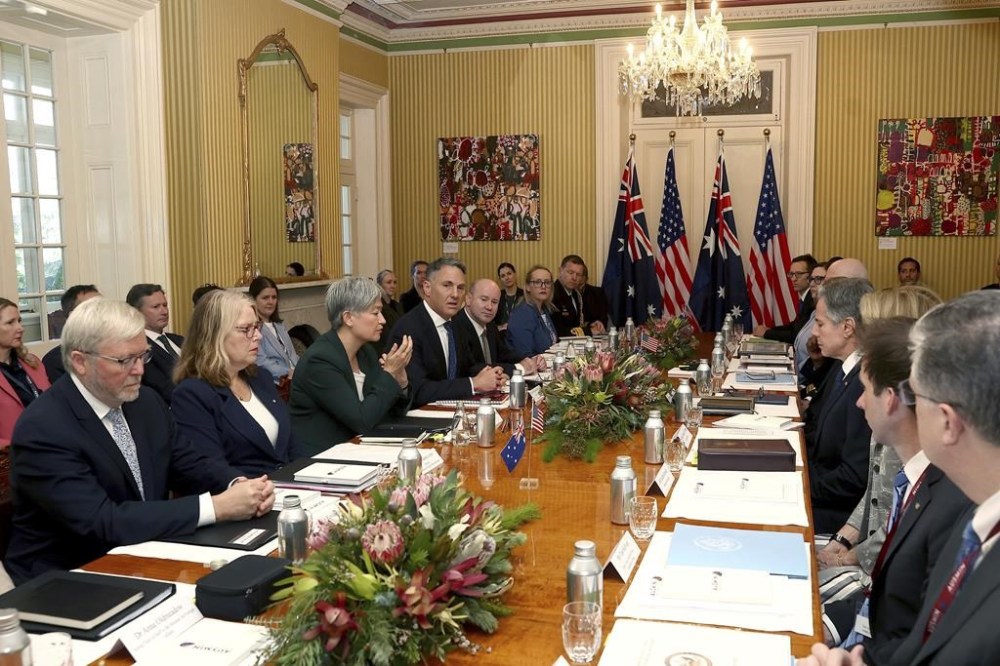
The greater integration of U.S. and Australian militaries was announced after annual talks between U.S. Defense Secretary Lloyd Austin and Secretary of State Antony Blinken and their Australian counterparts, Defense Minister Richard Marles and Foreign Minister Penny Wong.
They agreed to cooperate on Australia producing Guided Multiple Launch Rocket Systems by 2025, a communique said.
U.S. companies Raytheon and Lockheed Martin only established an Australian enterprise to build such weapons last year. That followed the drain on Western countries’ munitions caused by the Russian invasion of Ukraine.
Austin said the move on missiles would strengthen the two allies’ defense industrial base and technological edge.
“We’re racing to accelerate Australia’s priority access to munitions through a streamlined acquisition process,” Austin told reporters in Brisbane, Australia.
Marles welcomed U.S. support to achieve Australian missile production within two years.
“We are really pleased with the steps that we are taking in respect of establishing a guided weapons and explosive ordnance enterprise in this country,” Marles said.
The two governments also agreed to upgrade joint military facilities in Australia and to increase U.S. nuclear submarine visits as the United States increases its focus on the South Pacific.
The region came to the forefront of the U.S. competition with China for influence last year, when Beijing signed a security pact with Solomon Islands and raised the prospect of a Chinese naval base being established there.
Austin became the first U.S. defense secretary to visit Papua New Guinea and Blinken visited New Zealand and Tonga before they arrived in Australia.
Saturday’s meeting was overshadowed by the loss of an Australian Army helicopter with four air crew late Friday, during military exercises with the U.S. off the northeastern coast of Australia.
U.S., Australian and Canadian militaries are taking part in the search for potential survivors near Whitsunday Islands off the Queensland state coast.
Austin and Marles will travel to north Queensland on Sunday to inspect Talisman Sabre, a biennial military exercise between the two countries that this year includes 13 nations and more than 30,000 military personnel.