

Interpol at 100: A mixed legacy of hunting fugitives and merging police data from 195 countries
Advertisement
Read this article for free:
or
Already have an account? Log in here »
To continue reading, please subscribe:

Digital Subscription
One year of digital access for only $205*
- Enjoy unlimited reading on winnipegfreepress.com
- Read the E-Edition, our digital replica newspaper
- Access News Break, our award-winning app
- Play interactive puzzles
*First annual payment billed as $205.00 + GST for one year. This annual subscription will automatically renew at $233.00 + GST every 52 weeks (10% off the regular annual price of $259.35). Offer available to new and qualified returning subscribers only. Cancel any time.
To continue reading, please subscribe:
Add Free Press access to your Brandon Sun subscription for only an additional
$1 for the first 4 weeks*
- Enjoy unlimited reading on winnipegfreepress.com
- Read the E-Edition, our digital replica newspaper
- Access News Break, our award-winning app
- Play interactive puzzles
*Your next Brandon Sun subscription payment will increase by $1.00 and you will be charged $17.95 plus GST for four weeks. After four weeks, your payment will increase to $24.95 plus GST every four weeks.
Read unlimited articles for free today:
or
Already have an account? Log in here »
Hey there, time traveller!
This article was published 06/09/2023 (1123 days ago), so information in it may no longer be current.
LYON, France (AP) — Interpol is turning 100 with a mixed legacy — as a misconstrued crime-fighting organization, a network that merges police data from authoritarian states and democracies, and a global adviser on how to handle criminal trends.
Secretary-General Jürgen Stock, a German who took office in 2014, has said he believes all police officers ultimately have the same goal: stopping criminals. The challenge, he said in an interview with The Associated Press, is that Interpol brings 195 very different countries into a network of databases of crimes and wanted fugitives.
Interpol has no police force of its own, no weapons stockpile, and certainly no fleet of helicopters to swoop in and pluck criminals off rooftops. Its power rests almost entirely in information shared by member nations.
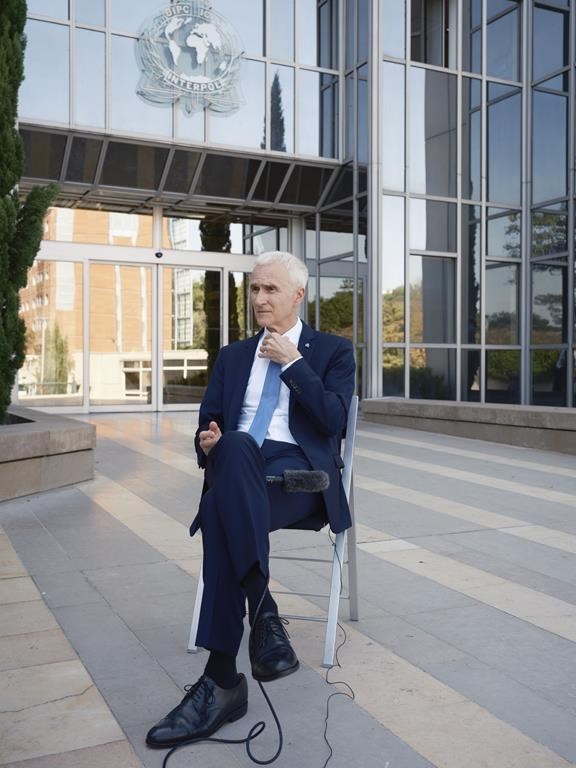
Critics, even those who praise Stock’s tenure as one of a new openness for Interpol, say that’s exactly the problem. They accuse many countries, notably Russia and China, of abusing the red notice system, which flags people deemed fugitives to law enforcement worldwide and is one of Interpol’s most important tools.
“The red notices, the diffusions, all those sensitive instruments that on the one hand allow thousands of criminals being arrested all over the world every single year — almost every day we have these success stories — but on the other hand, making sure that these instruments are not used or even abused or misused for any political purposes, military purposes,” Stock told the AP.
Dissidents, minorities, and sometimes asylum-seekers get wrongly detained. In at least one case during Stock’s tenure, a Chinese Uyghur was detained in Morocco before his red notice was cancelled and remains at risk of extradition to China. Interpol is named in an American federal lawsuit filed in July by an Egyptian-American activist who was detained in the United Arab Emirates for what police told him was a red notice in November 2022.
Stock says cases like that are getting rarer under a review system he put in place in 2016, and now “inappropriate” notices and diffusions account for just 5% of the overall total. He said if Interpol didn’t exist, it would have to be created to handle modern transnational crime, a growing list which includes online child sex abuse, cyberattacks, environmental trafficking, human trafficking and terrorism.
Those crimes, according to Interpol specialists, are essentially on the rise at a much faster clip than Interpol’s budget. And for Interpol, and the man who describes himself as an “international public servant” at its helm, success is measured the quantity and integrity of information transmitted.
Ben Keith, a human rights lawyer, said he has dozens of cases of people contesting spurious diffusions and red notices since 2016, about half of them from China. Stock said 95% of new red notices are non-controversial and that the system is effective. He would not name countries that abuse the system but insisted they were sanctioned internally by Interpol.
“The whole problem with Interpol is everything is opaque,” Keith said.
Interpol’s predecessor organization, the International Criminal Police Commission, was founded on Sept. 7, 1923, in Vienna, Austria. During World War II, the organization moved to Paris and ultimately to the French city of Lyon, where it remains.
Its last several years have been difficult ones.
Meng Hongwei, a former Chinese police official who became Interpol’s president in 2016, was detained during a work trip to Beijing in 2018 and accused of corruption in what appeared to be a Communist Party purge. His wife, who has since received asylum in France, remains livid that Interpol’s first communication on Meng’s disappearance was an announcement that he had resigned, effective immediately.
In January 2020, a court announced he’d been sentenced to 13 years and six months in prison on charges of accepting more than $2 million in bribes.
In 2021, Interpol elected as president Maj. Gen. Ahmed Naser al-Raisi, who as inspector general at the United Arab Emirates’ interior ministry was accused by human rights groups of involvement in torture and arbitrary detentions in the UAE.
Stock has no control over the selection of president, which is a more ceremonial position than that of secretary-general. On Tuesday he described the allegations against al-Raisi as “an issue between the parties involved” and similarly described Meng’s detention as an internal Chinese legal affair.
He acknowledged that Russia’s war in Ukraine has complicated matters even further but doesn’t dwell on it.
“Our operational work continues,” he said. “Global conflicts, a difficult situation, might have some impact on our work, but overall, the statistics are quite clear. We have more data in our databases than ever.”
Going forward, he hopes for still more. Cybercrime and evidence of the global market for child sex abuse make up a growing portion of Interpol’s caseload. Both have special units dedicated to them, because the crimes cross borders swiftly and invisibly.
And he sees no solution that does not involve law enforcement expanding the use of artificial intelligence and biometric data.
“We need to use artificial intelligence. There is no other way for law enforcement,” Stock said. “The criminals are already using it. We also have to use that.”
That could raise new ethical issues.
“Interpol is bound by its own rules to assume that everything a member government submits is legitimate,” said Ted Bromund, a senior research fellow at The Heritage Foundation who has served as an expert witness in cases involving problematic red notices.
Stock acknowledged as much.
“We are not policing our member countries,” he said. “What they are doing on a national level, how they apply their rules, how they use biometrics, how they use, in the future, artificial intelligence is up to the member countries, not up to Interpol.”