

Facing Beijing’s threats, Taiwan president says peace ‘only option’ to resolve political differences
Advertisement
Read this article for free:
or
Already have an account? Log in here »
To continue reading, please subscribe:

Digital Subscription
One year of digital access for only $205*
- Enjoy unlimited reading on winnipegfreepress.com
- Read the E-Edition, our digital replica newspaper
- Access News Break, our award-winning app
- Play interactive puzzles
*First annual payment billed as $205.00 + GST for one year. This annual subscription will automatically renew at $233.00 + GST every 52 weeks (10% off the regular annual price of $259.35). Offer available to new and qualified returning subscribers only. Cancel any time.
To continue reading, please subscribe:
Add Free Press access to your Brandon Sun subscription for only an additional
$1 for the first 4 weeks*
- Enjoy unlimited reading on winnipegfreepress.com
- Read the E-Edition, our digital replica newspaper
- Access News Break, our award-winning app
- Play interactive puzzles
*Your next Brandon Sun subscription payment will increase by $1.00 and you will be charged $17.95 plus GST for four weeks. After four weeks, your payment will increase to $24.95 plus GST every four weeks.
Read unlimited articles for free today:
or
Already have an account? Log in here »
Hey there, time traveller!
This article was published 10/10/2023 (1087 days ago), so information in it may no longer be current.
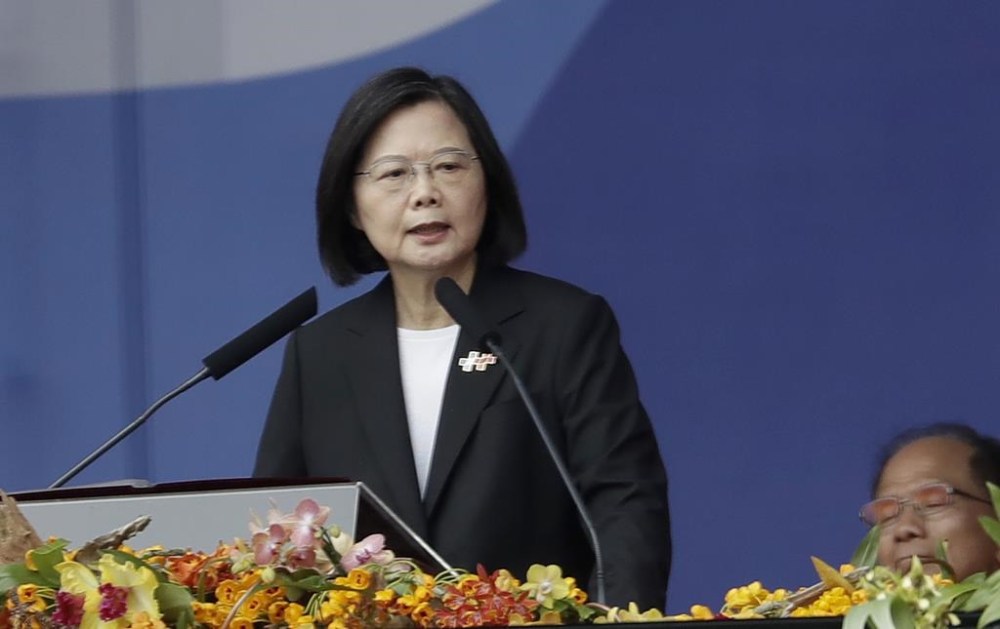
TAIPEI, Taiwan (AP) — Peace between Taiwan and China is the “only option,” Taiwanese President Tsai Ing-wen said Tuesday, while strongly asserting the self-governing island’s defenses against Beijing’s threats to invade.
Tsai said in a National Day address that the international community views stability in the Taiwan Strait as an “indispensable component of global security and prosperity.”
China claims Taiwan as its own territory and has been increasingly sending ships and warplanes across the Taiwan Strait in an effort to intimidate the population of 23 million, who strongly favor the status-quo of de-facto independence.
Tsai’s Democratic Progressive Party will seek to maintain power in elections next year against the Nationalists, who officially support unification between the sides that divided amid civil war in 1949.
“Let me reiterate that peace is the only option across the Taiwan Strait,” said Tsai, who will step down after two terms in office. “Maintaining the status quo, as the largest common denominator for all sides, is the critical key to ensuring peace.”
“Neither side can unilaterally change the status quo. Differences across the strait must be resolved peacefully,” Tsai said.
Tsai also referred to Taiwan’s recent launch of a home-built submarine as a major breakthrough in efforts to re-energize the domestic arms industry,
“We took a big step forward in our national defense self-sufficiency and further enhanced the asymmetric capabilities of our military,” she said.
The ceremonies with marching bands from Taiwan, Japan and the U.S. also underscored Taiwan’s split personality as a self-governing democracy whose national symbols and state institutions were founded on mainland China after the Manchu Qing dynasty was overthrown in 1911. The Chinese Nationalist Party under Chiang Kai-shek moved the government to Taiwan in 1949 following the takeover of mainland China by the Communist Party under Mao Zedong following a yearslong bloody civil war.
Now in the opposition, the Nationalists continue to support China’s goal of eventual unification between the sides. Former president and party leader Ma Ying-jeou and other Nationalist politicians boycotted this year’s ceremonies because the government used the term “Taiwan” rather than the official name of the Republic of China in English references to the occasion.
China cut off most communications with Tsai’s government shortly after she took office in 2016. Vice President William Lai is favored to win the presidential election, potentially laying the groundwork for further tensions between the sides, which retain close economic and cultural ties despite the massive gap between Beijing’s authoritarian one-party system and Taiwan’s robust democracy.