

Migrants flounder in Colombian migration point without the money to go on
Advertisement
Read this article for free:
or
Already have an account? Log in here »
To continue reading, please subscribe:

Digital Subscription
One year of digital access for only $205*
- Enjoy unlimited reading on winnipegfreepress.com
- Read the E-Edition, our digital replica newspaper
- Access News Break, our award-winning app
- Play interactive puzzles
*First annual payment billed as $205.00 + GST for one year. This annual subscription will automatically renew at $233.00 + GST every 52 weeks (10% off the regular annual price of $259.35). Offer available to new and qualified returning subscribers only. Cancel any time.
To continue reading, please subscribe:
Add Free Press access to your Brandon Sun subscription for only an additional
$1 for the first 4 weeks*
- Enjoy unlimited reading on winnipegfreepress.com
- Read the E-Edition, our digital replica newspaper
- Access News Break, our award-winning app
- Play interactive puzzles
*Your next Brandon Sun subscription payment will increase by $1.00 and you will be charged $17.95 plus GST for four weeks. After four weeks, your payment will increase to $24.95 plus GST every four weeks.
Read unlimited articles for free today:
or
Already have an account? Log in here »
Hey there, time traveller!
This article was published 12/10/2023 (1097 days ago), so information in it may no longer be current.
NECOCLI, Colombia (AP) — For Venezuelan Jennifer Serrano, $1,000 is a fortune beyond reach. Without it, she has no hope of continuing with her three children and husband on the long road to the U.S., which first means crossing the dangerous Darien Gap jungle.
She has to gather the money in Colombian pesos because the devalued bolivars of her native Venezuela don’t add up.
Her children — aged 9, 8 and 5 — are constantly throwing up, sick with diarrhea and the flu from living in plastic tents on the beach of Necocli, a coastal Colombian town near the Darien jungle that forms the natural border between Colombia and Panama.
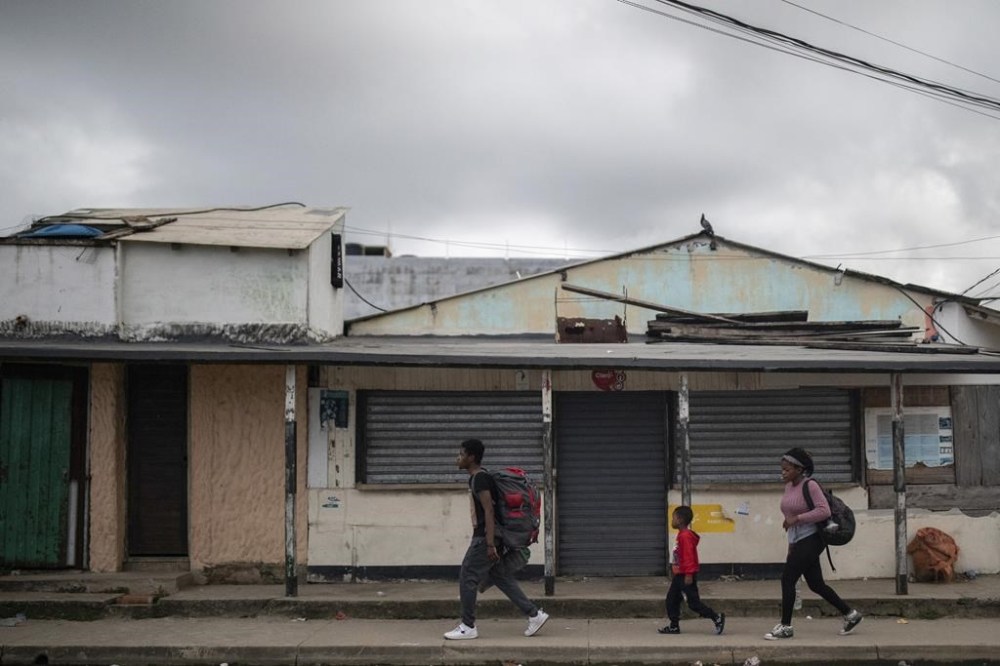
They arrived two months ago and for now see little chance of leaving.
“We didn’t know it would be so expensive. They had told me it would cost 160,000 pesos ($37) to travel through the Darien and we brought no more than 400,000 pesos ($93) and that’s gone to food and the children have gotten ill,” said Serrano, 29.
Her situation isn’t unique in Necocli. It is common to see migrants selling basic necessities like food and water or asking for help from any new faces they see arriving to gather money to continue on the route north.
The town’s local economy has shifted, now revolving around the migrants who have been arriving for several years.
Those hanging around no longer number in the thousands, as in 2021 after Haiti’s earthquake. Now there are just dozens, but they are stuck, most of them Venezuelans and a few from Asia and from other Latin American countries.
It’s common for houses to rent rooms by the day and for people on the streets to sell survival equipment for the jungle — rubber boots, water purification tablets, raincoats, plastic bags, water.
Sitting in a plastic chair on the town’s main street, Carolina García, 25, breastfeeds her 2-year-old daughter while offering water, soft drinks or cigarettes for less than a dollar in a town where more migrants than tourists pass through.
“This gives us something to eat, and we’re investing and we’re saving money to immigrate,” said García, who came to Necocli with her daughter and partner a month ago from Barinas, a city in west-central Venezuela.
Aníbal Gaviria, the governor of Colombia’s Antioquia state, has been warning for weeks about the situation in Necocli and in nearby towns like Turbo and Mutata, where other migrants are also stranded for lack of money.
Migration has become a profitable business in the area. Self-styled “guides” charge each person $350 for boat passage to Acandi, where they enter the Colombian jungle and climb to the “flag hill,” where the most dangerous, Panamanian section of the route begins.
For about $700, migrants can take another route, where the guides promise to avoid the jungle entirely and go by sea to Panama. However, boats can be wrecked on the open sea, or stopped by authorities.
In 2021, a boat leaving Necocli for the San Blas archipelago in Panama was wrecked with some 30 people on board. Three of them died and an 8-month-old baby was reported missing.
Migrants face robbery, extortion, rape and death along the jungle route plagued by “coyotes.” Police in the Uraba region, where Necocli is, say 54 people have been arrested this year for smuggling migrants.
So far in 2023, more than 400,000 migrants have crossed the Darien jungle, 60% of them Venezuelans, Panama’s national migration agency says. Ecuadorian, Haitian, Chinese and Colombian migrants have been the next most numerous, followed by dozens of other nationalities. The once impenetrable jungle has become an organized and profitable migration highway.
The dollar charges for continuing on from Necocli, which change over time, are well known to migrants. Serrano, from Venezuela, counted the money she didn’t have in her pocket as she watched a boat untie from Necocli’s dock, with migrants carrying bags covered in plastic to protect them from rain and the rivers that must be crossed in the jungle.
Serrano, her husband and their children do not have bags suitable for the jungle. They have only a tent, and wash their clothes with water from a public tank for migrants before drying them in the sun on the dock.
Living in these conditions has made her rethink whether to continue. She also fears making it through the jungle only to be deported from the U.S. back to Venezuela under a new directive from Biden administration.
“I’ve talked to my mom and I start crying. I tell her I can’t take this anymore,” Serrano said, her voice breaking. “We want to go back, get to Pasto,” a city in west Colombia, “where my husband has a brother. We have asked for help, but we have not found any.”