

Australia looks for new ways to lift Indigenous living standards after referendum loss
Advertisement
Read this article for free:
or
Already have an account? Log in here »
To continue reading, please subscribe:

Digital Subscription
One year of digital access for only $205*
- Enjoy unlimited reading on winnipegfreepress.com
- Read the E-Edition, our digital replica newspaper
- Access News Break, our award-winning app
- Play interactive puzzles
*First annual payment billed as $205.00 + GST for one year. This annual subscription will automatically renew at $233.00 + GST every 52 weeks (10% off the regular annual price of $259.35). Offer available to new and qualified returning subscribers only. Cancel any time.
To continue reading, please subscribe:
Add Free Press access to your Brandon Sun subscription for only an additional
$1 for the first 4 weeks*
- Enjoy unlimited reading on winnipegfreepress.com
- Read the E-Edition, our digital replica newspaper
- Access News Break, our award-winning app
- Play interactive puzzles
*Your next Brandon Sun subscription payment will increase by $1.00 and you will be charged $17.95 plus GST for four weeks. After four weeks, your payment will increase to $24.95 plus GST every four weeks.
Read unlimited articles for free today:
or
Already have an account? Log in here »
Hey there, time traveller!
This article was published 14/10/2023 (1092 days ago), so information in it may no longer be current.
CANBERRA, Australia (AP) — Australia will look for new ways to lift Indigenous living standards after voters soundly rejected a proposal to create a new advocacy committee, the deputy prime minister said on Sunday.
Every state and mainland territory apart from Australian Capital Territory voted against a proposal to enshrine in the constitution an Indigenous Voice to Parliament to advocate on behalf of the nation’s most disadvantaged ethnic minority.
Deputy Prime Minister Richard Marles said his government remained committed to improving Indigenous welfare to close the eight-year gap in average life expectancies between Indigenous Australians and the wider community.
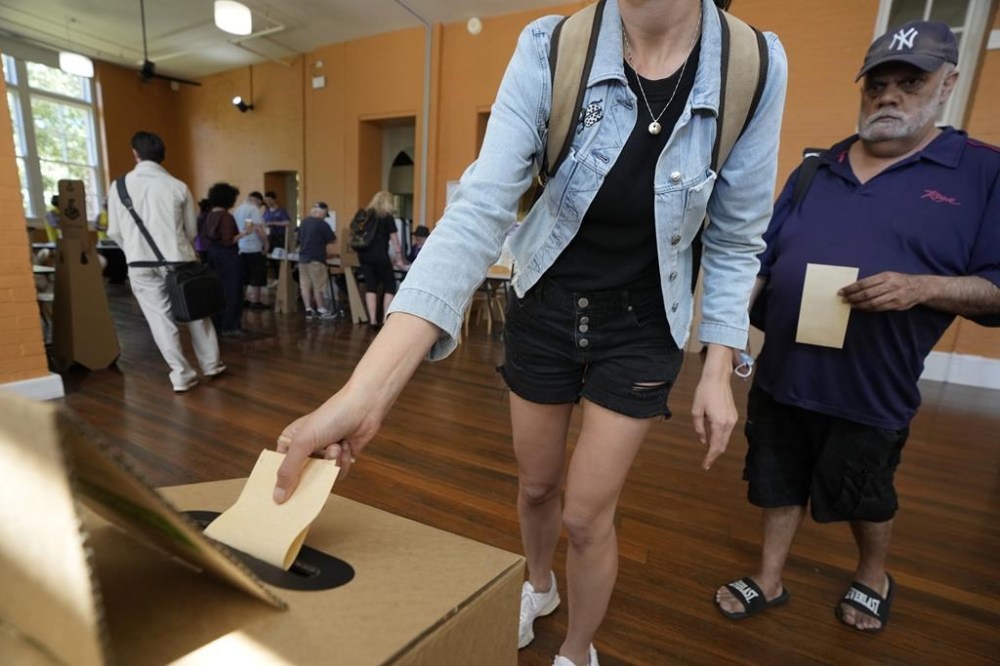
“In terms of exactly what the precise steps forward are from here is a matter that we need to take some time to work through and I think people can understand that,” Marles told Australian Broadcasting Corp.
“Coming out of this referendum there is a greater call for action on closing the gap,” Marles added.
Indigenous Voice campaigners were flying Aboriginal flags at half-staff across Australia on Sunday as a mark of their disappointment.
Proponents had hoped that the Voice’s advice would lead to better government service delivery and improved outcomes for Indigenous people.
Accounting for only 3.8% of the population, Indigenous Australians have a suicide rate twice that of the national average, are more likely to be incarcerated than other Australians and suffer from diseases in the remote Outback that have been eradicated from other wealthy countries.
Latest counting on Sunday found more than 60% of voters had opposed the Voice. There was majority support for the Voice in Outback polling booths in the Northern Territory. That part of the country has Australia’s highest proportion of Aboriginal residents and the result suggests the Voice was popular among Indigenous Australians.
Many Voice supporters accused opposition lawmakers of spreading misinformation and disinformation about the Voice.
Marcia Langton, an Indigenous academic who helped draft the Voice proposal, said opposition leader Peter Dutton through his “no” campaign had “cemented racism into the body politic.”
“The nation has been poisoned. There is no fix for this terrible outcome,” Langton wrote in The Saturday Paper.
Dutton accused Prime Minister Anthony Albanese of dividing Australians by holding the referendum.
“This is the referendum that Australia did not need to have. The proposal and the process should have been designed to unite Australians, not to divide us,” Dutton said.
Albanese blamed Dutton’s campaigning against the measure for the failure. No referendum has ever succeeded without support of the major parties.
“When you do the hard things, when you aim high, sometimes you fall short,” Albanese said after conceding defeat.
Minister for Indigenous Australians Linda Burney, who is Aboriginal, told Indigenous people that the recent months of referendum campaign had been “tough.”
“But be proud of who you are. Be proud of your identity,” a tearful Burney said after conceding the referendum had been rejected.
“Be proud of the 65,000 years of history and culture that you are a part of. And your rightful place in this country. We will carry on and we’ll move forward and we will thrive,” she added.
It is the second time that Australians have rejected a referendum that would have included recognition of Indigenous people in the constitution.
When a referendum was last held in 1999, Australians rejected adding a preamble to the constitution — an introduction that carried only symbolic and no legal significance — acknowledging that Indigenous Australians had inhabited the country “since time immemorial” and were “honored for their ancient and continuing cultures.”
Australians have now rejected 37 referendums since the constitution took effect 122 years ago. Only eight have succeeded and none since 1977.