

Fijian leader hopes Australian submarines powered by US nuclear technology will enhance peace
Advertisement
Read this article for free:
or
Already have an account? Log in here »
To continue reading, please subscribe:

Digital Subscription
One year of digital access for only $205*
- Enjoy unlimited reading on winnipegfreepress.com
- Read the E-Edition, our digital replica newspaper
- Access News Break, our award-winning app
- Play interactive puzzles
*First annual payment billed as $205.00 + GST for one year. This annual subscription will automatically renew at $233.00 + GST every 52 weeks (10% off the regular annual price of $259.35). Offer available to new and qualified returning subscribers only. Cancel any time.
To continue reading, please subscribe:
Add Free Press access to your Brandon Sun subscription for only an additional
$1 for the first 4 weeks*
- Enjoy unlimited reading on winnipegfreepress.com
- Read the E-Edition, our digital replica newspaper
- Access News Break, our award-winning app
- Play interactive puzzles
*Your next Brandon Sun subscription payment will increase by $1.00 and you will be charged $17.95 plus GST for four weeks. After four weeks, your payment will increase to $24.95 plus GST every four weeks.
Read unlimited articles for free today:
or
Already have an account? Log in here »
Hey there, time traveller!
This article was published 17/10/2023 (1041 days ago), so information in it may no longer be current.
CANBERRA, Australia (AP) — Fiji’s prime minister said Tuesday he hopes Australia’s acquisition of a fleet of submarines powered by U.S. nuclear technology will enhance peace in the Pacific region but stopped short of endorsing the increased military cooperation with the United States.
Prime Minister Sitiveni Rabuka said he will discuss with Australian Prime Minister Anthony Albanese on Wednesday how a “zone of peace” could be established in the vast expanse of the Pacific Ocean, including the two countries plus 16 other island nations that make up the Pacific Islands Forum bloc.
Increased Chinese and U.S. military engagement is adding to tensions in the region.
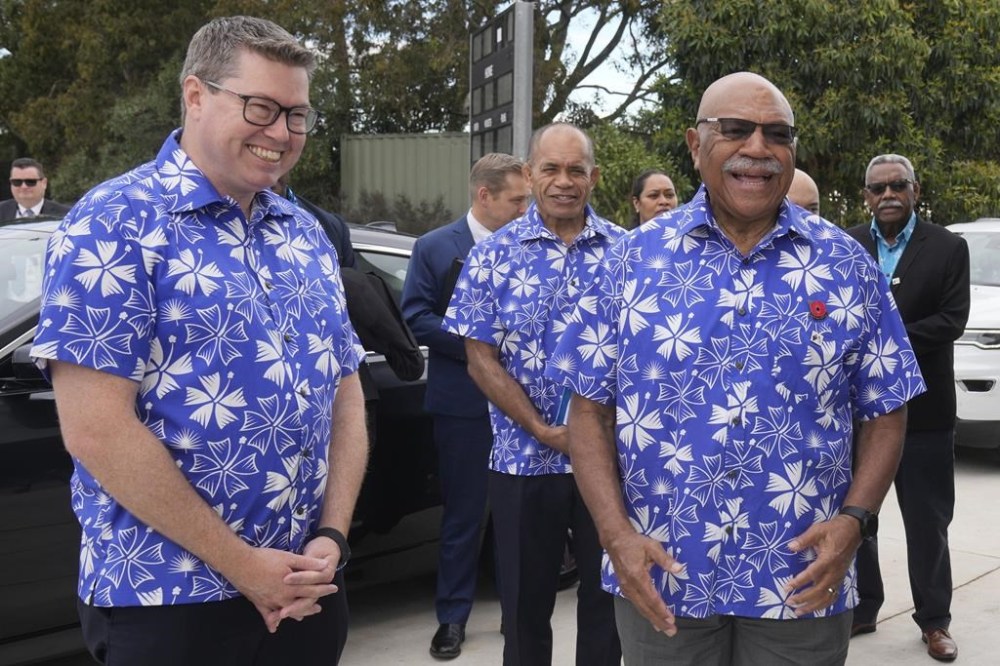
Questioned during an address to the Lowy Institute foreign policy think tank in Canberra, Rabuka said his government had not backed the signing of a three-way agreement involving the United States and Britain to provide nuclear-powered submarines to Australia.
Rabuka said Albanese gave him one day’s notice that the so-called AUKUS agreement would be signed in San Diego in March.
“I was not part of the planning. I’m in no position to try to stop it. This is a tripartite strategic project,” Rabuka said.
“All I can do is hope that this project will assist the concept of the zone of peace in the Pacific,” he said.
Rabuka said he will propose that the Pacific Islands Forum endorse his zone of peace proposal at a meeting in the Cook Islands in November.
The proposal could include nations refraining from actions that jeopardize regional order and stability while respecting neighbors’ sovereignty and territorial integrity, he said.
Australia and the United States have stepped up their diplomatic engagement with the South Pacific after China struck a security pact with Solomons Islands last year that raised fears of a Chinese naval base being established in the region.
Under the AUKUS agreement, Australia will buy three Virginia-class submarines from the United States and build five new AUKUS-class submarines in cooperation with Britain in response to China’s growing influence in the region.