

France’s Macron seeks international support for his proposal to build a coalition against Hamas
Advertisement
Read this article for free:
or
Already have an account? Log in here »
To continue reading, please subscribe:
Monthly Digital Subscription
$1 per week for 24 weeks*
- Enjoy unlimited reading on winnipegfreepress.com
- Read the E-Edition, our digital replica newspaper
- Access News Break, our award-winning app
- Play interactive puzzles
*Billed as $4.00 plus GST every four weeks. After 24 weeks, price increases to the regular rate of $19.95 plus GST every four weeks. Offer available to new and qualified returning subscribers only. Cancel any time.
Monthly Digital Subscription
$4.99/week*
- Enjoy unlimited reading on winnipegfreepress.com
- Read the E-Edition, our digital replica newspaper
- Access News Break, our award-winning app
- Play interactive puzzles
*Billed as $19.95 plus GST every four weeks. Cancel any time.
To continue reading, please subscribe:
Add Free Press access to your Brandon Sun subscription for only an additional
$1 for the first 4 weeks*
*Your next subscription payment will increase by $1.00 and you will be charged $16.99 plus GST for four weeks. After four weeks, your payment will increase to $23.99 plus GST every four weeks.
Read unlimited articles for free today:
or
Already have an account? Log in here »
Hey there, time traveller!
This article was published 25/10/2023 (899 days ago), so information in it may no longer be current.
PARIS (AP) — French President Emmanuel Macron sought to promote — with little success so far — the creation of an international coalition to fight the armed Palestinian group Hamas, during a two-day trip to the Middle East that started in Israel.
Leaders he met with in Israel, the West Bank, Jordan and Egypt didn’t publicly address the issue.
The first response to the devastating Israel-Hamas war is “the fight against terrorism,” Macron said Wednesday after his meeting with Egyptian President Abdel Fattah el-Sissi.
“The right response is to cooperate, to draw lessons from the international coalition against the Islamic State group” that intervened in Iraq and Syria, he added.
Macron first made the proposal Tuesday after his meeting with Israel Prime Minister Benjamin Netanyahu, mentioning the idea of a “regional and international coalition” against the Hamas group that rules the Gaza Strip.
Netanyahu did not specifically comment on the French offer.
The French presidency later said the proposal was not about sending troops on the ground, but that it could rather involve sharing intelligence and combating the financing of terrorism.
It will “be up to our partners, and Israel in particular, to express their needs,” the French presidency said.
U.S. officials said they are aware of Macron’s proposal and that it has been a subject of informal discussion within the administration and with other countries.
However, the officials said it has not reached the point of serious consideration mainly because there doesn’t yet appear to be any Arab interest in creating such a force.
The U.S. believes Arab buy-in and actual participation — as there was with the anti-IS coalition — would be essential to the success of any multi-national operation, according to the officials who, spoke on condition of anonymity to discuss internal deliberations.
The U.S. State Department designated Hamas a terrorist group in 1997. The European Union and other Western countries also consider it a terrorist organization.
Over the years, Hamas has received backing from Arab countries, such as Qatar and Turkey. Recently, it has moved closer to Iran and its allies.
During his meeting with Macron, King Abdullah II of Jordan called for the international community to pressure Israel to stop its attacks on Gaza, according to the Jordanian royal court.
El-Sissi didn’t address the coalition issue during his joint declaration with Macron.
Earlier on Wednesday, the Egyptian president cautioned his forces against any direct involvement in the war between Hamas and Israel, speaking in front of dozens of tanks in the port city of Suez.
“My message to the army and people is not to make your military power make you rush into wrong decisions,” el-Sissi said.
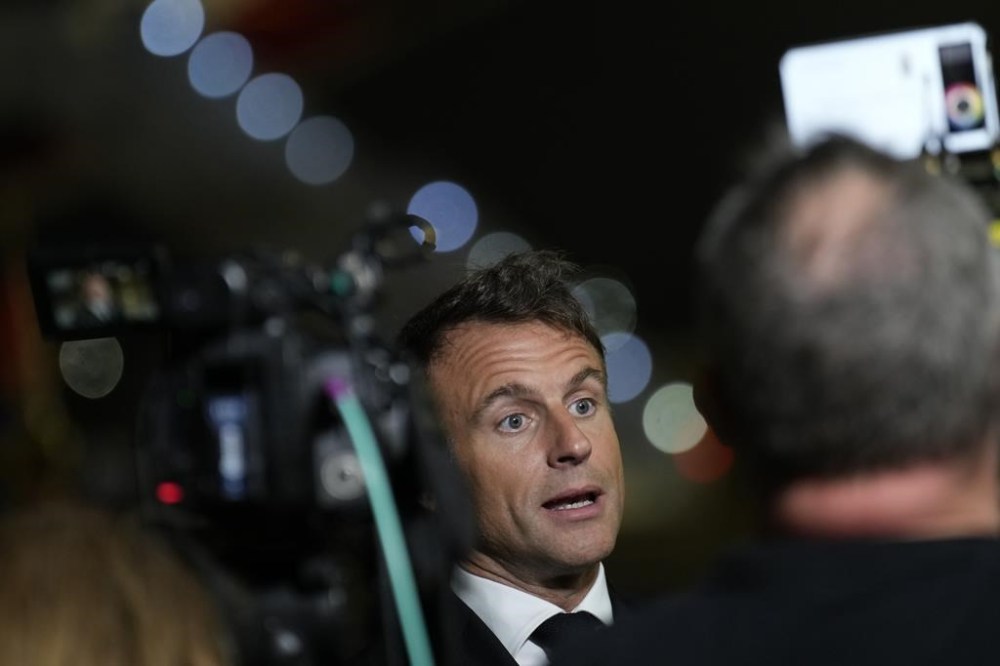
Before leaving Cairo on Wednesday evening, Macron told French reporters he felt both Egypt and Jordan’s leaders were “very worried” about their region and said they were willing to work with “some discretion especially regarding top security issues, which I want to respect.”
Macron’s office said talks with France’s partners will continue in the coming days, as the French president is to take part in a European summit starting Thursday in Brussels.
Macron had said he would travel to Israel only to be “useful,” as his visit came after those of U.S. President Joe Biden, British Prime Minister Rishi Sunak, German Chancellor Olaf Scholz, Italy’s Giorgia Meloni and The Netherlands’ Mark Rutte.
Héloïse Fayet, a Middle-East researcher at the French Institute of International Relations, told French radio RFI “one wonders what France and other countries … could bring to Israel, which is one of the most advanced countries in the fight against terrorism.”
___
Associated Press writers Jack Jeffery and Sam Magdy in Cairo and Matthew Lee in Washington contributed to the story.