

Migration experts say Italy’s deal to have Albania house asylum-seekers violates international law
Advertisement
Read this article for free:
or
Already have an account? Log in here »
To continue reading, please subscribe:

Digital Subscription
One year of digital access for only $205*
- Enjoy unlimited reading on winnipegfreepress.com
- Read the E-Edition, our digital replica newspaper
- Access News Break, our award-winning app
- Play interactive puzzles
*First annual payment billed as $205.00 + GST for one year. This annual subscription will automatically renew at $233.00 + GST every 52 weeks (10% off the regular annual price of $259.35). Offer available to new and qualified returning subscribers only. Cancel any time.
To continue reading, please subscribe:
Add Free Press access to your Brandon Sun subscription for only an additional
$1 for the first 4 weeks*
- Enjoy unlimited reading on winnipegfreepress.com
- Read the E-Edition, our digital replica newspaper
- Access News Break, our award-winning app
- Play interactive puzzles
*Your next Brandon Sun subscription payment will increase by $1.00 and you will be charged $17.95 plus GST for four weeks. After four weeks, your payment will increase to $24.95 plus GST every four weeks.
Read unlimited articles for free today:
or
Already have an account? Log in here »
Hey there, time traveller!
This article was published 07/11/2023 (1063 days ago), so information in it may no longer be current.
MILAN (AP) — Migration experts and activists on Tuesday panned an agreement between Italy and Albania that would direct thousands of migrants to the Balkan nation while their asylum applications are under review, arguing the deal would potentially violate international law.
The exact workings of the arrangement announced Monday as Albania’s leader visited Rome were still unknown, but it recalls a similar move by Denmark to locate asylum-seekers in Africa that was later put on hold.
The European Commission, which supervises the application of European Union laws, suggested the deal could prove problematic if Italy sends migrants found in the EU’s territorial waters to a non-EU nation. It left a door open for the agreement if it is applied to migrants who were picked up in international waters.
“If you have a vessel within the territory, then you have the asylum procedure recommendation, which applies,’’ European Commission spokesperson Anitta Hipper told reporters in Brussels. That means anyone picked up in waters belonging to an EU member nation would have the right to request asylum there — and not to be transferred to a third country.
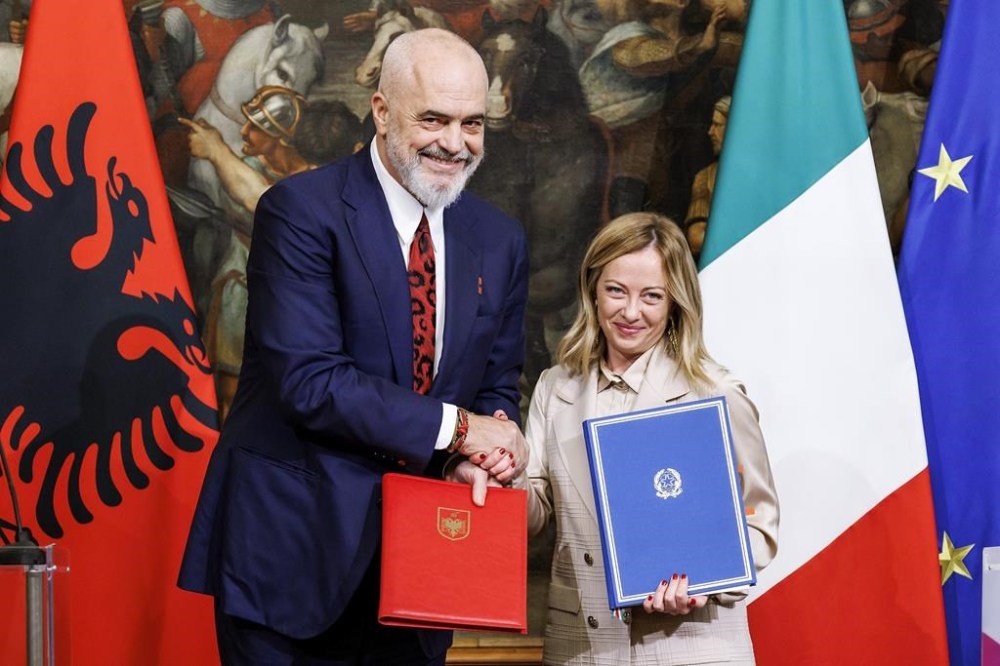
Italian Premier Giorgia Meloni and Albanian Prime Minister Edi Rama said that under their initiative, aspiring EU member Albania agreed to temporarily shelter thousands of migrants with asylum petitions in Italy.
If Italy rejects the asylum bids, Albania would then deport the migrants. Children and pregnant women will be excluded from the plan.
Italy will pay for the construction of two centers in Albania, which can hold up to 3,000 migrants at a time, as many as 36,000 a year. Albania would also provide security at the centers, which would be under Italian jurisdiction.
Danish lawmakers two years ago voted in favor of establishing a refugee reception center in another country, likely one in Africa. But the idea was criticized as undermining international cooperation and has since been put on hold.
Experts see both legal and jurisdictional issues with Italy’s proposal. For example, migrants rescued at sea by an Italian vessel “are technically on Italian territory,’’ said Giorgia Linardi, a spokesperson for the non-profit maritime rescue group Sea-watch.
If those people then “disembark in Albania, we are already talking about an act that goes against international law, but also against European law,” she said.
The accord as outlined so far also fails to address how Albania would manage to deport migrants back to their countries of origin when Italy has difficulty doing so.
“We are hugely worried, because the people who are rescued by these military ships and brought to centers in Albania risk a de facto deportation,’’ said Mattia Ferrari, an official of the charity rescue group Mediterranea Saving Humans. “The deportation risks violating international norms but that above all wounds their humanity.”

The International Rescue Committee said that the deal “strikes a further blow to the principle of EU solidarity” and emphasized that closing borders would not stem migration.
“It’s time to shift the focus from walls to welcome,” Susanna Zanfrini, the IRC’s Italy country director, said. ”Closing borders will not deter people from seeking safety; instead it may force them to under take even more perilous routes.”
___
Thomas reported from Rome. Lorne Cook contributed from Brussels.
___
Follow AP’s global migration coverage at https://apnews.com/hub/migration