

Dutch official says Geert Wilders and 3 other party leaders should discuss forming a new coalition
Advertisement
Read this article for free:
or
Already have an account? Log in here »
To continue reading, please subscribe:

Digital Subscription
One year of digital access for only $205*
- Enjoy unlimited reading on winnipegfreepress.com
- Read the E-Edition, our digital replica newspaper
- Access News Break, our award-winning app
- Play interactive puzzles
*First annual payment billed as $205.00 + GST for one year. This annual subscription will automatically renew at $233.00 + GST every 52 weeks (10% off the regular annual price of $259.35). Offer available to new and qualified returning subscribers only. Cancel any time.
To continue reading, please subscribe:
Add Free Press access to your Brandon Sun subscription for only an additional
$1 for the first 4 weeks*
- Enjoy unlimited reading on winnipegfreepress.com
- Read the E-Edition, our digital replica newspaper
- Access News Break, our award-winning app
- Play interactive puzzles
*Your next Brandon Sun subscription payment will increase by $1.00 and you will be charged $17.95 plus GST for four weeks. After four weeks, your payment will increase to $24.95 plus GST every four weeks.
Read unlimited articles for free today:
or
Already have an account? Log in here »
Hey there, time traveller!
This article was published 11/12/2023 (1012 days ago), so information in it may no longer be current.
THE HAGUE, Netherlands (AP) — The far-right party led by Dutch election winner Geert Wilders should open negotiations with three other parties on forming a new government, the official appointed to investigate possible coalitions said Monday.
Ronald Plasterk, who acted as the “scout” in two weeks of preliminary talks, said it was “too early” to say how long it might take to form a new government amid significant policy differences between some of the parties.
Wilders’ Party for Freedom won 37 seats in the 150-seat lower house of the Dutch parliament in the Nov. 22 election, making it the biggest party and putting the veteran anti-Islam lawmaker in pole position to form the next ruling coalition.
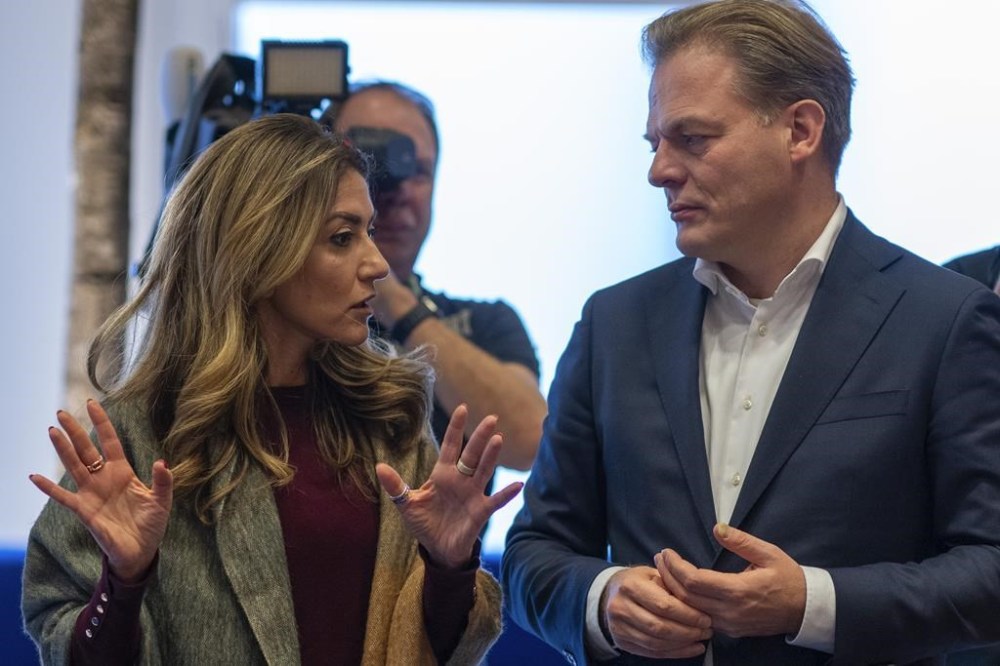
Plasterk said that Wilders should hold coalition talks with New Social Contract, a reformist party formed over the summer that won 20 seats, the People’s Party for Freedom and Democracy, or VVD, which was led by outgoing Prime Minister Mark Rutte, and the Farmer Citizen Movement, or BBB.
Together, the four parties have 88 seats — a comfortable majority in the lower house. However, the four parties don’t have a majority in the Dutch senate.
Coalition talks will be tricky as the parties have significant ideological differences to bridge if they are to form the next Cabinet. Wilders is likely to have to convince potential partners that he will shelve some of his controversial policies — including his call for a ban on mosques, Islamic schools and the Quran — which breach the freedom of religion that is enshrined in the Dutch Constitution.
Plasterk’s report acknowledged the issue and said that the first stage of the coalition talks should be to investigate if the leaders can agree “on a common baseline for guaranteeing the constitution, fundamental rights and the democratic rule of law.”
The aim of the initial round of negotiations that should be completed by the end of January is to “establish if there is a basis for a next round (of talks) about a form of political cooperation that would form the foundation of a stable Cabinet,” Plasterk said in his report.
That could be a minority administration without the VVD. The party’s new leader, Dilan Yeşilgöz-Zegerius, said shortly after the election that she wouldn’t join a coalition led by Wilders, but would be prepared to support it from parliament.
Plasterk said that if the leaders can agree on the constitutional issues, then they should move on to discuss whether there is “a real perspective” for cooperation on key election issues, including migration, good governance, foreign policy, climate, pollution and agriculture.
Plasterk held several days of talks with political leaders before writing his report. The recently installed lower house of parliament will debate his findings on Wednesday and will then likely appoint an “informer” to lead the coalition talks over the next two months and report back to parliament by early February.
Coalition talks after the last Dutch general election were the longest ever in the Netherlands at nearly nine months.