

Plaintiffs in a Georgia redistricting case are asking a judge to reject new Republican-proposed maps
Advertisement
Read this article for free:
or
Already have an account? Log in here »
To continue reading, please subscribe:
Digital Subscription
One year of digital access for only $1.44 a week*
- Enjoy unlimited reading on winnipegfreepress.com
- Read the E-Edition, our digital replica newspaper
- Access News Break, our award-winning app
- Play interactive puzzles
*Billed as $5.77 plus GST every four weeks. After 52 weeks, price increases to the regular rate of $19.95 plus GST every four weeks. Offer available to new and qualified returning subscribers only. Cancel any time.
To continue reading, please subscribe:
Add Free Press access to your Brandon Sun subscription for only an additional
$1 for the first 4 weeks*
- Enjoy unlimited reading on winnipegfreepress.com
- Read the E-Edition, our digital replica newspaper
- Access News Break, our award-winning app
- Play interactive puzzles
*Your next Brandon Sun subscription payment will increase by $1.00 and you will be charged $17.95 plus GST for four weeks. After four weeks, your payment will increase to $24.95 plus GST every four weeks.
Read unlimited articles for free today:
or
Already have an account? Log in here »
Hey there, time traveller!
This article was published 12/12/2023 (1040 days ago), so information in it may no longer be current.
ATLANTA (AP) — The people who sued to overturn Georgia’s congressional and state legislative districts on Tuesday attacked plans that Republican state lawmakers claim cure illegal dilution of Black votes while preserving GOP power, calling them a “mockery” of federal law and a “total failure of compliance.”
The three sets of plaintiffs in the case filed briefs with the federal judge who ruled in their favor in October, urging him to reject Georgia’s proposed maps and draw new voting districts himself in time for 2024’s legislative and congressional elections.
U.S. District Judge Steve Jones has scheduled a Dec. 20 hearing on whether he should accept the plans. The state is supposed to file its defense of the plans next week.
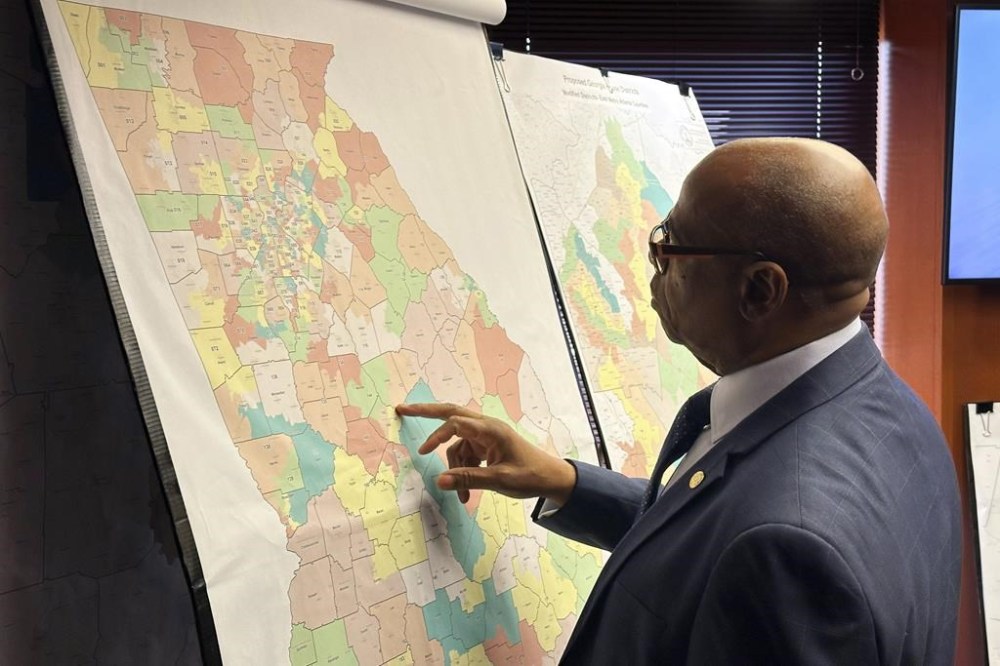
Republican legislative leaders repeatedly said during a special legislative session that ended last week that their goal was to comply with Jones’ directive. He told lawmakers they had to draw an additional Black-majority congressional district, two additional Black-majority state Senate districts and five additional Black-majority state House districts.
But the plaintiffs on Tuesday, echoing arguments made by Democrats during the session, said the Republican maps don’t do enough to remedy problems in the particular districts that Jones found to be illegal under Section 2 of the Voting Rights Act, which prohibits dilution of Black votes.
“The inescapable conclusion is that the proposed plans do not come close to following the court’s order,” wrote lawyers for one of two sets of plaintiffs challenging state legislative districts. “Putting eyes on the 2023 proposed plans confirms the total failure of compliance.”
The plaintiffs also argue the plans illegally dismantle other districts that let Black and other minority voters elect their chosen candidates. Most importantly, Republicans wiped out a current district in suburban Atlanta represented by Democratic U.S. Rep. Lucy McBath at the same time they were drawing a new Black-majority district in Fulton, Douglas, Cobb and Fayette counties.
“The General Assembly’s attempt to minimize and zero out minority voting opportunity in a purported ‘remedy’ to the state’s Section 2 violation is precisely the sort of gamesmanship Section 2 was meant to stamp out,” wrote lawyers for plaintiffs challenging the state’s congressional map.
The plaintiffs say that the state’s plans should be rejected because they shuffled around too many Black voters from outside the districts Jones had ruled were illegal, instead of providing enough opportunities to Black voters in those areas to elect new representatives. They argue the shifts may increase the statewide number of majority-Black districts, but don’t provide opportunity for the particular voters Jones has ruled are being harmed, particularly on the southern and western sides of metropolitan Atlanta.
Lawyers for the people challenging the congressional district argued that McBath’s current district in Gwinnett and Fulton counties is protected under the Voting Rights Act as a minority opportunity district, even if it isn’t majority Black. They argue that a coalition of Black, Hispanic and Asian voters in McBath’s 7th District vote cohesively as a group, and that they are opposed by white voters who vote cohesively against nonwhite-preferred candidates.
The state has signaled that it plans to argue that only districts made up of one nonwhite group, like Black voters, are legally protected, saying that earlier claims of protection for a coalition district rest on indefensible legal foundations. But the plaintiffs argue that protections for minority districts are law in Georgia, writing that “so long as different minority communities cohesively support the same candidates, they can be counted together.”
All of the plaintiffs pointed to plans drawn by their own experts that they said would be less disruptive and produce fairer results for Black voters. If Jones rejects the state plans, he could accept those proposed plans, or appoint a special master to draw plans.
“The General Assembly’s purported remedy makes a mockery of that process, the court’s ruling and the Voting Rights Act, and reflects the state’s continued refusal to afford minority voters equal opportunity to participate in electoral politics,” wrote those challenging congressional districts.