

Bulgaria dismantles a Soviet army monument that has dominated the Sofia skyline since 1954
Advertisement
Read this article for free:
or
Already have an account? Log in here »
To continue reading, please subscribe:
Digital Subscription
One year of digital access for only $1.44 a week*
- Enjoy unlimited reading on winnipegfreepress.com
- Read the E-Edition, our digital replica newspaper
- Access News Break, our award-winning app
- Play interactive puzzles
*Billed as $5.77 plus GST every four weeks. After 52 weeks, price increases to the regular rate of $19.95 plus GST every four weeks. Offer available to new and qualified returning subscribers only. Cancel any time.
To continue reading, please subscribe:
Add Free Press access to your Brandon Sun subscription for only an additional
$1 for the first 4 weeks*
- Enjoy unlimited reading on winnipegfreepress.com
- Read the E-Edition, our digital replica newspaper
- Access News Break, our award-winning app
- Play interactive puzzles
*Your next Brandon Sun subscription payment will increase by $1.00 and you will be charged $17.95 plus GST for four weeks. After four weeks, your payment will increase to $24.95 plus GST every four weeks.
Read unlimited articles for free today:
or
Already have an account? Log in here »
Hey there, time traveller!
This article was published 13/12/2023 (1040 days ago), so information in it may no longer be current.
SOFIA, Bulgaria (AP) — Bulgaria on Wednesday began dismantling a monument to the army of the Soviet Union that dominated the skyline of the capital, Sofia, for nearly 70 years and was widely seen as a symbol of Russia’s influence in the Balkan country.
The monument was erected in 1954 to commemorate the 10th anniversary of Soviet forces entering Bulgaria, which had been allied with Nazi Germany in World War II. Their arrival in 1944 marked the beginning of 45 years of hardline Communist rule.
Following the collapse of communism in 1989, the local council in Sofia voted to remove the monument, but successive governments shied away from taking the final step.
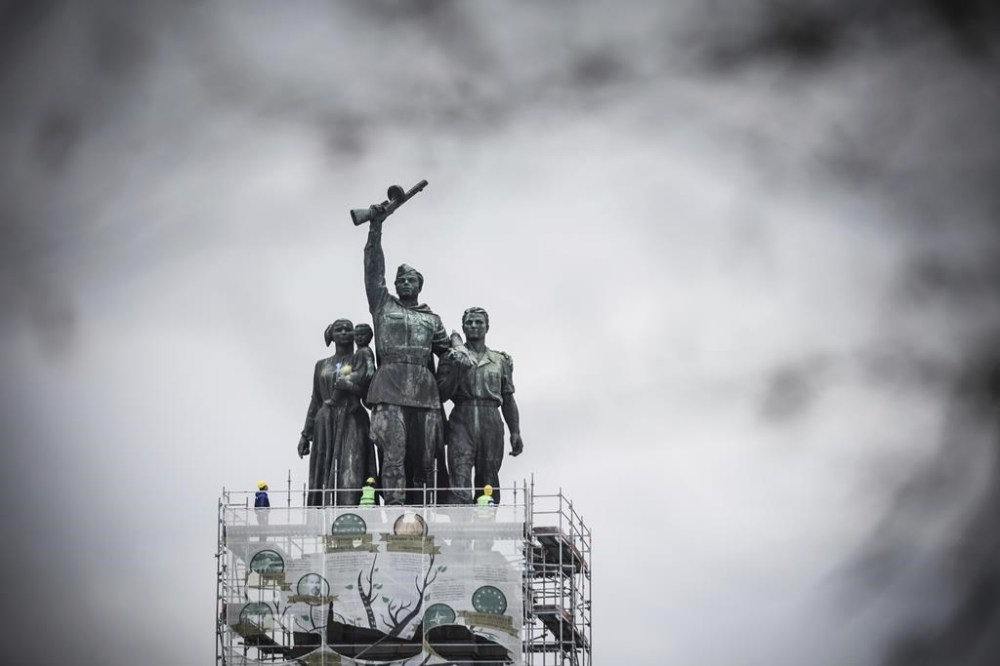
On Wednesday, following years of heated debate, workers began to dismantle the 45-meter-high (147-foot) installation, removing the figures at the top, which showed a Soviet soldier holding an automatic rifle, a woman with her child, and a worker.
Vyara Todeva, regional governor of Sofia, said that for 70 years the monument was never restored and serious cracks had appeared in the figures.
It will take at least a month to dismantle the whole monument, she said, and the figures will likely be taken to the Museum of Socialist Art in Sofia.
In recent years, the monument has become a focal point of the deep divisions between pro-Russian and pro-Western groups in Bulgaria’s society. It has often been covered with paint by unknown artists, lately with the blue and yellow colors of the Ukrainian flag.
A heavy police presence was dispatched to secure the area around the monument and to prevent possible clashes between those in favor and those opposed to its removal.
The Socialists and other pro-Moscow groups in Parliament who fiercely oppose the monument’s removal said they would seek to organize a referendum on its fate. They said “similar anti-fascist monuments are standing untouched in many European cities”.
They received strong backing from Moscow, where the spokeswoman for the Russian Foreign Ministry, Maria Zakharova, said the dismantling would worsen relations with Bulgaria.
“We consider the destruction of the monument to our common past as another hostile step by official Sofia, which aggravates the already deadlocked situation in bilateral relations. Bulgaria once again chooses the wrong side of history,” she is quoted as saying.