

Lawsuits target Maine referendum aimed at curbing foreign influence in local elections
Advertisement
Read this article for free:
or
Already have an account? Log in here »
To continue reading, please subscribe:

Digital Subscription
One year of digital access for only $205*
- Enjoy unlimited reading on winnipegfreepress.com
- Read the E-Edition, our digital replica newspaper
- Access News Break, our award-winning app
- Play interactive puzzles
*First annual payment billed as $205.00 + GST for one year. This annual subscription will automatically renew at $233.00 + GST every 52 weeks (10% off the regular annual price of $259.35). Offer available to new and qualified returning subscribers only. Cancel any time.
To continue reading, please subscribe:
Add Free Press access to your Brandon Sun subscription for only an additional
$1 for the first 4 weeks*
- Enjoy unlimited reading on winnipegfreepress.com
- Read the E-Edition, our digital replica newspaper
- Access News Break, our award-winning app
- Play interactive puzzles
*Your next Brandon Sun subscription payment will increase by $1.00 and you will be charged $17.95 plus GST for four weeks. After four weeks, your payment will increase to $24.95 plus GST every four weeks.
Read unlimited articles for free today:
or
Already have an account? Log in here »
Hey there, time traveller!
This article was published 13/12/2023 (1008 days ago), so information in it may no longer be current.
PORTLAND, Maine (AP) — Two utilities and two media organizations are suing over a referendum in Maine that closed a loophole in federal election law that allows foreign entities to spend on local and state ballot measures.
The three lawsuits take aim at the proposal overwhelmingly approved by voters on Nov. 7 to address foreign election influence.
The Maine Association of Broadcasters and Maine Press Association contend the new law that goes into effect on Jan. 5. imposes a censorship mandate on news outlets, which are going to be required to police campaign ads to ensure there’s no foreign government influence.
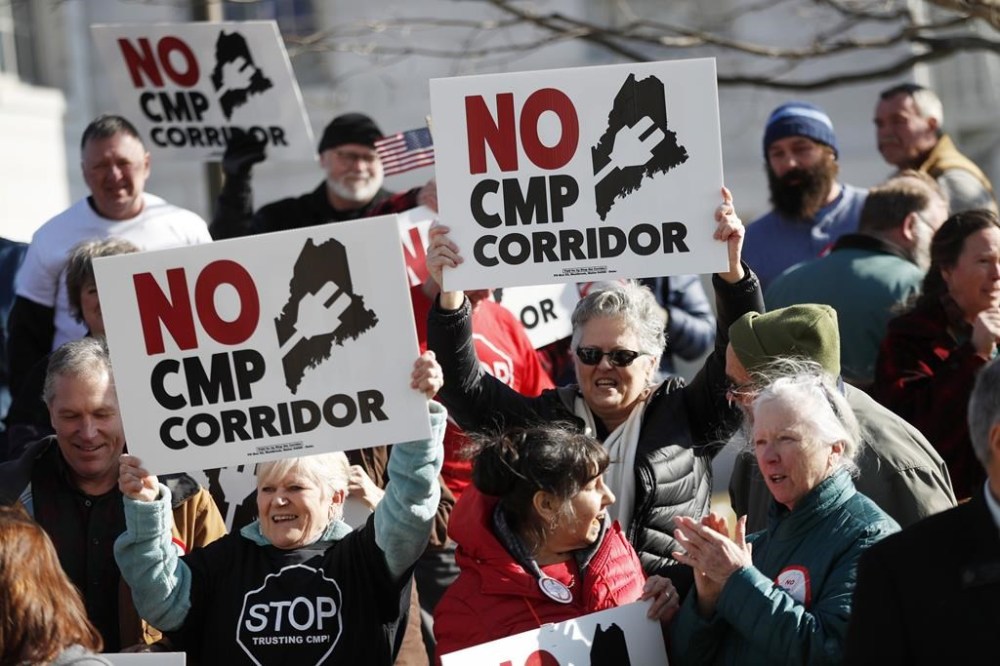
Meanwhile, Central Maine Power and Versant, the state’s largest electric utilities, each filed separate lawsuits raising constitutional challenges about the law they claim violates their free speech and engagement on issues affecting them.
The Maine Commission on Government Ethics and Campaign Practices is studying the federal complaints filed Tuesday and consulting with the attorney general, Jonathan Wayne, the commission’s executive director, said Wednesday in an email.
The attorney general’s office declined comment.
State Sen. Rick Bennett, who led the effort to put the proposal on the ballot, said Wednesday that the federal lawsuits “speak volumes about what a deplorable state that we’ve reached in our politics.”
“This is something that Mainers are united about. Their voices are being drowned out by these people who are bringing the lawsuits,” he said.
The referendum, which was approved by a margin of 86% to 14%, bans foreign governments — or companies with 5% or more foreign government ownership — from donating to state referendum races.
The proposal was put on the ballot after a Canadian government-owned utility, Hydro Quebec, spent $22 million to influence a project on which it’s a partner in Maine. That hydropower corridor project ultimately moved forward after legal challenges.
But there are implications for Maine-based utilities, too.
The law applies to Versant because it’s owned by the city of Calgary in Alberta, Canada, but it’s unclear whether it applies to Central Maine Power.
CMP’s corporate parent Avangrid narrowly missed the cutoff by one measure. It is owned by a Spanish company — not the government — and minority shareholders owned by foreign governments, Norway’s central bank Norges Bank and the government-owned Qatar Investment Authority, together fall below the 5% threshold.
But Qatar Investment Authority also has an 8.7% minority stake in Spain-based Iberdrola, which owns Avangrid and CMP, and that’s part of the reason CMP argues that the law is unconstitutionally vague.
Before the Maine proposal went to voters it was vetoed by Democratic Gov. Janet Mills, who cited concerns about the proposal’s constitutionality and said its broadness could silence “legitimate voices, including Maine-based businesses.”
Federal election law currently bans foreign entities from spending on candidate elections, but allows such donations for local and state ballot measures.
Maine was the 10th state to close the election spending loophole when the referendum was approved, according to the Campaign Legal Center in Washington, D.C., which supported the Maine proposal.
Bennett, R-Oxford, said other states’ laws have withstood legal challenges even though some of their definitions are more stringent than Maine’s.
He also said it was ironic that Versant would sue for a right that it doesn’t have in Canada. “In Canada it is completely illegal for any foreign individual or corporation to be involved in any of their elections,” he said.
___
Follow David Sharp on X, the platform formerly known as Twitter, @David_Sharp_AP