

Palestinian poll shows a rise in Hamas support and close to 90% wanting US-backed Abbas to resign
Advertisement
Read this article for free:
or
Already have an account? Log in here »
To continue reading, please subscribe:

Digital Subscription
One year of digital access for only $205*
- Enjoy unlimited reading on winnipegfreepress.com
- Read the E-Edition, our digital replica newspaper
- Access News Break, our award-winning app
- Play interactive puzzles
*First annual payment billed as $205.00 + GST for one year. This annual subscription will automatically renew at $233.00 + GST every 52 weeks (10% off the regular annual price of $259.35). Offer available to new and qualified returning subscribers only. Cancel any time.
To continue reading, please subscribe:
Add Free Press access to your Brandon Sun subscription for only an additional
$1 for the first 4 weeks*
- Enjoy unlimited reading on winnipegfreepress.com
- Read the E-Edition, our digital replica newspaper
- Access News Break, our award-winning app
- Play interactive puzzles
*Your next Brandon Sun subscription payment will increase by $1.00 and you will be charged $17.95 plus GST for four weeks. After four weeks, your payment will increase to $24.95 plus GST every four weeks.
Read unlimited articles for free today:
or
Already have an account? Log in here »
Hey there, time traveller!
This article was published 13/12/2023 (1013 days ago), so information in it may no longer be current.
RAMALLAH, West Bank (AP) — A wartime opinion poll among Palestinians published Wednesday shows a rise in support for Hamas, which appears to have ticked up even in the devastated Gaza Strip, and an overwhelming rejection of Western-backed President Mahmoud Abbas, with nearly 90% saying he must resign.
The findings by a Palestinian pollster signal more difficulties ahead for the Biden administration’s postwar vision for Gaza and raise questions about Israel’s stated goal of ending Hamas’ military and governing capabilities.
Washington has called for the West Bank-based Palestinian Authority, currently led by Abbas, to eventually assume control of Gaza and run both territories as a precursor to statehood. U.S. officials have said the PA must be revitalized, without letting on whether this would mean leadership changes.
The PA administers pockets of the Israeli-occupied West Bank and has governed Gaza until a takeover by Hamas militants in 2007. The Palestinians have not held elections since 2006 when Hamas won a parliamentary majority.
Prime Minister Benjamin Netanyahu, who leads the most right-wing government in Israel’s history, has soundly rejected any role for the PA in Gaza and insists Israel must retain open-ended security control there.
Arab allies of the U.S. have said they’ll only get involved in post-war reconstruction if there’s a credible push toward a two-state solution, which is unlikely under the Netanyahu government dominated by opponents of Palestinian statehood.
With survey results indicating a further erosion of the PA’s legitimacy, at a time when there’s no apparent path toward restarting credible negotiations on Palestinian statehood, the default for postwar Gaza is an open-ended Israeli occupation, pollster Khalil Shikaki said.
“Israel is stuck in Gaza,” Shikaki told The Associated Press ahead of the publication of the survey’s results by his Palestinian Center for Policy and Survey Research, or PSR. “Maybe the next (Israeli) government will decide that Netanyahu is not right in putting all these conditions, and they might decide to withdraw unilaterally from Gaza. But the default for the future, for Israel and Gaza, is that Israel is in full reoccupation of Gaza.”
The survey was conducted from from Nov. 22 to Dec. 2 among 1,231 people in the West Bank and Gaza and had an error margin of 4 percentage points. In Gaza, poll workers conducted 481 in-person interviews during a weeklong cease-fire that ended Dec. 1.
Shikaki, who runs regular polls, said the error margin was one percentage point higher than usual because of disruptions caused by the mass displacement of residents during the Israel-Hamas war. Hundreds of thousands of Palestinians had fled fierce fighting in northern Gaza, and poll workers only conducted interviews in central and southern Gaza, including among displaced people, because they could not reach the north during the cease-fire.
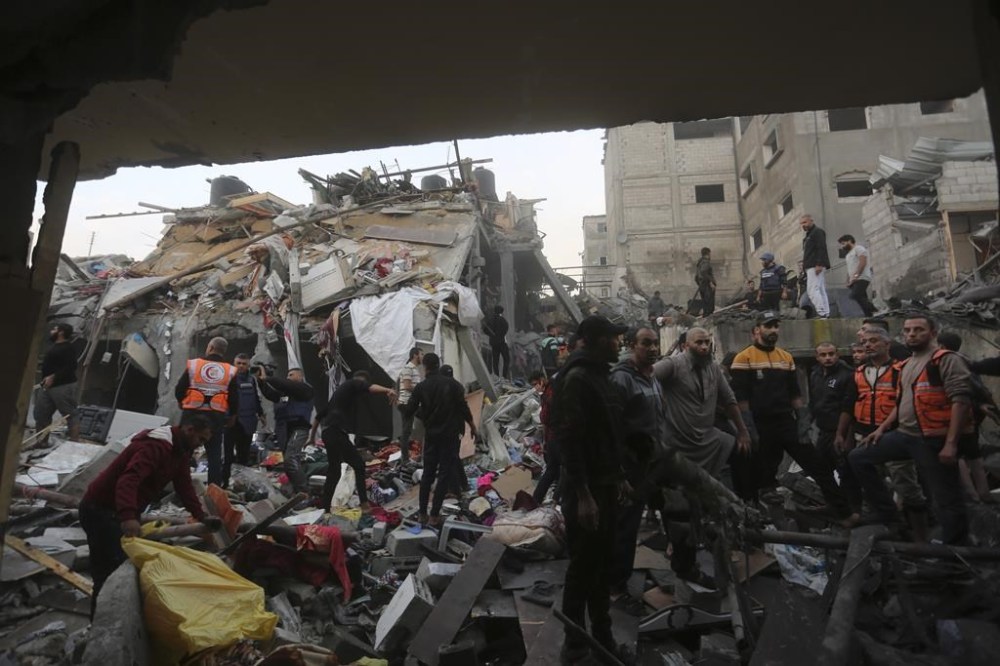
The survey provided insights about Palestinian views of the Oct. 7 attack by Hamas and other Gaza militants in southern Israel, in which about 1,200 people were killed, most of them civilians. More than 18,400 Palestinians, about two-thirds of them women and children, have been killed in a sustained bombing campaign and ground offensive in Gaza during Israel’s subsequent war on Hamas, now in its third month.
Shikaki said that Gaza residents are more critical of Hamas than those in the West Bank, that support for Hamas typically spikes during periods of armed conflict before leveling out, and that even now most Palestinians do not back the militant group.
Despite the devastation, 57% of respondents in Gaza and 82% in the West Bank believe Hamas was correct in launching the October attack, the poll indicated. A large majority believed Hamas’ claims that it acted to defend a major Islamic shrine in Jerusalem against Jewish extremists and win the release of Palestinian prisoners. Only 10% said they believed Hamas has committed war crimes, with a large majority saying they did not see videos showing the militants committing atrocities.
The videos, along with extensive eyewitness testimony and reporting by The Associated Press and others, show that hundreds of civilians in southern Israel, including women and children, were abducted or gunned down inside their own homes. There have also been accounts of widespread sexual violence.
But while Israeli media coverage has focused intensely on the attack in the weeks since, Palestinian outlets have been fixated on the war in Gaza and the suffering of civilians there.
Shikaki said the most popular politician remains Marwan Barghouti, a prominent figure in Abbas’ Fatah movement who is serving multiple life terms in an Israeli prison for his alleged role in several deadly attacks during the second Palestinian uprising two decades ago. In a two-way presidential race, Ismail Haniyeh, the exiled political leader of Hamas, would trounce Abbas while in a three-way race, Barghouti would be ahead just slightly, the pollster said.
Overall, 88% want Abbas to resign, up by 10 percentage points from three months ago. In the West Bank, 92% called for the resignation of the octogenarian who has presided over an administration widely seen as corrupt, autocratic and ineffective.
At the same time, 44% in the West Bank said they supported Hamas, up from just 12% in September. In Gaza, the militants enjoyed 42% support, up slightly from 38% three months ago.
Shikaki said support for the PA declined further, with nearly 60% now saying it should be dissolved. In the West Bank, Abbas’ continued security coordination with Israel’s military against Hamas, his bitter political rival, is widely unpopular.
Netanyahu has attacked Abbas for years, alleging he was enabling anti-Israeli incitement in the West Bank, while at the same time permitting regular Qatari support payments to Gaza that strengthened Hamas. Critics of Netanyahu’s overall approach say it was aimed at preventing negotiations on Palestinian statehood.
The poll also signaled widespread frustration with the international community, particularly the United States, key European countries and even the United Nations, which has pushed for an immediate humanitarian cease-fire in Gaza.
“The level of anti-Americanism and anti-Westernism is huge among Palestinians because of the positions they have taken regarding international humanitarian law and what is happening in Gaza,” Shikaki said.
Related Articles
9 Israeli soldiers killed in Gaza City ambush in sign that Hamas resistance is still strong

Advertisement Advertise With Us
Advertisement Advertise With Us