

Mexico’s president inaugurates first part of $20 billion tourist train project on Yucatan peninsula
Advertisement
Read this article for free:
or
Already have an account? Log in here »
To continue reading, please subscribe:

Digital Subscription
One year of digital access for only $205*
- Enjoy unlimited reading on winnipegfreepress.com
- Read the E-Edition, our digital replica newspaper
- Access News Break, our award-winning app
- Play interactive puzzles
*First annual payment billed as $205.00 + GST for one year. This annual subscription will automatically renew at $233.00 + GST every 52 weeks (10% off the regular annual price of $259.35). Offer available to new and qualified returning subscribers only. Cancel any time.
To continue reading, please subscribe:
Add Free Press access to your Brandon Sun subscription for only an additional
$1 for the first 4 weeks*
- Enjoy unlimited reading on winnipegfreepress.com
- Read the E-Edition, our digital replica newspaper
- Access News Break, our award-winning app
- Play interactive puzzles
*Your next Brandon Sun subscription payment will increase by $1.00 and you will be charged $17.95 plus GST for four weeks. After four weeks, your payment will increase to $24.95 plus GST every four weeks.
Read unlimited articles for free today:
or
Already have an account? Log in here »
Hey there, time traveller!
This article was published 15/12/2023 (1020 days ago), so information in it may no longer be current.
MEXICO CITY (AP) — Mexico’s president on Friday inaugurated the first part of the pet project of his administration, a tourist train that runs in a rough loop around the Yucatan peninsula.
The $20 billion, 950-mile line, called the Maya Train, is meant to connect beach resorts and archaeological sites. However, it is not finished yet. Officials pledged the rest of the line would be ready by the end of February. But it was clear from the unfinished earthworks and the existence of just a single lane of a planned double-lane track, even the first section has not been completed yet.
President Andrés Manuel López Obrador opened a 290-mile (473-kilometer) stretch Friday between the colonial Gulf coast city of Campeche and the Caribbean coast resort of Cancun. That is about one-third of the entire project, and covers the least controversial stretch.
It will take about 5 1/2 hours to travel from Campeche to Cancun at an average speed of about 50 miles per hour (80 kph), though officials have promised the train will be capable of speeds of up to 75 mph (120 kph).
There will be two trains per day each way, with stops in the colonial city of Merida, the Mayan ruins at Chichen Itza and about ten other towns. Originally, officials had planned on charging separate, lower fares for Mexicans on the line, and foreign tourists would pay a higher fare.
But the only prices listed for the first runs were differentiated only by first-class and “tourist class” tickets, on sale starting Saturday, though most are sold out.
A first-class ticket on one of the two trains from Cancun to Merida each day will cost the equivalent of $68. A first-class bus ticket on the same route costs about $58, with buses leaving about every half hour.
The first train cars to set out Friday were reserved for officials, dignitaries and the press. López Obrador called it a record-setting project that will eventually link Cancun with beach towns like Playa del Carmen and Tulum, and Mayan ruins at Calakmul and Palenque.
“There are no public works projects like this in the world,” López Obrador said. “It was also done in record time.”
Layda Sansores, the governor of Campeche state, claimed “the entire peninsula is breaking out in cries of ‘Hallelujah!’”
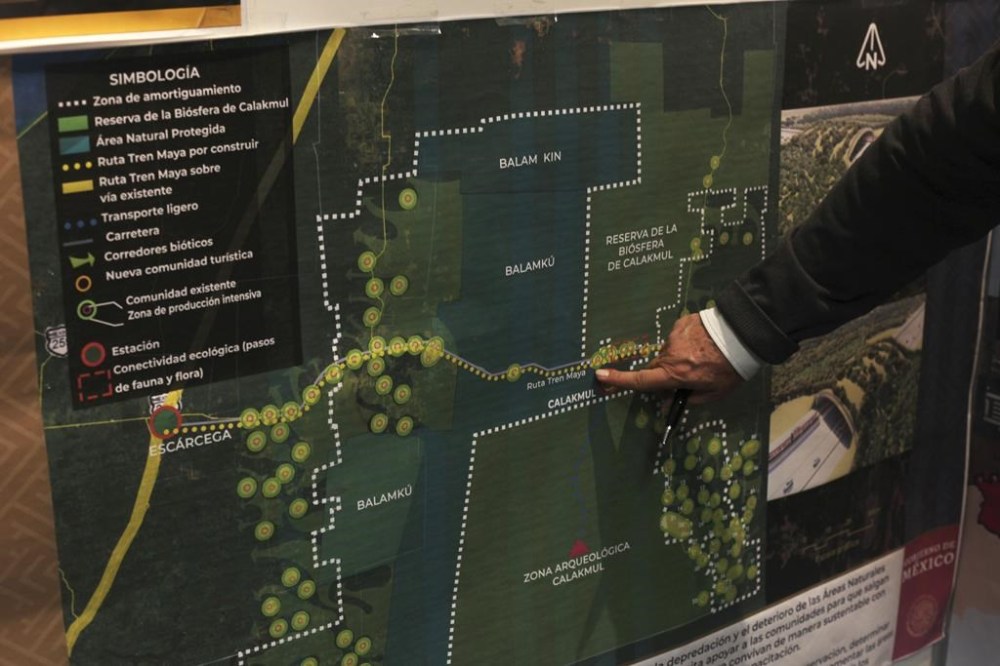
Unlike the remaining two-thirds of the Maya Train, the part of the line inaugurated Friday already had an old train line running over much of the route. Many of the still-unfinished parts were cut through the jungle and built over sensitive, relic-filled cave systems, drawing objections from environmentalists.
López Obrador has raced to finish the Maya Train project before he leaves office in September, rolling over the objections of ecologists, cave divers and archaeologists.
The train runs along the Caribbean coast and threatens extensive caves where some of the oldest human remains in North America have been discovered. Because of the region’s limestone geology, it is riddled with caves that carry most of its water.
While officials have touted the train as utilitarian transport for freight and local residents, its only real source of significant income would be tourists. However, given its frequent stops, unwieldy route and lack of feasibility studies, it is unclear how many tourists will actually want to buy tickets.
“The train won’t help residents get to work or school, and besides, it’s very expensive,” SELVAME, a coalition of groups opposing the project, said in a statement Friday. “The train runs through the jungle, filling cenotes (sinkhole lakes) and underground rivers with concrete, without any studies.”
López Obrador has tried to rush through the Maya Train project by exempting it from normal permitting, public reporting and environmental impact statements, claiming it is vital to national security.
In November 2021, López Obrador’s government issued a broad decree requiring all federal agencies to give automatic approval for any public works project the government deems to be “in the national interest” or to “involve national security.”
The train was partly built by the Mexican army and will be run by the armed forces, to whom López Obrador has entrusted more projects than any other president in at least a century.
López Obrador is known for his fascination with trains, the armed forces and state-owned companies in general. In November, he announced he will require private rail companies that mostly carry freight to offer passenger service or else have the government schedule its own trains on their tracks.
Almost no regular passenger rail service remains in Mexico following a 1995 reform that gave concessions to two private railway companies: Mexico’s Ferromex and a subsidiary of U.S. railway Kansas City Southern.
A few tourist trains run on relatively short, unconnected routes to tourist attractions like northern Mexico’s Copper Canyon and the western tequila-producing region around Jalisco.
____
Follow AP’s coverage of Latin America and the Caribbean at https://apnews.com/hub/latin-america