

Mexico’s Maya tourist train opens for partial service amid delays and cost overruns
Advertisement
Read this article for free:
or
Already have an account? Log in here »
To continue reading, please subscribe:

Digital Subscription
One year of digital access for only $205*
- Enjoy unlimited reading on winnipegfreepress.com
- Read the E-Edition, our digital replica newspaper
- Access News Break, our award-winning app
- Play interactive puzzles
*First annual payment billed as $205.00 + GST for one year. This annual subscription will automatically renew at $233.00 + GST every 52 weeks (10% off the regular annual price of $259.35). Offer available to new and qualified returning subscribers only. Cancel any time.
To continue reading, please subscribe:
Add Free Press access to your Brandon Sun subscription for only an additional
$1 for the first 4 weeks*
- Enjoy unlimited reading on winnipegfreepress.com
- Read the E-Edition, our digital replica newspaper
- Access News Break, our award-winning app
- Play interactive puzzles
*Your next Brandon Sun subscription payment will increase by $1.00 and you will be charged $17.95 plus GST for four weeks. After four weeks, your payment will increase to $24.95 plus GST every four weeks.
Read unlimited articles for free today:
or
Already have an account? Log in here »
Hey there, time traveller!
This article was published 16/12/2023 (1007 days ago), so information in it may no longer be current.
MEXICO CITY (AP) — Mexico’s Maya Train rail project opened partially to the general public Saturday, amid hours-long delays and huge cost overruns.
Passengers waiting for the twice-daily train to leave the resort of Cancun were left waiting on the platform for about five hours before being able to board. Officials apologized for the delayed and said it was due to trains being “reconfigured.”
Some passengers napped on the floor of the concrete platform. Some — many self-declared supporters of President Andrés Manuel López Obrador — cheered when the train finally appeared in Cancun.
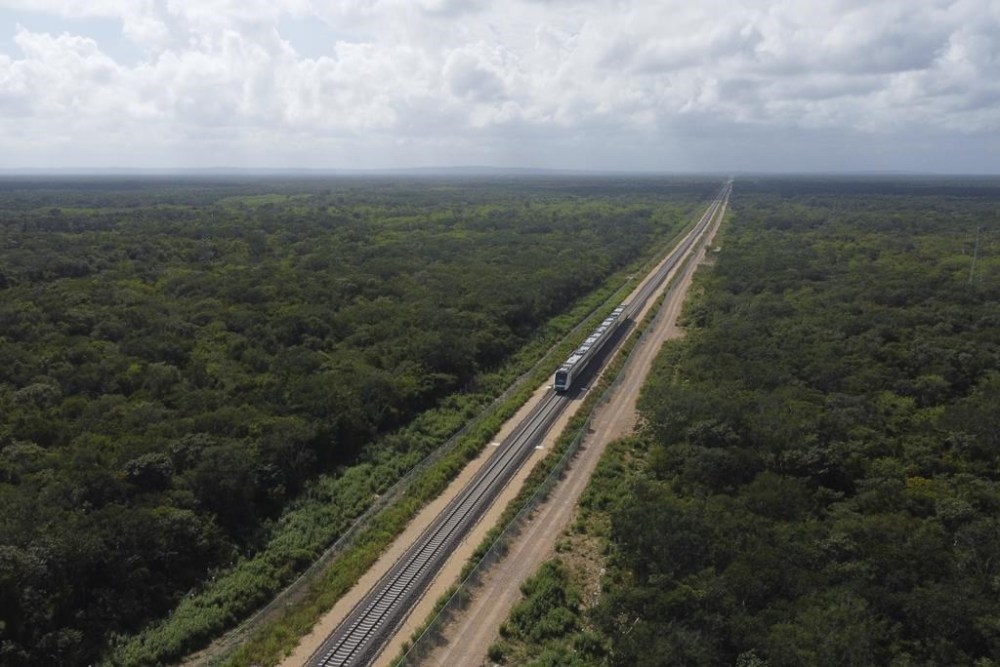
The train running in the other direction from the Gulf coast colonial city of Campeche was also delayed for hours, because only one side of the planned double rail line is finished. Officials estimated it would take about 5 1/2 hours to travel the 290 miles (473 kilometers) from Campeche to Cancun.
Meanwhile, the cost of the project has soared from original estimates of around $8.5 billion, to as much as $28 billion.
The 950-mile line, called the Maya Train, is meant to connect beach resorts and archaeological sites. However, only about one-third of it — the 290-mile (473-kilometer) stretch that President Andrés Manuel López Obrador inaugurated with dignitaries and the press Friday — has even been partly finished.
Officials pledged the rest of the line would be ready by the end of February. But even on the part López Obrador inaugurated Friday, just a single line of a planned double-line track has been finished, meaning one train has to wait on a siding while another passes.
The stretch running between Campeche and Cancun is about one-third of the entire project and covers the least controversial portion of the route, which crosses many environmentally sensitive areas.
A first-class ticket on one of the two trains from Cancun to Merida, the most popular stop, will cost the equivalent of $68. A first-class bus covers the route in about the same time and costs about $58, with buses leaving about every half hour from the city centers, rather than remote train stations on the outskirts.
That led to questions about whether the train will ever cover its operating costs, much less its construction budget.
Mexico’s army, which operates the train and built part of the railway, did not respond to a request for comment about the delays or cost overruns.
In comments Friday, López Obrador acknowledged, “Yes, things are lacking (on the train), of course,” and predicted it would take “three years, four years” for the train system to begin covering its operating costs under the best scenario.
Asked how much the construction cost of the project would be, the president said: “I don’t know … I don’t have the exact figure.”
Originally projected to cost $8.6 billion, by now $22.7 billion has been assigned to the project, and Treasury Secretary Rogelio Ramírez told local media the final cost would be around $28 billion.
Unlike the remaining two-thirds of the Maya Train, the part of the line inaugurated Friday already had an old train line running over much of the route. Many of the still-unfinished parts were cut through the jungle and built over sensitive, relic-filled cave systems, drawing objections from environmentalists.
López Obrador has raced to finish the Maya Train project before he leaves office in September, rolling over the objections of ecologists, cave divers and archaeologists.
The train runs along the Caribbean coast and threatens extensive caves where some of the oldest human remains in North America have been discovered. Because of the region’s limestone geology, it is riddled with caves that carry most of its water.
While officials have touted the train as utilitarian transport for freight and local residents, its only real source of significant income would be tourists. However, given its frequent stops, unwieldy route and lack of feasibility studies, it is unclear how many tourists will actually want to buy tickets.
“The train won’t help residents get to work or school, and besides, it’s very expensive,” SELVAME, a coalition of groups opposing the project, said in a statement Friday. “The train runs through the jungle, filling cenotes (sinkhole lakes) and underground rivers with concrete, without any studies.”
López Obrador has tried to rush through the project by exempting it from normal permitting, public reporting and environmental impact statements, claiming it is vital to national security.
In November 2021, his administration issued a broad decree requiring all federal agencies to give automatic approval for any public works project the government deems to be “in the national interest” or to “involve national security.”
____
Follow AP’s coverage of Latin America and the Caribbean at https://apnews.com/hub/latin-america