

Senate border security talks grind on as Trump invokes Nazi-era ‘blood’ rhetoric against immigrants
Advertisement
Read this article for free:
or
Already have an account? Log in here »
To continue reading, please subscribe:

Digital Subscription
One year of digital access for only $205*
- Enjoy unlimited reading on winnipegfreepress.com
- Read the E-Edition, our digital replica newspaper
- Access News Break, our award-winning app
- Play interactive puzzles
*First annual payment billed as $205.00 + GST for one year. This annual subscription will automatically renew at $233.00 + GST every 52 weeks (10% off the regular annual price of $259.35). Offer available to new and qualified returning subscribers only. Cancel any time.
To continue reading, please subscribe:
Add Free Press access to your Brandon Sun subscription for only an additional
$1 for the first 4 weeks*
- Enjoy unlimited reading on winnipegfreepress.com
- Read the E-Edition, our digital replica newspaper
- Access News Break, our award-winning app
- Play interactive puzzles
*Your next Brandon Sun subscription payment will increase by $1.00 and you will be charged $17.95 plus GST for four weeks. After four weeks, your payment will increase to $24.95 plus GST every four weeks.
Read unlimited articles for free today:
or
Already have an account? Log in here »
Hey there, time traveller!
This article was published 17/12/2023 (1012 days ago), so information in it may no longer be current.
WASHINGTON (AP) — Time slipping, White House and Senate negotiators struggled Sunday to reach a U.S. border security deal that would unlock President Joe Biden’s request for billions of dollars worth of military aid for Ukraine and other national security needs before senators leave town for the holiday recess.
The Biden administration, which is becoming more deeply involved in the talks, is facing pressure from all sides over any deal. Negotiators insist they are making progress, but a hoped-for framework did not emerge. Republican leaders signaled that without bill text, an upcoming procedural would likely fail.
The talks come as Donald Trump, the Republican presidential front-runner in 2024, delivered alarming anti-immigrant remarks about “blood” purity over the weekend, echoing Nazi slogans of World War II at a political rally.

“They’re poisoning the blood of our country,” Trump said about the record numbers of immigrants coming to the U.S. without immediate legal status.
Speaking in the early-voting state of New Hampshire, Trump, drew on words similar to Adolf Hitler’s “Mein Kampf” as the former U.S. president berated Biden’s team over the flow of migrants. “All over the world they’re pouring into our country,” Trump said.
Throughout the weekend, senators and top Biden officials, including Homeland Security Secretary Alejandro Mayorkas, have been working intently behind closed doors at the Capitol to strike a border deal, which Republicans in Congress are demanding in exchange for any help for Ukraine, Israel and other national security needs. Mayorkas arrived for more talks late Sunday afternoon.
“Everyday we get closer, not farther away,” said Sen. Chris Murphy, D-Conn., as talks wrapped up in the evening.
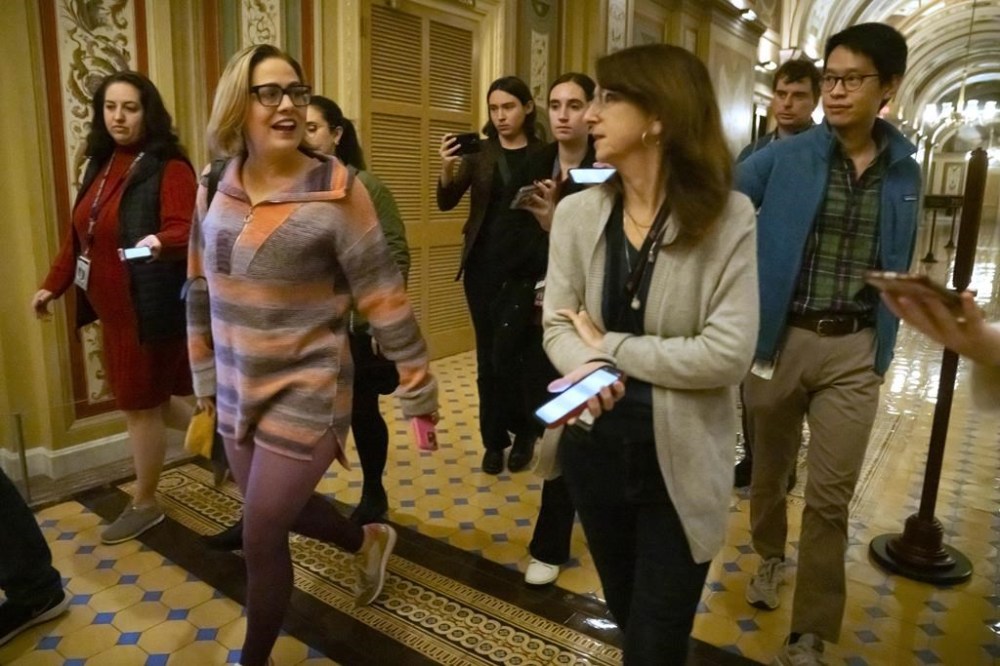
Their holiday recess postponed, Murphy and Sen. Kyrsten Sinema, the Arizona independent, acknowledged the difficulty of drafting, and securing support, for deeply complicated legislation on an issue that has vexed Congress for years. Ahead of more talks Monday, it is becoming apparent any action is unlikely before year’s end.
Republican Sen. Lindsey Graham of South Carolina said senators don’t want to be “jammed” by a last-minute compromise reached by negotiators.
“We’re not anywhere close to a deal,” Graham, whose staff has joined the talks, said Sunday on NBC’s “Meet the Press.”
Graham predicted the deliberations will go into next year. He was among 15 Republican senators who wrote to GOP leadership urging them to wait until the House returns Jan. 8 to discuss the issue.

Top GOP negotiator Sen. James Lankford of Oklahoma and Senate Republican Leader Mitch McConnell also signaled in their own letter Sunday that talks still had a ways to go. Lankford said later that the January timeline was “realistic.”
The Biden administration faces an increasingly difficult political situation as global migration is on a historic rise, and many migrants are fleeing persecution or leaving war-torn countries for the United States, with smugglers capitalizing on the situation.
The president is being berated daily by Republicans, led by Trump, as border crossings have risen to levels that make even some in Biden’s own Democratic Party concerned.
But the Biden administration, in considering revival of Trump-like policies, is drawing outrage from Democrats and immigrant advocates who say the ideas would gut the U.S. asylum system and spark fears of deportations from immigrants already living in the U.S.
The White House’s failure to fully engage Latino lawmakers in the talks until recently, or ensure a seat at the negotiating table, has led to a near revolt from leaders of the Congressional Hispanic Caucus.
“It’s unacceptable,” said Rep. Nanette Barragan, D-Calif., chair of the Hispanic Caucus, on social media. “We represent border districts & immigrant communities that will be severely impacted by extreme changes to border policy.”
Progressives in Congress are also warning the Biden administration off any severe policies that would bar immigrants a legal path to enter the country. “No backroom deal on the border without the involvement of the House, the House Hispanic Caucus, Latino senators is going to pass,” said Rep. Ro Khanna, D-Calif., on Fox News.

White House chief of staff Jeff Zients, along with Mayorkas, heard from leading Latino lawmakers during a conference call with the Hispanic Caucus on Saturday afternoon.
The senators and the White House appear to be focused on ways to limit the numbers of migrants who are eligible for asylum at the border, primarily by toughening the requirements to qualify for their cases to go forward.
The talks have also focused removing some migrants who have already been living in the U.S. without full legal status, and on ways to temporarily close the U.S.-Mexico border to some crossings if they hit a certain metric, or threshold. Arrests of migrants have topped 10,000 on some days.
There has also been discussion about limiting existing programs that have allowed groups of arrivals from certain countries to temporarily enter the U.S. while they await proceedings about their claims. Decades ago, those programs welcomed Vietnamese arrivals and others, and have since been opened to Ukrainians, Afghans and a group that includes Cubans, Nicaraguans, Venezuelans and Haitians.
Meanwhile, Biden’s massive $110 billion aid package for Ukraine, Israel and other security needs is hanging in the balance.
Ukrainian President Volodymyr Zelenskyy made a dramatic, if disappointing, visit to Washington last week to plead with Congress and the White House for access to U.S. weaponry as his country fights against Russian President Vladimir Putin’s invasion.
Many, but not all, Republicans have soured on helping Ukraine fight Russia, taking their cues from Trump. The former president praised Putin, quoting the Russian leader during Saturday’s rally while slamming the multiple investigations against him as politically motivated — including the federal indictment against Trump for conspiring to overturn the 2020 election that resulted in the Jan. 6, 2021 attack on the Capitol by a mob of Trump supporters.
Ukraine’s ambassador to the United States said Sunday she believes in “Christmas miracles” and won’t give up hope.
Of Biden’s package, some $61 billion would go toward Ukraine, about half of the money for the U.S. Defense Department to buy and replenish tanks, artillery and other weaponry sent to the war effort.
“All the eyes are on Congress now,” the envoy, Oksana Markarova, said on CBS’ “Face the Nation.”
“We can just only pray and hope that there will be resolve there, and that the deal that they will be able to reach will allow the fast decisions also on the support to Ukraine,” she said.
The House already left for the holiday recess, but Republican Speaker Mike Johnson is being kept aware of the negotiations in the Senate.