

Cherelle Parker publicly sworn in as Philadelphia’s 100th mayor
Advertisement
Read this article for free:
or
Already have an account? Log in here »
To continue reading, please subscribe:

Digital Subscription
One year of digital access for only $205*
- Enjoy unlimited reading on winnipegfreepress.com
- Read the E-Edition, our digital replica newspaper
- Access News Break, our award-winning app
- Play interactive puzzles
*First annual payment billed as $205.00 + GST for one year. This annual subscription will automatically renew at $233.00 + GST every 52 weeks (10% off the regular annual price of $259.35). Offer available to new and qualified returning subscribers only. Cancel any time.
To continue reading, please subscribe:
Add Free Press access to your Brandon Sun subscription for only an additional
$1 for the first 4 weeks*
- Enjoy unlimited reading on winnipegfreepress.com
- Read the E-Edition, our digital replica newspaper
- Access News Break, our award-winning app
- Play interactive puzzles
*Your next Brandon Sun subscription payment will increase by $1.00 and you will be charged $17.95 plus GST for four weeks. After four weeks, your payment will increase to $24.95 plus GST every four weeks.
Read unlimited articles for free today:
or
Already have an account? Log in here »
Hey there, time traveller!
This article was published 02/01/2024 (985 days ago), so information in it may no longer be current.
Cherelle Parker, who has held local and state office and first got involved in politics as a teenager, publicly swore her oath of office on Tuesday as Philadelphia’s 100th mayor, becoming the first woman to do so.
The 51-year-old Democrat with years of political experience took the helm of the nation’s sixth-largest city in a ceremony at the historic Met in Philadelphia. She succeeds term-limited Democratic Mayor Jim Kenney.
“By every statistic imaginable, I am not supposed to be standing here today,” Parker told supporters gathered for her roughly hourlong address. “I, Cherelle Parker, was a child who most people thought would never succeed. And they almost did have me thinking the same thing.”
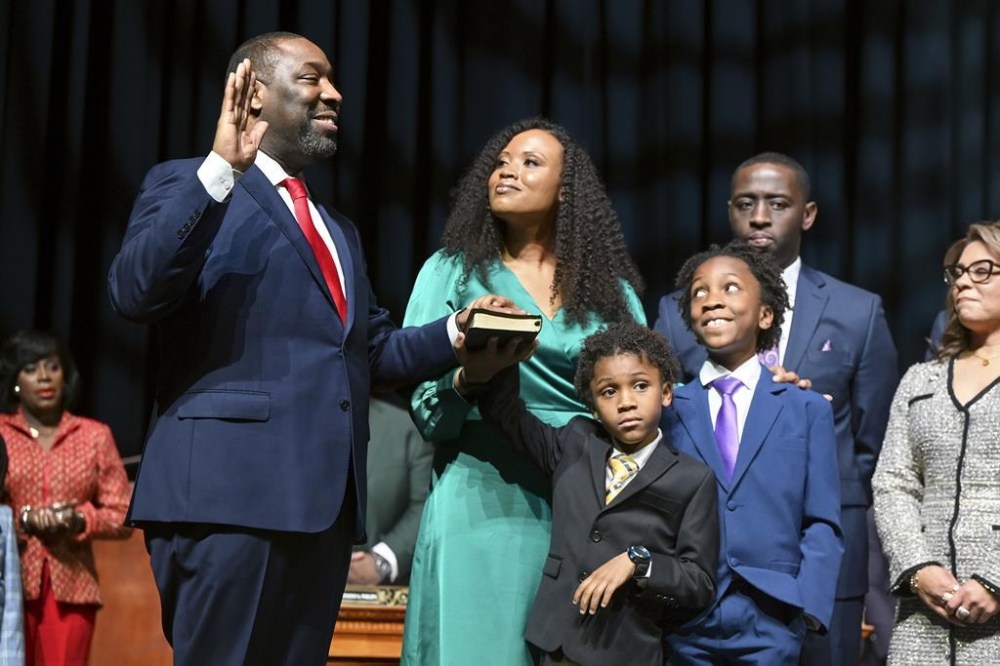
Surrounded by family, friends, former mayors and current U.S. and state legislators and officials, Parker echoed her campaign promise: to make Philadelphia the “safest, cleanest, greenest big city in the nation that will provide access to economic opportunity for all.”
Parker had emerged early in the crowded mayoral race as the only leading Black candidate, and soared to a victory in November’s election in the heavily Democratic city. Parker’s moderate message resonated with voters who are increasingly worried about public safety as well as quality-of-life issues, from faulty streetlights to potholes to trash collection. She also promised a well-trained police force that is engaged with the community along with mental health and behavioral support.
Parker served for 10 years as a state representative for northwest Philadelphia before her election to the City Council in 2015. She said she was a leader whose government experience would allow her to address gaping problems in the city.
Tucked into attendees’ seats was an action plan laying out her intentions, which Parker promised was a commitment. And to the naysayers who may cast doubt before she gets started, she asked supporters to tell them, “Don’t throw shade on my Philly shine.”
She vowed in her remarks to — in the first 100 days — announce a plan to increase the number of Philadelphia police officers on the streets, acting “as guardians, and not warriors,” she said. She also said she’d declare a public safety emergency to drive resources into neighborhoods, eyeing crime, gun violence and addiction.
Parker tapped her new police commissioner in November, who she said will tackle the city’s pressing concerns.
She promised not to shy away from tough decisions, acknowledging that she heard criticism on the campaign trail that she lacked compassion in dealing with addiction.
“We’re going to have a data-driven and research-based approach that is put together by the best law enforcement and public health professionals that we can find,” she said. “But I want you to know everyone is not going to be happy when we make these decisions.
Her administration pledged to eliminate some barriers for city jobs such as college degree requirements. She also announced intentions to keep school buildings open longer; to review the city’s Lank Bank to better understand developing city-owned property to make way for more affordable housing; reducing the red tape to do business in the city; and a new approach to solving the city’s issues with dumping, litter, abandoned cars and potholes.
“This opportunity to deliver in a meaningful way for the city of Philadelphia — not just for the next four years, but the work we do now — it should be a foundation for the future,” she said. “I’m not talking about incremental change. I’m talking about bold transformative steps, that when people walk outside of their houses, they can touch, see and feel the results of our labor. If they don’t see it, it’s on us.”
Across the state in Allegheny County, home to the state’s second-largest city of Pittsburgh, Sara Innamorato took her oath as county executive on Tuesday. Innamorato is also the first woman to serve in the role and, she joked, perhaps the first with tattoos. She won on a progressive campaign, envisioning a green, sustainable city that is “union-made and union-run,” while compassionately tackling issues of poverty, crime and addiction.
Dressed in all white — a nod to the suffragettes — she promised, “In my administration, the community’s priorities will be the county’s priorities.”
The reality is, she told supporters, there are people in the county living vastly different experiences.
“In too many cases, those differences stem from shortcomings in our approach to economics, to social services and to justice,” she said. “Now we don’t need to be ashamed of these facts and where we fall short, but we do have to acknowledge it. We have to be comfortable identifying injustices, naming them and understanding them because only then can we root them out, repair our foundations and rebuild on stronger footing.”