

Guyana turns to US to help boost its military as territorial dispute with Venezuela deepens
Advertisement
Read this article for free:
or
Already have an account? Log in here »
To continue reading, please subscribe:

Digital Subscription
One year of digital access for only $205*
- Enjoy unlimited reading on winnipegfreepress.com
- Read the E-Edition, our digital replica newspaper
- Access News Break, our award-winning app
- Play interactive puzzles
*First annual payment billed as $205.00 + GST for one year. This annual subscription will automatically renew at $233.00 + GST every 52 weeks (10% off the regular annual price of $259.35). Offer available to new and qualified returning subscribers only. Cancel any time.
To continue reading, please subscribe:
Add Free Press access to your Brandon Sun subscription for only an additional
$1 for the first 4 weeks*
- Enjoy unlimited reading on winnipegfreepress.com
- Read the E-Edition, our digital replica newspaper
- Access News Break, our award-winning app
- Play interactive puzzles
*Your next Brandon Sun subscription payment will increase by $1.00 and you will be charged $17.95 plus GST for four weeks. After four weeks, your payment will increase to $24.95 plus GST every four weeks.
Read unlimited articles for free today:
or
Already have an account? Log in here »
Hey there, time traveller!
This article was published 10/01/2024 (963 days ago), so information in it may no longer be current.
GEORGETOWN, Guyana (AP) — Guyana’s government said it is seeking help from the U.S. to improve its defense capabilities amid fears that neighboring Venezuela might one day seize a disputed region in western Guyana that is rich in minerals and oil.
The announcement follows two days of talks among top Guyanese officials and Daniel P. Erikson, deputy assistant secretary of defense for the Western Hemisphere who traveled to the South American country to discuss defense and security partnerships.
The talks ended late Tuesday with Erikson saying the U.S. would help Guyana create a more organized and better equipped military in coming months. He did not provide further details. Erikson also said that security forces and specialized training teams that have visited Guyana in the past year will continue to do so in 2024.
Erikson told reporters that Guyana is seeking to modernize its defense capabilities, and that part of the talks focused on scope and capability, as well as cybersecurity.
“One thing of great interest to us is ensuring that as Guyana looks to increase its defense capacities, it does so through a plan that is strategic, nested in its overall defense institutions, and sustainable over time,” Erikson said.
He described the talks with Guyanese officials as productive and said the U.S. is aware of what steps are needed to improve defense capabilities.
“We are looking forward to working with them, especially deepening information sharing,” he said. “We do recognize that Guyana’s at a turning point in terms of its own economic development, in terms of the regional role that it is capable of playing, and so we want to make sure that our defense relationship with Guyana continues to meet the times as the situation in Guyana continues to evolve.”
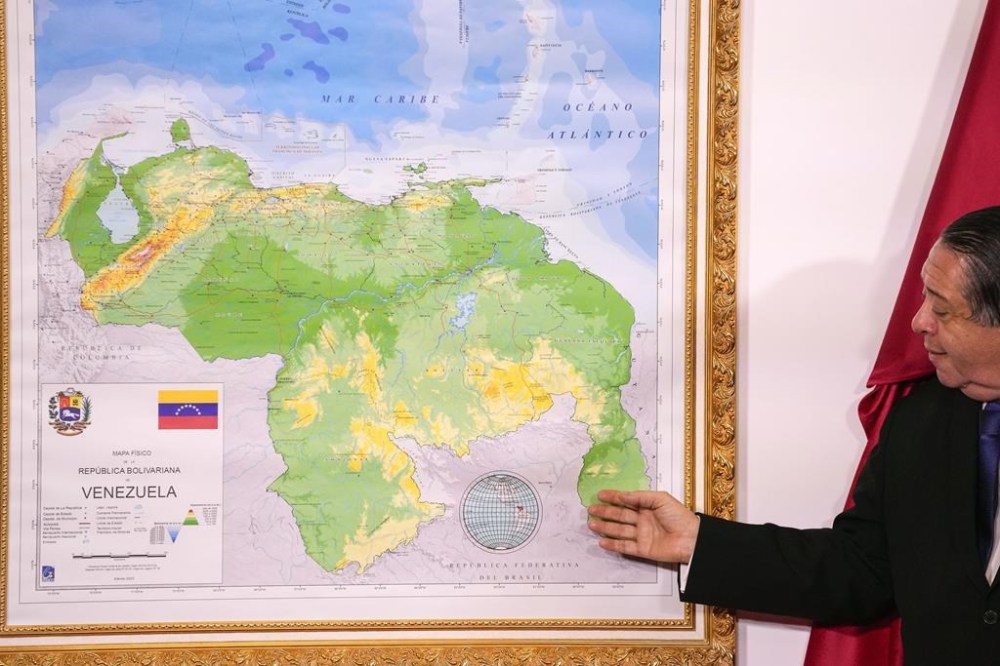
Erikson’s trip comes just weeks after a century-old dispute over Guyana’s Essequibo region deepened, with Venezuela holding a referendum in December to claim sovereignty over an area that represents two-thirds of Guyana.
Tensions continued to worsen late last year until Guyana President Irfaan Ali and Venezuelan President Nicolás Maduro met in the eastern Caribbean island of St. Vincent as part of an emergency mediation meeting organized by regional leaders to prevent further escalation. After the meeting, both sides agreed to refrain from using force, but the territorial dispute continues.
Venezuela has long insisted that Essequibo was part of its territory during the Spanish colonial period and argues a 1966 Geneva agreement among Venezuela, Britain and then-British Guiana, now Guyana, nullified a border drawn in 1899 by international arbitrators.
Venezuela stepped up its aggression toward Guyana after American oil giant ExxonMobil and consortium partners discovered huge deposits of oil and gas off Guyana’s coast in 2015. Daily production is at nearly 600,000 barrels of oil and is expected to increase.
Late last year, the U.S. and Guyana conducted routine joint overflights near the border region with Venezuela during the height of tension leading up to the Venezuelan referendum. Guyana also has hosted joint military exercises with the U.S. and other Caribbean nations as recently as last July.
A British warship also arrived in Guyana in late December, prompting Venezuela to start military exercises near the disputed territory. The U.K. Defense Ministry said the ship visited Guyana as part of multiple engagements with the region, and that the vessel would undergo training exercises with Guyana’s military.
Tensions between Guyana and Venezuela have subsided some this month, with leaders of both countries scheduled to meet later this year in Brazil to continue talks.