

The Supreme Court will decide whether local anti-homeless laws are ‘cruel and unusual’
Advertisement
Read this article for free:
or
Already have an account? Log in here »
To continue reading, please subscribe:

Digital Subscription
One year of digital access for only $205*
- Enjoy unlimited reading on winnipegfreepress.com
- Read the E-Edition, our digital replica newspaper
- Access News Break, our award-winning app
- Play interactive puzzles
*First annual payment billed as $205.00 + GST for one year. This annual subscription will automatically renew at $233.00 + GST every 52 weeks (10% off the regular annual price of $259.35). Offer available to new and qualified returning subscribers only. Cancel any time.
To continue reading, please subscribe:
Add Free Press access to your Brandon Sun subscription for only an additional
$1 for the first 4 weeks*
- Enjoy unlimited reading on winnipegfreepress.com
- Read the E-Edition, our digital replica newspaper
- Access News Break, our award-winning app
- Play interactive puzzles
*Your next Brandon Sun subscription payment will increase by $1.00 and you will be charged $17.95 plus GST for four weeks. After four weeks, your payment will increase to $24.95 plus GST every four weeks.
Read unlimited articles for free today:
or
Already have an account? Log in here »
Hey there, time traveller!
This article was published 12/01/2024 (992 days ago), so information in it may no longer be current.
WASHINGTON (AP) — The Supreme Court agreed Friday to review lower-court rulings that make it harder for cities in the western United States to prevent people from sleeping on the streets when there aren’t enough beds in homeless shelters.
The justices will hear an appeal from the city of Grants Pass, in southwest Oregon, that has the backing of California Gov. Gavin Newsom, a Democrat, as well as other Democratic and Republican elected officials who have struggled to deal with homelessness brought on by rising housing costs and income inequality.
The court’s action comes a day after a panel of the 9th U.S. Circuit Court of Appeals affirmed a lower-court ruling blocking anti-camping ordinances in San Francisco, where Newsom once was the mayor.
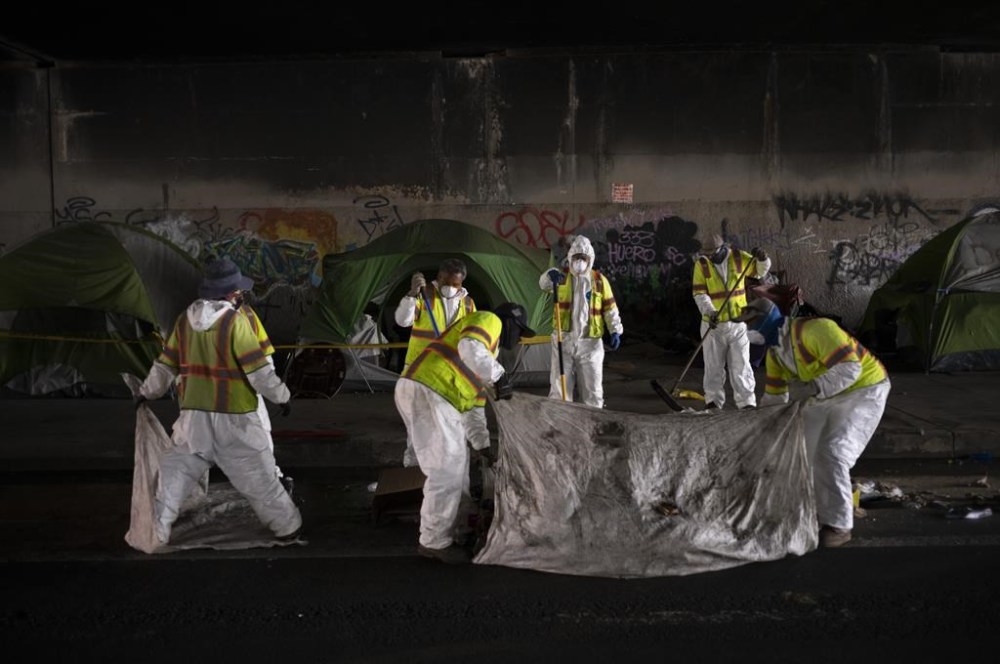
A separate 9th circuit panel ruled in the Oregon case that Grants Pass could not enforce local ordinances that prohibit homeless people “from using a blanket, pillow, or cardboard box for protection from the elements.” The decision applies across nine western states, Alaska, Arizona, California, Hawaii, Idaho, Montana, Nevada, Oregon and Washington.
The two rulings, like a 2018 decision from the 9th circuit in a case from Boise, Idaho, found that punishing people for sleeping on the streets when no alternative shelter is available amounts to “cruel and unusual punishment” in violation of the Constitution.
Elected officials urged the justices to take up the case because they say the rulings complicate their efforts to clear tent encampments, which have long existed in West Coast cities, but have more recently become more common across the U.S. The federal count of homeless people reached 580,000 last year, driven by a lack of affordable housing, a pandemic that economically wrecked households, and a lack of access to mental health and addiction treatment.
“The Supreme Court can now correct course and end the costly delays from lawsuits that have plagued our efforts to clear encampments and deliver services to those in need,” Newsom said in a statement.
Theane Evangelis, a lawyer for Grants Pass, said in a statement that the appellate decisions “are actually harming the very people they purport to protect.”
Homeless people and their advocates say the sweeps are cruel and a waste of taxpayer money. They say the answer is more housing, not crackdowns.
“The issue before the Court is whether cities can punish homeless residents simply for existing without access to shelter,” Ed Johnson, a lawyer for homeless people who challenged the Grants Pass ordinances, said in a statement. “Nevertheless, some politicians and others are cynically and falsely blaming the judiciary for the homelessness crisis to distract the public and deflect blame for years of failed policies.”
Cities from Los Angeles to New York have stepped up efforts to clear encampments, records reviewed by The Associated Press show, as public pressure grew to address what some residents say are dangerous and unsanitary living conditions. But despite tens of millions of dollars spent in recent years, there appears to be little reduction in the number of tents propped up on sidewalks, in parks and by freeway off-ramps.
It’s unclear whether the case will be argued in the spring or the fall.