

US delegation praises Taiwan’s democracy after pro-independence presidential candidate wins election
Advertisement
Read this article for free:
or
Already have an account? Log in here »
To continue reading, please subscribe:

Digital Subscription
One year of digital access for only $205*
- Enjoy unlimited reading on winnipegfreepress.com
- Read the E-Edition, our digital replica newspaper
- Access News Break, our award-winning app
- Play interactive puzzles
*First annual payment billed as $205.00 + GST for one year. This annual subscription will automatically renew at $233.00 + GST every 52 weeks (10% off the regular annual price of $259.35). Offer available to new and qualified returning subscribers only. Cancel any time.
To continue reading, please subscribe:
Add Free Press access to your Brandon Sun subscription for only an additional
$1 for the first 4 weeks*
- Enjoy unlimited reading on winnipegfreepress.com
- Read the E-Edition, our digital replica newspaper
- Access News Break, our award-winning app
- Play interactive puzzles
*Your next Brandon Sun subscription payment will increase by $1.00 and you will be charged $17.95 plus GST for four weeks. After four weeks, your payment will increase to $24.95 plus GST every four weeks.
Read unlimited articles for free today:
or
Already have an account? Log in here »
Hey there, time traveller!
This article was published 14/01/2024 (986 days ago), so information in it may no longer be current.
TAIPEI, Taiwan (AP) — Retired U.S. officials met with Taiwan’s President Tsai Ing-wen on Monday and praised the island’s democratic process that produced a new president-elect and legislature over the weekend in defiance of China’s claim of sovereignty over Taiwan and threat to annex it by military force.
“Taiwan’s democracy has set a shining example for the world, a democratic success story based on transparency, the rule of law and respect for human rights and freedoms,” former national security advisor Stephen Hadley said.
America’s commitment to Taiwan is “rock solid,” he said.
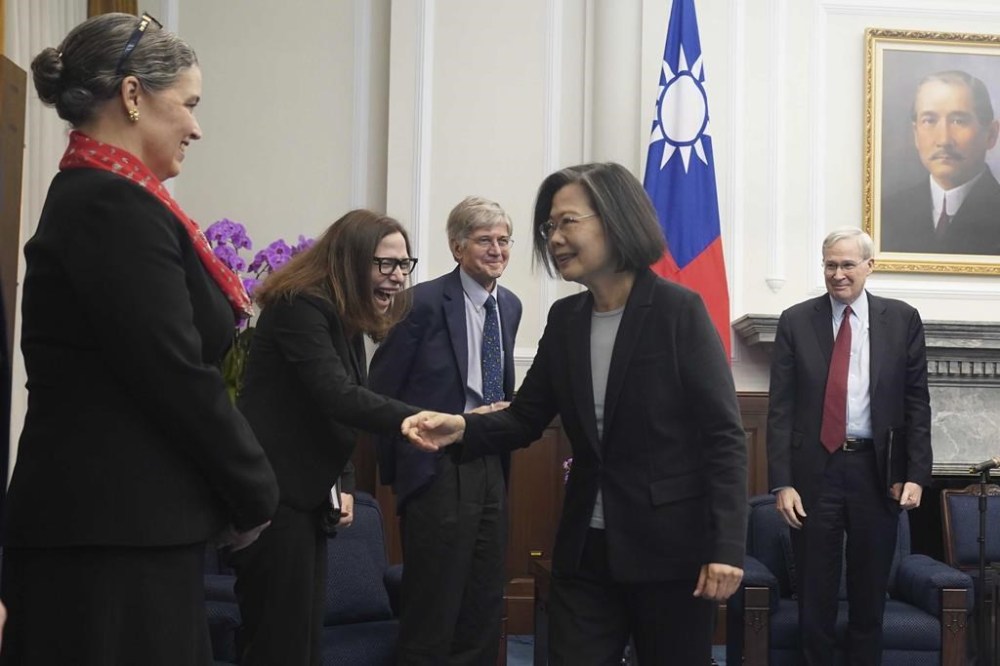
Taiwan on Saturday elected current Vice President Lai Ching-te as the new head of government, a move likely to prompt China to maintain its military, diplomatic and economic threats against the island.
Hadley was joined by former Deputy Secretary of State James B. Steinberg, who affirmed bipartisan support for Taiwan “based on our unofficial but warm relationship, our insistence on exclusively peaceful means to address the cross (Taiwan Strait) issues, the importance of dialogue and the avoidance of unilateral efforts to change the status quo.”
Their delegations later met with Lai and Vice President-elect Bi-khim Hsiao, Taiwan’s former de-facto ambassador to the U.S.
“Democracy and freedom are the most valuable assets of the Taiwanese people,” Lai said. “It is also the core value of Taiwan and the United States and the basis of the long-term partnership between Taiwan and the United States.”
“Although China continues to intrude on Taiwan with military and other gray zone activities, Taiwan is still able to deal with it calmly and work together with the United States and other international partners who share the same philosophy to maintain the status quo of stability in the Taiwan Strait,” Lai said. Gray zone activities refer to the application of military and socio-economic pressure that comes short of outright armed conflict.
Tsai said that Taiwan’s “need to continue to progress and move forward remains unchanged.”
“We hope that Taiwan-U.S. relations continue to advance and serve as a key driving force in regional and global prosperity and development,” she said.
Despite having cut official diplomatic relations with Taiwan in 1979, the U.S. remains the island’s chief diplomatic ally and source of military hardware and intelligence.
Taiwan’s presidential and parliamentary elections have always been a source of contention between the two sides of the Taiwan Strait that divided amid civil war in 1949, amplifying the difference between Taiwan’s free-wheeling democratic process and China’s strict Communist Party authoritarian rule.
That divide is a major flashpoint in U.S.-China relations that potentially risks leading to an actual war in the future, accentuated by China’s claim to virtually the entire South China Sea and competition for markets and diplomatic influence in the Asia-Pacific region.
Lai’s victory was a setback for China’s efforts to bring Taiwan under its control. His Democratic Progressive Party advocates maintaining the status quo of de-facto independence, under which the island’s 23 million people carry Taiwanese passports, maintain their own government and defense and issue their own currency, but are denied recognition at the United Nations in deference to China.
China has refused to acknowledge the result of the election, which left the legislature closely divided between the DPP and the Nationalists, also known as the Kuomintang or KMT. China’s Foreign Ministry said in a statement on the election that “the Taiwan question is China’s internal affair” and “the basic fact that … Taiwan is part of China will not change.”
Taiwan said Beijing’s position “is completely inconsistent with international understanding and the current cross-strait situation. It goes against the expectation of global democratic communities and goes against the will of the people of Taiwan to uphold democratic values. Such cliches are not worth refuting.”
U.S. Secretary of State Antony Blinken congratulated Lai on his victory, prompting the Chinese Foreign Ministry to say that message “sends a gravely wrong signal to the ‘Taiwan independence’ separatist forces” and goes against a U.S. commitment to maintain only unofficial ties with Taiwan.
Lai’s victory means the Democratic Progressive Party will hold the presidency for a third four-year term, following eight years under Tsai. Lai won a three-way race for president with 40% of the vote, less than the clear majority Tsai won in 2020. He will take office in May.
___
Associated Press video journalist Johnson Lai contributed to this report.