

Protesting farmers heap pressure on new French prime minister ahead of hotly anticipated measures
Advertisement
Read this article for free:
or
Already have an account? Log in here »
To continue reading, please subscribe:

Digital Subscription
One year of digital access for only $205*
- Enjoy unlimited reading on winnipegfreepress.com
- Read the E-Edition, our digital replica newspaper
- Access News Break, our award-winning app
- Play interactive puzzles
*First annual payment billed as $205.00 + GST for one year. This annual subscription will automatically renew at $233.00 + GST every 52 weeks (10% off the regular annual price of $259.35). Offer available to new and qualified returning subscribers only. Cancel any time.
To continue reading, please subscribe:
Add Free Press access to your Brandon Sun subscription for only an additional
$1 for the first 4 weeks*
- Enjoy unlimited reading on winnipegfreepress.com
- Read the E-Edition, our digital replica newspaper
- Access News Break, our award-winning app
- Play interactive puzzles
*Your next Brandon Sun subscription payment will increase by $1.00 and you will be charged $17.95 plus GST for four weeks. After four weeks, your payment will increase to $24.95 plus GST every four weeks.
Read unlimited articles for free today:
or
Already have an account? Log in here »
Hey there, time traveller!
This article was published 26/01/2024 (982 days ago), so information in it may no longer be current.
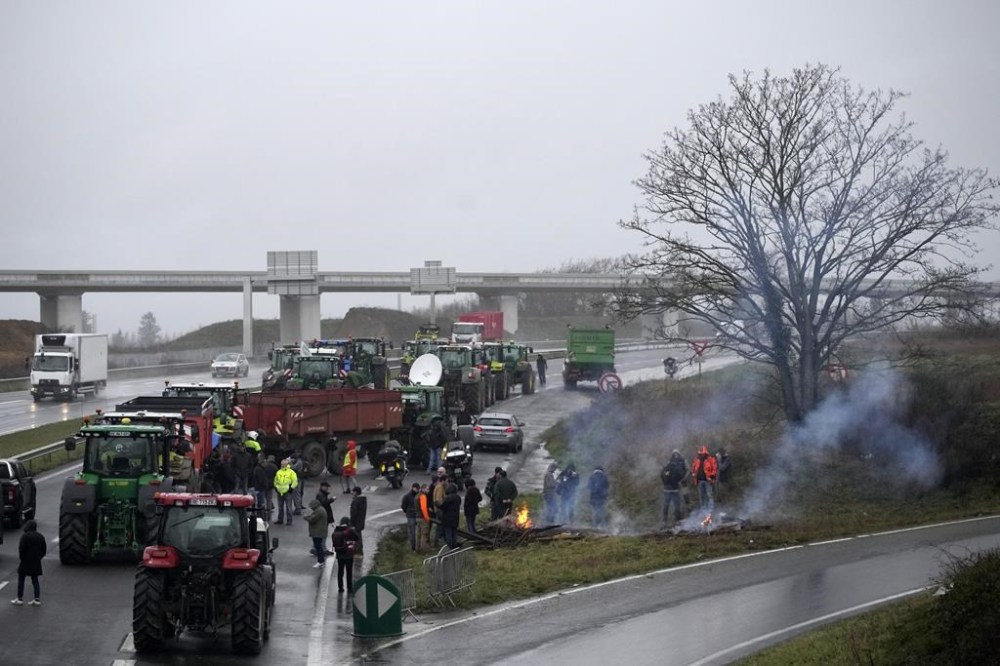
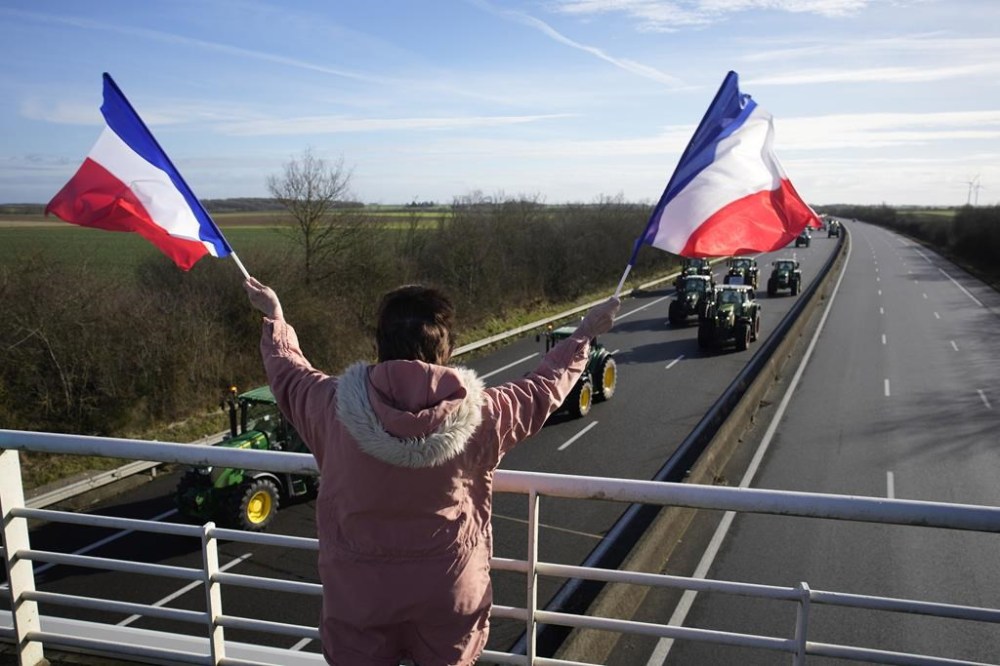
PARIS (AP) — Protesting farmers shut down long stretches of some of France’s major highways again Friday, using tractors to block and slow traffic and squeeze the government ever more tightly to give in to their demands that growing and rearing food be made easier and more lucrative.
The farmers’ spreading movement for better remuneration for their produce, less red tape and lower costs, as well as protection against cheap imports is increasingly becoming a major crisis for the government. It echoes the 2018-2019 yellow vest demonstrations against economic injustice that rocked the first term of President Emmanuel Macron and lastingly dented his popularity.
This time, Macron’s new Prime Minister Gabriel Attal, his mettle being sorely tested just two weeks into the job, is hoping to assuage and win over demonstrating farmers with a series of measures he announced during a visit to a cattle farm in southern France on Friday afternoon. They include “drastically simplifying” certain technical procedures “starting today.” Some of the measures will reduce 14 rules to one, Attal said.
In another move to placate farmers, he announced the progressive end to diesel fuel taxes for farm vehicles.
The prime minister, wearing a suit and tie and reading from notes that rested on a bale of hay, said the government has decided “to put agriculture above all,” words he repeated numerous times. In an apparent nod to the far right, he said the “marching order” is “to protect our heritage and identity” because French agriculture defines “who we are.”
“We have to open a new chapter, change the mentality … firstly that of the state,” he said, before heading to one of the first farmers’ blockades for a first-hand encounter with the anger.
Ranged against the government has been the well-organized and media-savvy movement by determined farmers. Using their tractors and sometimes hay bales as barriers, they’ve been blocking and slowing traffic on major roads. They’ve also dumped stinky agricultural waste at the gates of government offices.
Highway operator Vinci Autoroutes said two highways that are usually busy thoroughfares for road traffic through southern France and into Spain, the A7 and A9, were closed Friday morning by farmers’ blockades for long stretches totaling nearly 400 kilometers (250 miles). Blockades also severed more than a dozen other highways, Vinci said. Tractors also blocked some major roads leading toward Paris.
Farmer Nicolas Gallepin, who took part in a demonstration in his tractor at a traffic circle south of Paris this week, said thickets of regulations that govern how food can be produced are swallowing up chunks of his time and that fuel costs are eating into his bottom line.
“We’ve seen, in the last 10 years, one good year in 2022, but that’s it. We’ve not been paid what we deserve in 10 years,” he said. “What really hurts us is competing imports from other countries that don’t comply with the same regulations.”
The yellow vest protests held France in their grip for months, starting among provincial workers camped out at traffic circles to protest fuel taxes and subsequently snowballing into a nationwide challenge to Macron’s government. Likewise, farmers initially vented their anger more modestly, turning road signs upside down to protest what they argue are nonsensical agricultural policies.
But their grievances were largely unheard before they started to grab headlines in recent weeks with traffic blockades and other protests.
More widely, the unrest in France is are also symptomatic of discontent in agricultural heartlands across the European Union. The influential and heavily subsidized sector is becoming a hot-button issue ahead of European Parliament elections in June. Populist and far-right parties are hoping to make hay from rural disgruntlement against free trade agreements, burdensome costs worsened by Russia’s war in Ukraine and other complaints.
___
Associated Press writer Elaine Ganley in Paris and videojournalist Nicolas Garriga in Auvernaux, France contributed to this report.