

Thai court rules that progressive Move Forward party must stop trying to change royal defamation law
Advertisement
Read this article for free:
or
Already have an account? Log in here »
To continue reading, please subscribe:
Digital Subscription
One year of digital access for only $1.44 a week*
- Enjoy unlimited reading on winnipegfreepress.com
- Read the E-Edition, our digital replica newspaper
- Access News Break, our award-winning app
- Play interactive puzzles
*Billed as $5.77 plus GST every four weeks. After 52 weeks, price increases to the regular rate of $19.95 plus GST every four weeks. Offer available to new and qualified returning subscribers only. Cancel any time.
To continue reading, please subscribe:
Add Free Press access to your Brandon Sun subscription for only an additional
$1 for the first 4 weeks*
- Enjoy unlimited reading on winnipegfreepress.com
- Read the E-Edition, our digital replica newspaper
- Access News Break, our award-winning app
- Play interactive puzzles
*Your next Brandon Sun subscription payment will increase by $1.00 and you will be charged $17.95 plus GST for four weeks. After four weeks, your payment will increase to $24.95 plus GST every four weeks.
Read unlimited articles for free today:
or
Already have an account? Log in here »
Hey there, time traveller!
This article was published 31/01/2024 (995 days ago), so information in it may no longer be current.
BANGKOK (AP) — Thailand’s Constitutional Court ruled Wednesday that the progressive Move Forward party must cease advocating amending the law on royal defamation — a decision that leaves the party vulnerable to being dissolved.
The court’s nine judges deemed it unconstitutional to advocate a change in Article 112 in the country’s Criminal Code — also known as lese-majeste law — which protects the royal institution from criticism by imposing severe penalties on those found to violate it, including up to 15 years in jail per offense.
Critics say the law is often wielded as a tool to quash political dissent. Student-led pro-democracy protests beginning in 2020 openly criticized the monarchy, previously a taboo subject, leading to vigorous prosecutions under the law.
Since those protests, more than 260 people have been charged with the offense, according to Thai Lawyers for Human Rights.
The Move Forward party came in first in the 2023 general election, campaigning heavily on making an effort to amend Article 112, along with other democratic reforms. The win suggested Thai voters were ready for change after nearly a decade of military-controlled government.
But the military-installed Senate effectively blocked the party from power when they refused to approve then-party leader Pita Limjaroenrat as prime minister. Senators said they opposed Pita because of his intention to seek reforms to the monarchy.
In July, Teerayut Suwankesorn, a lawyer associated with royalist politics, petitioned the court to block Pita and the Move Forward party from seeking to change the law. He argued the election campaign proposal to amend the law on royal defamation violated a constitutional clause against seeking to overthrow the system of constitutional monarchy.
“The court unanimously voted that the act of the two accused exercised the rights and freedom to try to overthrow Democratic System under His patronage … and order to cease all opinions including speech, writing, publishing, advertising to amend 112,” read the court’s ruling.
Both the party and its critics say the decision paves the way for follow-up legal action that could see the party dissolved.
Move Forward supporters believe the conservative royalist establishment seeks to eliminate the party as a political force through rulings by courts and state agencies such as the Election Commission, which are staunch defenders of the status quo.
But agitation for a more liberal atmosphere surrounding discussion of the subject has grown since the death of King Bhumibol Adulyadej in 2016.
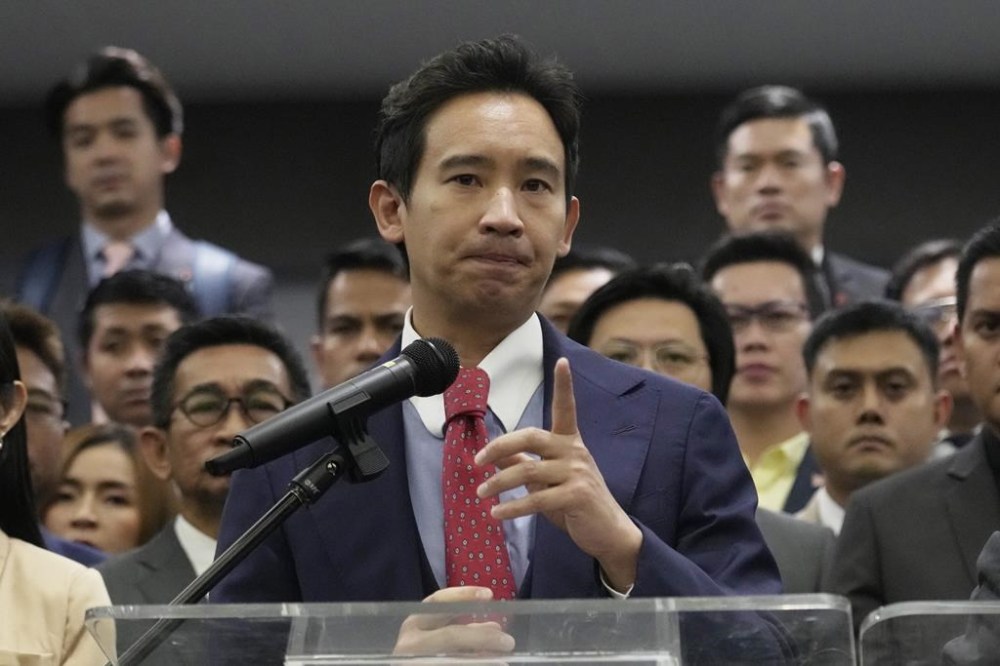
Speaking at a news conference Wednesday after the court’s ruling, Pita was asked if it marked an end to efforts to reform the harsh lese majeste law.
“It’s an opportunity lost, that we can use the parliament to find different views and an opportunity to find the consensus building for such an important and critical and fragile issue, that parliament would be the best place to do it, and we lost that opportunity today,” he responded.
“What’s my message to the voters?” he said. “We’ve tried our best and we have a very true intention of finding the proportionality of law between the protection of the monarchy and the proportionality of freedom of speech in the modern Thailand, so we’ve tried our best.”
Pita had been suspended from the legislature pending the court’s ruling on whether he violated the election law by owning shares in a media company. He was the executor of his father’s estate which included stock in a company that is the inactive operator of a defunct independent television station. Thailand’s Constitutional Court ruled Jan. 24 that Pita did not violate the law and can retain his seat in Parliament.
Pita has stepped down as party leader after his suspension so that a party colleague could become leader of the parliamentary opposition.
Earlier Wednesday, the Bangkok South Criminal Court convicted a prominent political activist of defaming the country’s monarchy and sentenced her to a two-year suspended jail term under Article 112.