

Normally at a crawl, the Los Angeles River threatens to overflow during torrential rains
Advertisement
Read this article for free:
or
Already have an account? Log in here »
To continue reading, please subscribe:

Digital Subscription
One year of digital access for only $205*
- Enjoy unlimited reading on winnipegfreepress.com
- Read the E-Edition, our digital replica newspaper
- Access News Break, our award-winning app
- Play interactive puzzles
*First annual payment billed as $205.00 + GST for one year. This annual subscription will automatically renew at $233.00 + GST every 52 weeks (10% off the regular annual price of $259.35). Offer available to new and qualified returning subscribers only. Cancel any time.
To continue reading, please subscribe:
Add Free Press access to your Brandon Sun subscription for only an additional
$1 for the first 4 weeks*
- Enjoy unlimited reading on winnipegfreepress.com
- Read the E-Edition, our digital replica newspaper
- Access News Break, our award-winning app
- Play interactive puzzles
*Your next Brandon Sun subscription payment will increase by $1.00 and you will be charged $17.95 plus GST for four weeks. After four weeks, your payment will increase to $24.95 plus GST every four weeks.
Read unlimited articles for free today:
or
Already have an account? Log in here »
Hey there, time traveller!
This article was published 05/02/2024 (962 days ago), so information in it may no longer be current.
LOS ANGELES (AP) — It’s easy to forget that a river runs through the heart of Los Angeles. Normally flowing at a crawl, much of it through nondescript concrete channels, the Los Angeles River picks up speed during the rainy season.
By Monday, fed by a slow-moving atmospheric river dumping historic amounts of rain, the river was raging and even threatened to overspill its flood-control barriers in some sections.
In a dramatic river rescue Monday afternoon, an LA Fire Department helicopter crew pulled a man from the turbulent water after he jumped in to save his dog when the animal was swept away by the current. The man was hoisted to safety and flown to a hospital. The dog was able to swim to safety.
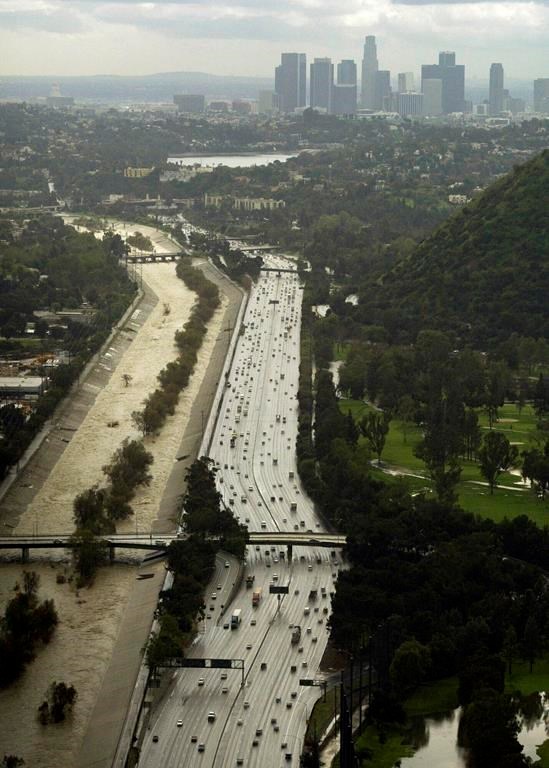
The deluge raised concerns for the region’s large population of homeless people, many of whom set up encampments along the river and on small dirt outcroppings and brush-covered islands. First responders patrolled the river and swift-water rescue teams were poised to deploy.
The river wanders through 14 cities from the San Fernando Valley through downtown Los Angeles and south to Long Beach, where it empties into the ocean. It once flowed much more freely.
A 1939 flood that wiped out neighborhoods prompted officials to hem in the riverbanks with concrete. For decades, the 51-mile (82-kilometer) waterway largely existed as a no-man’s land, a fenced-off, garbage-strewn scar running through the city. It served as an occasional set for Hollywood movies — “Grease” and “Terminator 2: Judgment Day” among them — and frequent canvas for graffiti artists.
The city’s relationship to the river changed when in 2010 the U.S. Environmental Protection Agency deemed the river navigable and subject to the protections of the Clean Water Act.
A year later, the Corps of Engineers began permitting kayaking along stretches north of downtown where the bottom is soft brown dirt instead of concrete. Habitat was restored and herons, egrets and other birds arrived to pick through grassy shallows shaded by willows and cottonwoods.
Even in the verdant sections, there are of course reminders of city life such as tents, overturned grocery carts and litter.
In 2014, the Army Corps recommended approval of the city’s plan to widen the river, create wetlands and invite new commercial and residential development. Much of the proposal is still in the planning stages.