

Gov. Lamont gives upbeat assessment of Connecticut as pro-Palestinian protesters disrupt opening day
Advertisement
Read this article for free:
or
Already have an account? Log in here »
To continue reading, please subscribe:

Digital Subscription
One year of digital access for only $205*
- Enjoy unlimited reading on winnipegfreepress.com
- Read the E-Edition, our digital replica newspaper
- Access News Break, our award-winning app
- Play interactive puzzles
*First annual payment billed as $205.00 + GST for one year. This annual subscription will automatically renew at $233.00 + GST every 52 weeks (10% off the regular annual price of $259.35). Offer available to new and qualified returning subscribers only. Cancel any time.
To continue reading, please subscribe:
Add Free Press access to your Brandon Sun subscription for only an additional
$1 for the first 4 weeks*
- Enjoy unlimited reading on winnipegfreepress.com
- Read the E-Edition, our digital replica newspaper
- Access News Break, our award-winning app
- Play interactive puzzles
*Your next Brandon Sun subscription payment will increase by $1.00 and you will be charged $17.95 plus GST for four weeks. After four weeks, your payment will increase to $24.95 plus GST every four weeks.
Read unlimited articles for free today:
or
Already have an account? Log in here »
Hey there, time traveller!
This article was published 07/02/2024 (976 days ago), so information in it may no longer be current.
HARTFORD, Conn. (AP) — Connecticut Gov. Ned Lamont on Wednesday gave an upbeat assessment of the state and its finances, countering calls from some of his fellow Democrats to raise taxes on the wealthy and spend more money on urgent needs including higher education and social services, as well as help for those struggling to make ends meet.
The two-term governor, a multimillionaire himself, lauded the fact that the two-year $51-billion budget passed last year on a bipartisan vote “is still in the black” unlike most of Connecticut’s peer states. It also includes tax cuts that take effect this year.
“And people are noticing,” Lamont told a joint session of the Democratic controlled General Assembly on opening day of the short, 13-week legislative session. “Unlike our neighboring states, which are losing population, Connecticut has gained population over the last few years.”
Lamont on Wednesday also released his proposed adjustments to the second year of the two-year budget. Despite calls to the contrary from progressive Democrats, the governor’s plan abides by the state’s “fiscal guardrails,” bipartisan financial restraints imposed in 2017 that have been credited with bringing financial stability to the state. Some top Democrats, including Senate President Pro Tempore Martin Looney, have suggested the caps on spending and borrowing should be adjusted to allow for more spending in key areas.
“Governor Lamont offered another status-quo budget address that yet again highlights how distant our multi-millionaire Governor is from everyday Connecticut residents,” said Norma Martinez HoSang, director of Connecticut For All, a coalition of faith, labor and advocacy groups, in a statement.
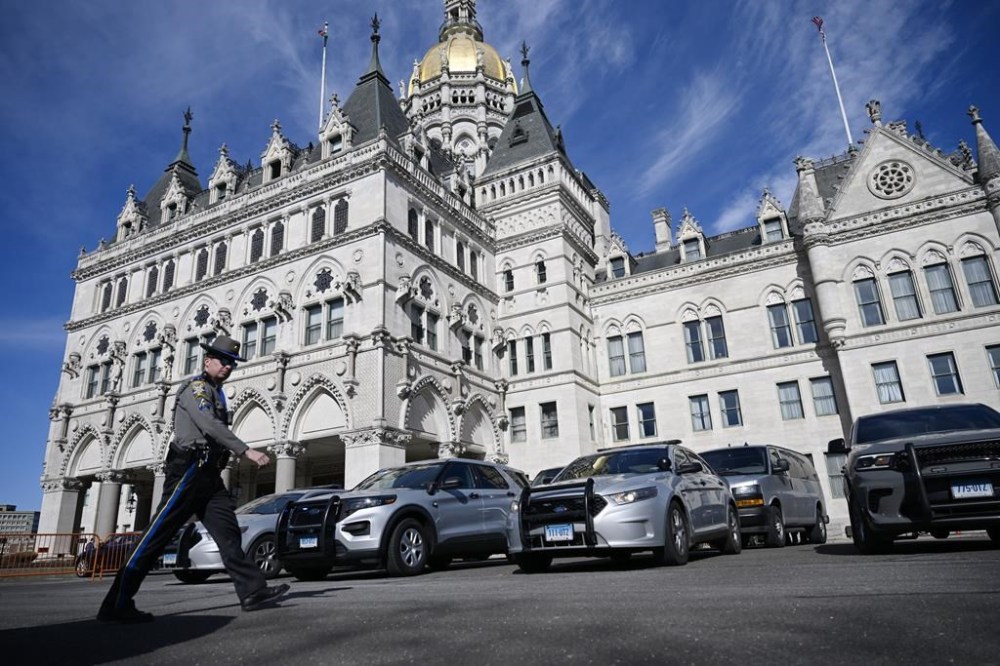
As Lamont was addressing state lawmakers, groups of protesters scattered throughout the state Capitol building began chanting “cease-fire” and unfurling banners calling for the U.S. stop funding Israel’s war with Hamas in Gaza. There was an unusually large contingent of police at the Capitol on Wednesday, and officers from multiple departments quickly removed about 25 people from a demonstration on the first floor and about 10 to 12 people from the House gallery, which is above where Lamont was speaking.
No one was arrested or issued a summons to court, State Capitol Police Lt. Gregory Wimble said.
While Lamont faces pushback from the more liberal wing of his party, the top Republican leader of the state Senate praised the governor for still embracing the budgetary caps, calling it “music to our ears.” Senate Minority Leader Kevin Kelly, a Republican from Stratford, said budgets are about priorities and if the Democrats want to spend more money on social services and other programs, then they need to reprioritize spending.
“The guardrails have worked fabulously well,” he said. “They’ve resulted in balanced budgets. They resulted in a rainy day fund. They’ve resulted in paying down debt.”
Looney said Democrats don’t want to “blow up” the guardrails, as they have been accused, but rather make adjustments, including to the so-called volatility cap that imposes a threshold for “volatile” income tax revenue such as capital gains from the stock market. It requires excess to be set aside for the state’s budget reserves or to pay down pension debt.
“There are a number of things that we could do, that are discreet things, that would not undermine the cap overall, would not undermine the guardrails, but would still give us a little bit more room to address what needs to be addressed,” he said. Looney also supports a surcharge on capital gains income for high-earners.
Lamont’s budget attempts to address some of the concerns of his fellow Democrats. He said it includes the “largest state grants ever” for Connecticut’s state college and the University of Connecticut. There is also a combination of state and federal COVID funds set aside to continue providing universal free breakfast and reduce-price meal subsidies for school lunches to students.
Lamont’s spending proposal also sets aside an additional $43.3 million, on top of the $68.8 million already in the budget, for various early childhood initiatives. He has also proposed eliminating state licensing fees for various occupations, including nurses and home child care workers. And Lamont’s plan includes additional funding to provide no-cost legal representation to income-eligible tenants facing eviction.
The governor stressed, however, that more work needs to be done to make housing in Connecticut affordable, noting that state funding is doubled for various housing initiatives in the two-year spending plan.
“We have too many people who cannot find a place to live,” Lamont said. “It is not available or it is not affordable.”