

Robert Badinter, who led France to end the death penalty and fought Holocaust denial, has died at 95
Advertisement
Read this article for free:
or
Already have an account? Log in here »
To continue reading, please subscribe:

Digital Subscription
One year of digital access for only $205*
- Enjoy unlimited reading on winnipegfreepress.com
- Read the E-Edition, our digital replica newspaper
- Access News Break, our award-winning app
- Play interactive puzzles
*First annual payment billed as $205.00 + GST for one year. This annual subscription will automatically renew at $233.00 + GST every 52 weeks (10% off the regular annual price of $259.35). Offer available to new and qualified returning subscribers only. Cancel any time.
To continue reading, please subscribe:
Add Free Press access to your Brandon Sun subscription for only an additional
$1 for the first 4 weeks*
- Enjoy unlimited reading on winnipegfreepress.com
- Read the E-Edition, our digital replica newspaper
- Access News Break, our award-winning app
- Play interactive puzzles
*Your next Brandon Sun subscription payment will increase by $1.00 and you will be charged $17.95 plus GST for four weeks. After four weeks, your payment will increase to $24.95 plus GST every four weeks.
Read unlimited articles for free today:
or
Already have an account? Log in here »
Hey there, time traveller!
This article was published 09/02/2024 (969 days ago), so information in it may no longer be current.
PARIS (AP) — Robert Badinter, who spearheaded the drive to abolish France’s death penalty, campaigned against antisemitism and Holocaust denial, and led a European body dealing with the legal fallout of Yugoslavia’s breakup, has died. He was 95.
French President Emmanuel Macron hailed Badinter, a revered human rights defender and former justice minister, as a ‘’figure of the century’’ who ‘’never ceased to advocate for the ideas of the Enlightenment.’’ The French Justice Ministry on Friday confirmed Badinter’s death, without providing details.
A famed lawyer and thinker, Badinter was best known for his sustained push to end capital punishment. He described seeing one of his own clients lose his head to a guillotine, used up until the 1970s to kill criminals in France.
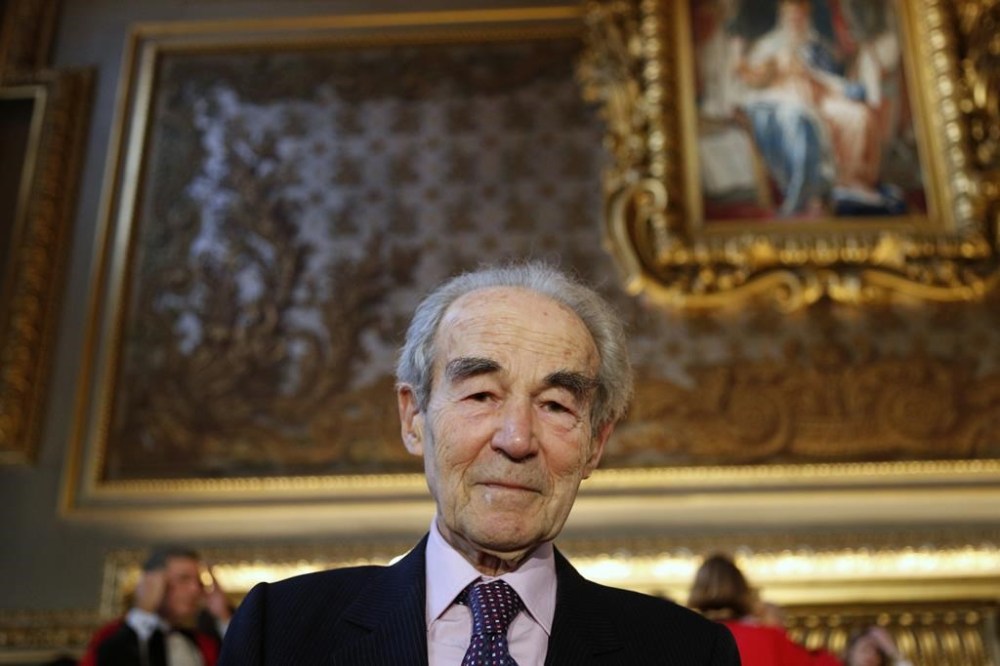
As justice minister under then-President Francois Mitterrand, Badinter overcame public opposition and won parliamentary support for abolishing the death penalty in 1981.
Born in Paris in 1928 to a Jewish family, Badinter saw Nazi horrors and France’s collaboration up close during World War II, and lost his father in the Sobibor death camp, according to Macron’s office. As a lawyer, he later pursued a notorious Holocaust denier in court.
Badinter went on to lead France’s Constitutional Court, served as a senator for 16 years, and was seen as a moral compass for many in France for his defense of human rights.
In 1991, Badinter led an arbitration body set up by the European Economic Community to provide the Peace Conference on Yugoslavia with legal advice after two of the country’s six republics – Slovenia and Croatia – had declared independence. The Badinter Commission, as the body became known, was made up of presidents of constitutional courts of the member nations of the EEC, precursor to the EU.
The Badinter Commission issued 15 legal opinions between 1991 and 1993, including one saying that the Socialist Federal Republic of Yugoslavia had dissolved. That paved the way for international recognition of Slovenia and Croatia as sovereign countries in 1992.
The Badinter Commission also declared the borders between former Yugoslav republics as international frontiers between newly independent countries that could only be changed through diplomacy, and not by force. Despite the legal pronouncements, wars raged in the 1990s in Croatia and later Bosnia and Herzegovina and Kosovo, claiming hundreds of thousands of lives and displacing the largest number of refugees in Europe since World War II.
Macron will preside over a special national homage to Badinter, the president’s office said.
In his statement, Macron honored the memory of a ‘’wise man of the republic,’’ who, ‘’after having experienced the tragedy of the century, embodied the most beautiful part of hope.’’
___
Barbara Surk in Nice, France, contributed.