Russia is rebuilding capacity to destabilize European countries, new UK report warns
Advertisement
Read this article for free:
or
Already have an account? Log in here »
To continue reading, please subscribe:

Digital Subscription
One year of digital access for only $205*
- Enjoy unlimited reading on winnipegfreepress.com
- Read the E-Edition, our digital replica newspaper
- Access News Break, our award-winning app
- Play interactive puzzles
*First annual payment billed as $205.00 + GST for one year. This annual subscription will automatically renew at $233.00 + GST every 52 weeks (10% off the regular annual price of $259.35). Offer available to new and qualified returning subscribers only. Cancel any time.
To continue reading, please subscribe:
Add Free Press access to your Brandon Sun subscription for only an additional
$1 for the first 4 weeks*
- Enjoy unlimited reading on winnipegfreepress.com
- Read the E-Edition, our digital replica newspaper
- Access News Break, our award-winning app
- Play interactive puzzles
*Your next Brandon Sun subscription payment will increase by $1.00 and you will be charged $17.95 plus GST for four weeks. After four weeks, your payment will increase to $24.95 plus GST every four weeks.
Read unlimited articles for free today:
or
Already have an account? Log in here »
Hey there, time traveller!
This article was published 20/02/2024 (957 days ago), so information in it may no longer be current.
LONDON (AP) — Russia is rebuilding its capacity to destabilize European countries and extend its influence in the Middle East and Africa, posing a strategic threat to NATO as its members focus on the war in Ukraine, a U.K.-based think tank said Tuesday.
In a sweeping report, researchers at the Royal United Services Institute argue that Western nations need to do more to counter Moscow’s use of unconventional warfare if they are to succeed in turning back Russia’s invasion of Ukraine.
“As the war in Ukraine protracts, Russia has an interest in creating crises further afield,’’ authors Jack Watling, Oleksandr V. Danylyuk and Nick Reynolds wrote, citing the Balkans as a region that is ripe for mischief.
“Russia also has an active interest in destabilizing Ukraine’s partners, and with a slew of elections forthcoming across Europe there is a wide range of opportunities to exacerbate polarization,’’ the authors said.
The 35-page report by the think tank, founded in 1831, was released only days before the second anniversary of Russia’s full-scale invasion of Ukraine.
While Russian efforts to destabilize countries such as Moldova failed due to security lapses and the mass expulsion of Kremlin operatives, the Russian military is now strengthening its ability to launch unconventional attacks, the report says.
Using documents obtained from Russian secret services and interviews with official bodies in Ukraine and some European states, the report weaves a narrative of Russia’s efforts to extend its influence beyond the present conflict in Ukraine.
The threat “extends beyond Ukraine and the active collaboration of those states that are being targeted,” it said and urged for “sustained vigilance” over a range of issues.
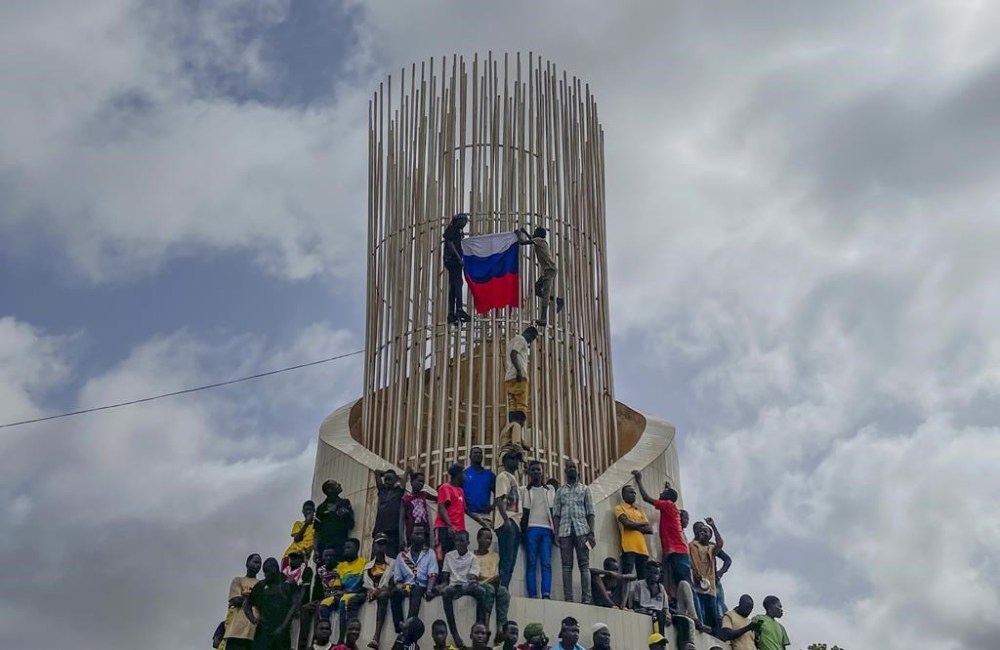
Russia has also been expanding ties with African and Middle Eastern states, displacing Western interests in those regions. This new “Russian colonialism” seeks to create what the authors call an “Entente Roscolonial’’ — a group of states that “actively seek to assist Russia, while also becoming increasingly subordinate to Russian influence,’’ according to the report.
The “entente” posed a serious threat to Western interests because of a “strong and bitter sense” that the U.S. and NATO act differently in Ukraine than they do in places like Gaza and Tigray, the region of northern Ethiopia that has been devastated by conflict, the report said.
“Similarly, the apparent contrast in Western language and rhetoric between how it described the destruction of Aleppo or Mariupol, and how it has excused Israeli operations in Gaza, leave many on the continent perceiving a gap between Western rhetoric about values and the values practiced by those who have, for so long, imposed constraints on the policies of African states to enforce values-based norms.’’
The new colonialism, the report said, was intertwined with the formation of the Wagner Group, a nominally private company that provided mercenaries for wars in Africa, the Middle East and Ukraine, giving the Russian government plausible deniability about its role in these conflicts.
Following the death of the Wagner leader Yevgeny Prigozhin, these units have been brought more directly under the control of the Russian military. This new Expeditionary Corps is now offering a “regime survival package” to authoritarian governments in countries like Mali and the Central African Republic.