

Army personnel file shows Maine reservist who killed 18 people received glowing reviews
Advertisement
Read this article for free:
or
Already have an account? Log in here »
To continue reading, please subscribe:

Digital Subscription
One year of digital access for only $205*
- Enjoy unlimited reading on winnipegfreepress.com
- Read the E-Edition, our digital replica newspaper
- Access News Break, our award-winning app
- Play interactive puzzles
*First annual payment billed as $205.00 + GST for one year. This annual subscription will automatically renew at $233.00 + GST every 52 weeks (10% off the regular annual price of $259.35). Offer available to new and qualified returning subscribers only. Cancel any time.
To continue reading, please subscribe:
Add Free Press access to your Brandon Sun subscription for only an additional
$1 for the first 4 weeks*
- Enjoy unlimited reading on winnipegfreepress.com
- Read the E-Edition, our digital replica newspaper
- Access News Break, our award-winning app
- Play interactive puzzles
*Your next Brandon Sun subscription payment will increase by $1.00 and you will be charged $17.95 plus GST for four weeks. After four weeks, your payment will increase to $24.95 plus GST every four weeks.
Read unlimited articles for free today:
or
Already have an account? Log in here »
Hey there, time traveller!
This article was published 27/02/2024 (950 days ago), so information in it may no longer be current.
PORTLAND, Maine (AP) — An Army reservist responsible for the deadliest shooting in Maine history received a glowing review from his superiors even as some of his family members were growing increasingly worried about his mental health.
The annual evaluation from April 2023 indicated Robert Card, 40, of Bowdoin, was “a consummate professional” who “excelled as a squad leader” and whose mentoring of troops was “among the best,” according to the documents released under an open records request. Six months later, Card killed 18 people in a mass shooting before killing himself.
The personnel files also show Card had received some mental health-related training years earlier when he volunteered to become one of his unit’s suicide prevention officers and attended associated schooling in 2015-2016.
Card’s last evaluation was dated shortly before his ex-wife and son reported to police in May that he had become angry and paranoid in the preceding months, and had falsely accused his son of saying things behind his back.
No disciplinary records were in the files released under the federal Freedom of Information Act, but those wouldn’t necessarily be turned over without permission from Card’s family, according to the Portland Press Herald, which first obtained the records.
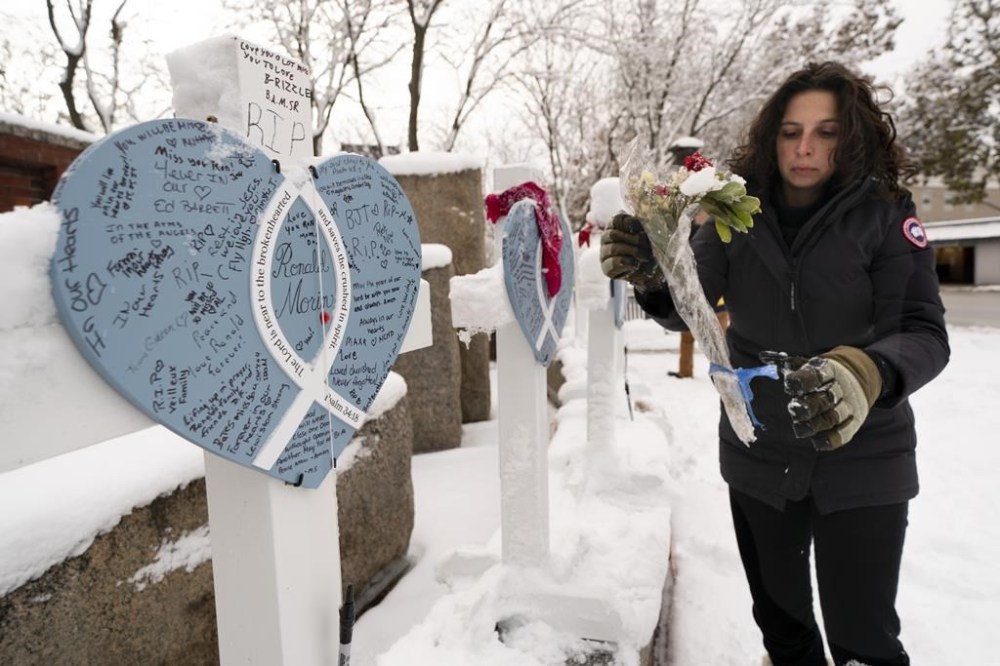
Several of Card’s fellow Army reservists are due to testify next month to a governor-appointed independent commission investigating the Oct. 25 shootings, which were carried out at a bowling alley and a bar in Lewiston.
Body camera video of police interviews with reservists before Card was hospitalized in upstate New York for two weeks last summer showed fellow reservists expressing worry and alarm about his behavior. One of them, a close friend of Card’s, later issued a stark warning to his superior officer — six weeks before the attacks — that Card was “going to snap and do a mass shooting.”
None of those concerns appeared in Card’s personnel record, which dates back to 2002 when he enlisted at the University of Maine.
In his final review, in April, evaluators said Card, a sergeant first class, “exceeded standards” in almost all areas of his role as a senior trainer, including instruction on the use of grenades. In short, Card was “a consummate professional” with an “approachable, reliable demeanor” who showed an “ability to train future leaders with great care for their safety and well-being,” according to the evaluation.
The documents didn’t mention concerns about Card’s mental health. Three months later, Card was hospitalized after pushing a fellow reservist and locking himself in his motel room while his unit was training near West Point, New York.
Fellow reservists told police who escorted Card for an evaluation that he’d been acting paranoid and accusing others of talking about him behind his back. Card said they were right to be worried: “They’re scared ’cause I’m gonna friggin’ do something. Because I am capable,” Card told police.
Card shot himself in the back of a tractor-trailer at a former employer’s parking lot as authorities led the biggest manhunt in state history. His body was found two days after he ended the lives of 18 other people. Thirteen others were injured.