

Russians embrace hope amid despair as Alexei Navalny says his final goodbye
Advertisement
Read this article for free:
or
Already have an account? Log in here »
To continue reading, please subscribe:

Digital Subscription
One year of digital access for only $205*
- Enjoy unlimited reading on winnipegfreepress.com
- Read the E-Edition, our digital replica newspaper
- Access News Break, our award-winning app
- Play interactive puzzles
*First annual payment billed as $205.00 + GST for one year. This annual subscription will automatically renew at $233.00 + GST every 52 weeks (10% off the regular annual price of $259.35). Offer available to new and qualified returning subscribers only. Cancel any time.
To continue reading, please subscribe:
Add Free Press access to your Brandon Sun subscription for only an additional
$1 for the first 4 weeks*
- Enjoy unlimited reading on winnipegfreepress.com
- Read the E-Edition, our digital replica newspaper
- Access News Break, our award-winning app
- Play interactive puzzles
*Your next Brandon Sun subscription payment will increase by $1.00 and you will be charged $17.95 plus GST for four weeks. After four weeks, your payment will increase to $24.95 plus GST every four weeks.
Read unlimited articles for free today:
or
Already have an account? Log in here »
Hey there, time traveller!
This article was published 01/03/2024 (942 days ago), so information in it may no longer be current.
Russians have seen many images of Alexei Navalny — a firebrand protest leader with a bullhorn. A government critic whose face was splashed with green dye by an attacker, which he joked turned him into the Hulk. A smiling political prisoner making a heart with his hands as he gestured to his wife in a defendant’s cage in court.
On Friday, there was one final picture of the opposition leader: Navalny in an open casket, red and white flowers heaped around him, and his forehead covered with a “venchik,” a traditional adornment for those who lived a righteous life.
His body, visibly thin from the months he’d spent in prison before his unexpected and still unexplained death, was a final confirmation: that this would be his last farewell.
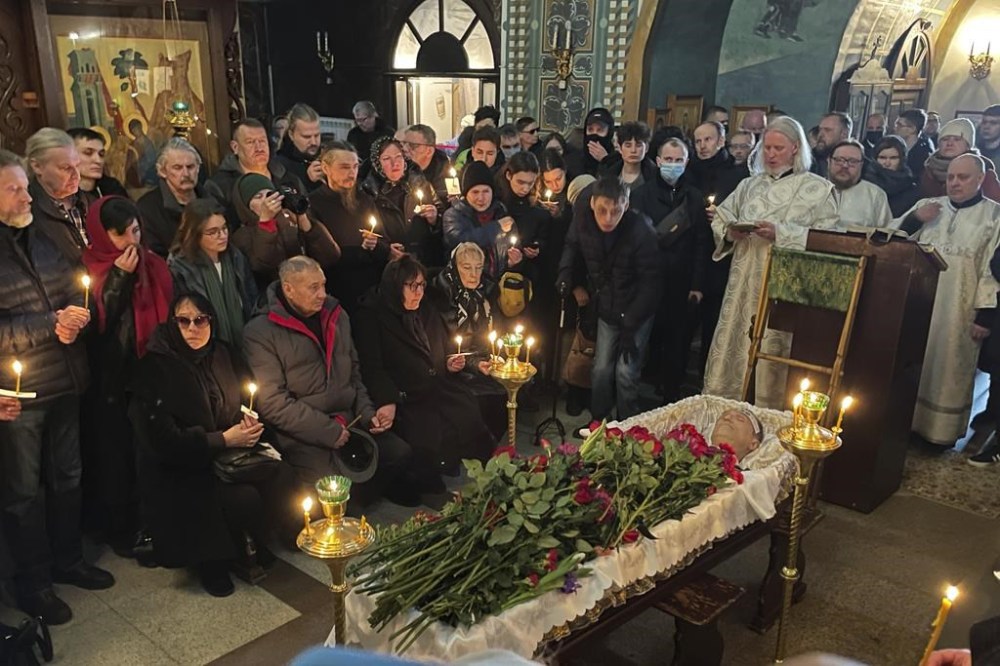
For those who had believed in Navalny’s vision of a freer, more peaceful Russia, it was a moment tinged with deep despair.
“What was done to him is incredibly difficult to accept and get through it,” said Nadezhda Ivanova, a mourner who stood outside the church where Navalny’s funeral service was held. “Today we say farewell to a truly great man and see him to his final journey.”
Only a select few were allowed to pay their respects inside the Church of the Icon of the Mother of God Soothe My Sorrows, where Navalny’s casket lay surrounded by candles.
Thousands more lined the streets outside the church and towards the graveyard where Navalny’s body was laid to rest. Some in the crowd threw flowers at the passing hearse, hemmed in by metal barriers and a heavy police presence.
When Navalny’s death was announced on Feb. 16, police detained hundreds who tried to leave flowers. Some had feared that the funeral would see similar large-scale arrests. That so many people still chose to publicly mourn Navalny was a testament to the politician’s stature, said Mark Galotti, head of the Mayak Intelligence consultancy.
“Despite the intimidatory police presence, the increasing thuggery of the state, all the new CCTV cameras to record their faces, thousands of Muscovites come out to say their farewells to Navalny in the largest grassroots demonstration for years,” he posted on X, formerly Twitter.
Crowds continued to gather at the cemetery’s gates, chanting: “Let us in to say goodbye!” Navalny’s mother and father stroked and kissed his head before the casket was finally closed and lowered into the earth.
When the gates finally opened, the mourners streamed in — a continuous line of people laying flowers and throwing small handfuls of dirt on top of the grave. The police stood close by, hurrying individuals along.
But with despair was also defiance. As dusk fell, the waiting crowds continued to chant: “Love is stronger than fear,” and “Putin is a killer.”
Navalny had often urged Russians never to give up. Now, many hope his death will become his final contribution to Russia’s pro-democracy movement, inspiring new strength.
Writing on social media, best-selling Russian-Georgian author Boris Akunin urged Russians not to let Navalny’s death be in vain.
“Today, they are burying a man who had a beautiful dream: to create the Beautiful Russia of the Future. A person can be killed. Anything that’s alive can be killed. Even a dream,” he said.
“Everything that Alexei could do for the Beautiful Russia of the Future, he did. Whether that was all for nothing will now depend on you and me. Eternal memory to Alexei and eternal shame to us if it was all in vain.”