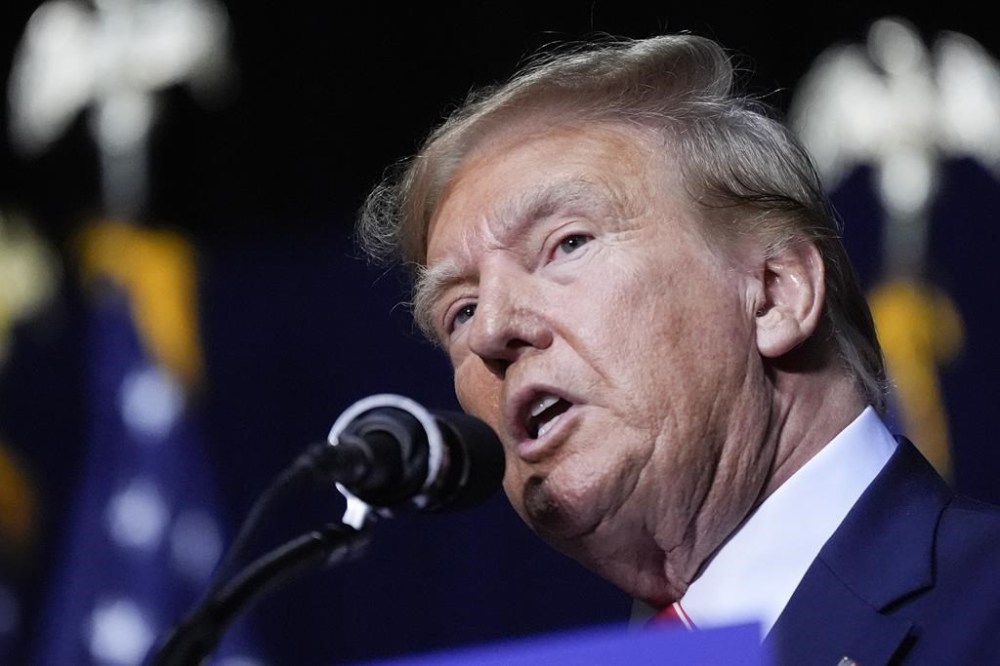
How Trump secured the delegates for the 2024 Republican presidential nomination
Advertisement
Read this article for free:
or
Already have an account? Log in here »
To continue reading, please subscribe:

Digital Subscription
One year of digital access for only $205*
- Enjoy unlimited reading on winnipegfreepress.com
- Read the E-Edition, our digital replica newspaper
- Access News Break, our award-winning app
- Play interactive puzzles
*First annual payment billed as $205.00 + GST for one year. This annual subscription will automatically renew at $233.00 + GST every 52 weeks (10% off the regular annual price of $259.35). Offer available to new and qualified returning subscribers only. Cancel any time.
To continue reading, please subscribe:
Add Free Press access to your Brandon Sun subscription for only an additional
$1 for the first 4 weeks*
- Enjoy unlimited reading on winnipegfreepress.com
- Read the E-Edition, our digital replica newspaper
- Access News Break, our award-winning app
- Play interactive puzzles
*Your next Brandon Sun subscription payment will increase by $1.00 and you will be charged $17.95 plus GST for four weeks. After four weeks, your payment will increase to $24.95 plus GST every four weeks.
Read unlimited articles for free today:
or
Already have an account? Log in here »
Hey there, time traveller!
This article was published 12/03/2024 (908 days ago), so information in it may no longer be current.
WASHINGTON (AP) — Former President Donald Trump’ s third consecutive stint as the presumptive Republican presidential nominee was made possible by an almost uninterrupted string of lopsided primary and caucus victories and his near sweep of GOP delegates awarded to date.
The Associated Press declared Trump the presumptive nominee at 11:09 p.m. EDT, following his wins Tuesday in Georgia, Mississippi and Washington. He won at least 126 of their combined available delegates to push him past the 1,215 needed to become the presumptive nominee.
The AP concluded Trump would secure enough delegates in Washington to clinch the nomination after an analysis found that he would receive a statewide vote majority, which would entitle him to the lion’s share of the state’s 43 delegates.

Washington’s Republican delegates are awarded based on both the statewide vote and the vote in each congressional district. A candidate who receives more than 50% of the statewide vote wins all 13 statewide delegates. The candidate who wins more than 50% of the vote in a congressional district wins all three delegates from that district. If no candidate receives a vote majority, delegates are then awarded in proportion to the statewide vote as well as the vote in each district. Candidates must receive at least 20% of the vote to qualify for any delegates in Washington.
As the polls closed in Washington, Trump was just 30 delegates shy of reaching the 1,215-delegate mark. Once the AP determined he would win a statewide vote majority, he was entitled to all 13 statewide delegates, leaving him 17 delegates short of 1,215. The AP’s analysis then concluded that Trump would win a vote majority in most if not all of the state’s 10 congressional districts, pushing him past the number of delegates needed to secure the nomination.
To determine whether Trump would receive a vote majority in any congressional district, the AP compared the current Washington vote results to past results in the state, as well as to the demographics of the counties that have already reported vote results and to the estimated turnout in counties across the state.
Trump’s path to unofficially clinching this year’s nomination more closely resembled the one he took as the incumbent in 2020 than his 2016 bid as a first-time candidate. He defeated an at-times crowded field of rivals to secure the 2024 nomination, his third in eight years.
Trump reaches the delegate milestone 57 days after Republicans first began awarding delegates at the Iowa caucuses on Jan. 15. That’s a faster pace than in 2016, when he reached the milestone after 115 days against a much more competitive field. It’s slightly behind the 38 days it took President Joe Biden to unofficially clinch the Democratic nomination on Tuesday, as well as the 43 days it took Trump in 2020 when he ran as the incumbent. Both Biden and Trump this year far outpaced the 111 days it took then-President Barack Obama to officially clinch his renomination in 2012.

The former president benefited greatly from the Republican delegate rules, which vary state by state. Some states allowed the primary or caucus winner or vote-majority winner to receive all the state’s delegates. Historically, these rules have favored front-runners and made it harder for trailing candidates like Haley to win delegates.
Trump’s near-clean sweep of last week’s Super Tuesday contests, as well as his win in American Samoa’s caucuses, put him just 126 delegates shy of the 1,215 needed to clinch the nomination heading into Tuesday’s contests. This included 11 delegates in Texas that the state party announced Tuesday would be awarded to Trump. The party had previously planned to award the delegates at the state party convention in May but instead awarded them based on the March 5 primary after saying in a social media post that their original plan was in conflict with Republican National Committee rules.
Trump needed about 78% of the 161 delegates available in Tuesday’s contests, a reasonable goal considering he won 93% of last week’s massive Super Tuesday delegate haul.
Candidates don’t officially become the Republican or Democratic presidential nominee until winning the vote at their party’s convention this summer.