

Famed American sculptor Richard Serra, the ‘poet of iron,’ has died at 85
Advertisement
Read this article for free:
or
Already have an account? Log in here »
To continue reading, please subscribe:

Digital Subscription
One year of digital access for only $205*
- Enjoy unlimited reading on winnipegfreepress.com
- Read the E-Edition, our digital replica newspaper
- Access News Break, our award-winning app
- Play interactive puzzles
*First annual payment billed as $205.00 + GST for one year. This annual subscription will automatically renew at $233.00 + GST every 52 weeks (10% off the regular annual price of $259.35). Offer available to new and qualified returning subscribers only. Cancel any time.
To continue reading, please subscribe:
Add Free Press access to your Brandon Sun subscription for only an additional
$1 for the first 4 weeks*
- Enjoy unlimited reading on winnipegfreepress.com
- Read the E-Edition, our digital replica newspaper
- Access News Break, our award-winning app
- Play interactive puzzles
*Your next Brandon Sun subscription payment will increase by $1.00 and you will be charged $17.95 plus GST for four weeks. After four weeks, your payment will increase to $24.95 plus GST every four weeks.
Read unlimited articles for free today:
or
Already have an account? Log in here »
Hey there, time traveller!
This article was published 26/03/2024 (909 days ago), so information in it may no longer be current.
Famed American artist and sculptor Richard Serra, known for turning curving walls of rusting steel and other malleable materials into large-scale pieces of outdoor artwork that are now dotted across the world, died Tuesday at his home in Long Island, New York. He was 85.
Considered one of his generation’s most preeminent sculptors, the San Francisco native originally studied painting at Yale University but turned to sculpting in the 1960s, inspired by trips to Europe.
His death was confirmed Tuesday night by his lawyer, John Silberman, whose firm is based in New York. He said the cause of death was pneumonia.
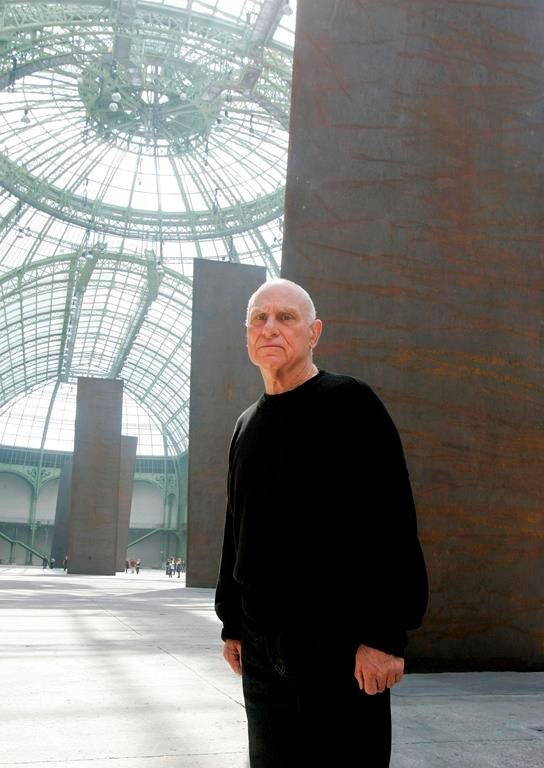
Known by his colleagues as the “poet of iron,” Serra became world-renowned for his large-scale steel structures, such as monumental arcs, spirals and ellipses. He was closely identified with the minimalist movement of the 1970s.
Serra’s work started to gain public attention in 1981, when he installed a 120-foot-long (36.5-meter-long) and 12-foot-high (3.6-meter-high) curving wall of raw steel that splits the Federal Plaza in New York City. The sculpture, called “Tilted Arc,” generated swift backlash from people who work there and a fierce demand that it should be removed. The sculpture was later taken down, but Serra’s popularity in the New York art scene had been cemented.
Most of Serra’s large-scale works are welded in Cor-Ten steel, but he also worked with other nontraditional materials such as rubber, latex, neon — as well as molten lead, which Serra threw against a wall or floor to create his “Splash” series in his early career.
His works have been installed in landscapes and included in the collections of museums across the world, from The Museum of Modern Art in New York to the deserts of Qatar.
In 2005, eight major works by Serra were installed permanently at the Guggenheim Museum in Spain. Carmen Jimenez, the exhibition organizer, said Serra was “beyond doubt the most important living sculptor.”
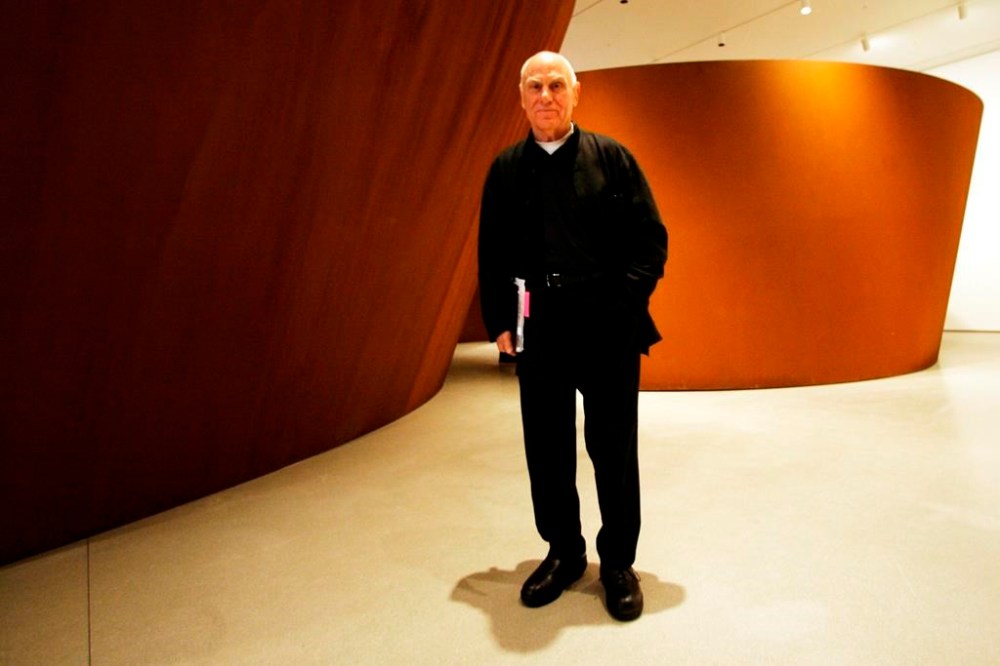
Born to a Russian-Jewish mother and a Spanish father in San Francisco, Serra was the second of three sons in the family. He started drawing at a young age and was inspired by the time he spent at a shipyard where his father worked as a pipefitter. Before his turn to sculpting, Serra worked in steel foundries to help finance his education at the Berkeley and Santa Barbara campuses of the University of California. He then went on to Yale, where he graduated in 1964.