

Texas asks court to decide if the state’s migrant arrest law went too far
Advertisement
Read this article for free:
or
Already have an account? Log in here »
To continue reading, please subscribe:

Digital Subscription
One year of digital access for only $205*
- Enjoy unlimited reading on winnipegfreepress.com
- Read the E-Edition, our digital replica newspaper
- Access News Break, our award-winning app
- Play interactive puzzles
*First annual payment billed as $205.00 + GST for one year. This annual subscription will automatically renew at $233.00 + GST every 52 weeks (10% off the regular annual price of $259.35). Offer available to new and qualified returning subscribers only. Cancel any time.
To continue reading, please subscribe:
Add Free Press access to your Brandon Sun subscription for only an additional
$1 for the first 4 weeks*
- Enjoy unlimited reading on winnipegfreepress.com
- Read the E-Edition, our digital replica newspaper
- Access News Break, our award-winning app
- Play interactive puzzles
*Your next Brandon Sun subscription payment will increase by $1.00 and you will be charged $17.95 plus GST for four weeks. After four weeks, your payment will increase to $24.95 plus GST every four weeks.
Read unlimited articles for free today:
or
Already have an account? Log in here »
Hey there, time traveller!
This article was published 03/04/2024 (897 days ago), so information in it may no longer be current.
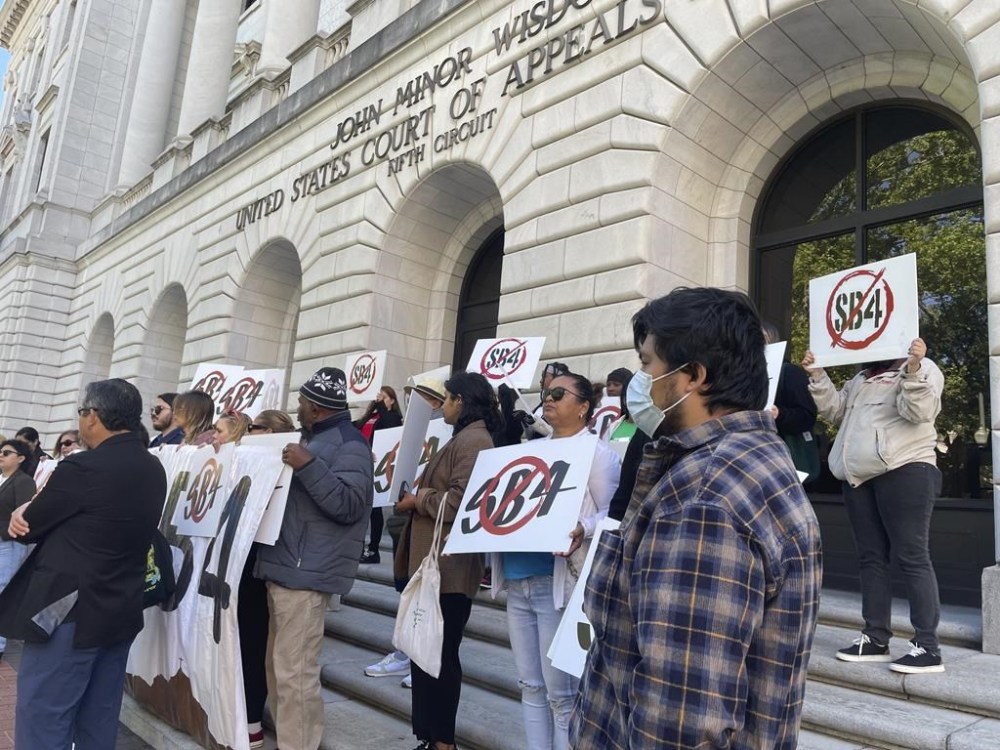
AUSTIN, Texas (AP) — An attorney defending Texas’ plans to arrest migrants who enter the U.S. illegally told a panel of federal judges Wednesday that it’s possible the law “went too far” but that will be up to the court to decide.
The comment was made to a 5th U.S. Circuit Court of Appeals panel that has already previously halted Republican Gov. Greg Abbott’s strict immigration measure. Similar proposals that would allow local police to arrest migrants are now moving through other GOP-led statehouses, including many far from the U.S.-Mexico border.
Texas was allowed to enforce the law for only a few confusing hours last month before it was put on hold by the same three-judge panel that heard arguments Wednesday. No arrests were announced during that brief window.
“What Texas has done here is they have looked at the Supreme Court’s precedent and they have tried to develop a statute that goes up to the line of Supreme Court precedent but no further,” Texas Solicitor General Aaron Nielson said. “Now, to be fair, maybe Texas went too far and that is the question this court is going to have to decide.”
The panel did not indicate whether it believed Texas has overstepped but later questioned Nielson about the specifics and application of the law.
During the hourlong hearing in New Orleans, the Justice Department argued that Texas was trying to usurp the federal government’s authority over immigration enforcement. Texas, however, insisted it would work with the federal government.
The law, known as SB4, allows any Texas law enforcement officer to arrest people suspected of entering the country illegally. Once in custody, migrants could either agree to a Texas judge’s order to leave the U.S. or be prosecuted on misdemeanor charges of illegal entry. Migrants who don’t leave could face arrest again under more serious felony charges.
Asked how the state would enforce judges’ orders for migrants to return to the country from which they entered the U.S. illegally, Nielson said they would be turned over to federal officials at ports of entry. He then stumbled to explain how that is different from what is happening at the border now. At one point, Chief Judge Priscilla Richman questioned what, then, the provision accomplished.
Daniel Tenny, an attorney representing the U.S. government, said the state was attempting to “rewrite Texas SB4 from the podium with regard to the removal provision.”
Richman, an appointee of Republican President George W. Bush, previously ruled in favor of temporarily halting the law.
Judge Andrew Oldham, who was appointed by President Donald Trump and previously opposed the stop, suggested each provision of the law should be scrutinized to determine which, if any, are preempted by federal mandates. Oldham also posed scenarios to attorneys for the federal government of how elements of the law could play out.
“If the court is persuaded that the criminal provisions of SB4 are preempted by federal law, as it indicated it was likely to do in the stay opinion, then really nothing that was said about the removal provisions matters,” Tenny said.
Abbott and other Republicans who approved the law say it’s necessary because President Joe Biden’s administration is not doing enough to prevent illegal border crossings. Justice Department officials have said it would create chaos in the enforcement of immigration law and affect foreign relations.
In the panel’s 2-1 decision last month, Richman cited a 2012 Supreme Court decision that struck down portions of a strict Arizona immigration law, including arrest power. Opponents of the Texas law have said it is the most dramatic attempt by a state to police immigration since that Arizona law.
The panel’s March 19 ruling came hours after the U.S. Supreme Court cleared the way for the Texas law to take effect. The high court, however, did not rule on the merits of the law and sent the case back to the appeals court for further proceedings.