

Why is Taiwan so exposed to earthquakes and so well prepared to withstand them?
Advertisement
Read this article for free:
or
Already have an account? Log in here »
To continue reading, please subscribe:

Digital Subscription
One year of digital access for only $205*
- Enjoy unlimited reading on winnipegfreepress.com
- Read the E-Edition, our digital replica newspaper
- Access News Break, our award-winning app
- Play interactive puzzles
*First annual payment billed as $205.00 + GST for one year. This annual subscription will automatically renew at $233.00 + GST every 52 weeks (10% off the regular annual price of $259.35). Offer available to new and qualified returning subscribers only. Cancel any time.
To continue reading, please subscribe:
Add Free Press access to your Brandon Sun subscription for only an additional
$1 for the first 4 weeks*
- Enjoy unlimited reading on winnipegfreepress.com
- Read the E-Edition, our digital replica newspaper
- Access News Break, our award-winning app
- Play interactive puzzles
*Your next Brandon Sun subscription payment will increase by $1.00 and you will be charged $17.95 plus GST for four weeks. After four weeks, your payment will increase to $24.95 plus GST every four weeks.
Read unlimited articles for free today:
or
Already have an account? Log in here »
Hey there, time traveller!
This article was published 03/04/2024 (894 days ago), so information in it may no longer be current.
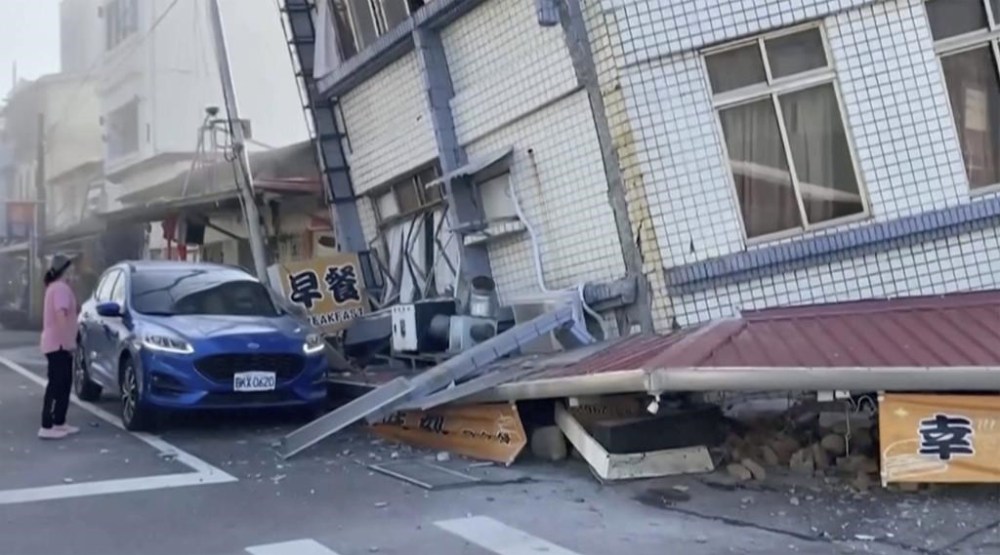
TAIPEI, Taiwan (AP) — Taiwan was struck Wednesday by its most powerful earthquake in a quarter of a century. At least nine people were killed and hundreds injured, buildings and highways damaged and dozens of workers at quarries stranded.
Taiwan is no stranger to powerful earthquakes yet their toll on the high-tech island’s 23 million residents has been relatively contained thanks to its excellent earthquake preparedness, experts say.
Here is a closer look at Taiwan’s history of earthquakes:

WHY SO MANY TEMBLORS?
Taiwan lies along the Pacific “Ring of Fire,” the line of seismic faults encircling the Pacific Ocean where most of the world’s earthquakes occur.
The area is particularly vulnerable to temblors due to the tension accumulated from the interactions of two tectonic plates, the Philippine Sea Plate and the Eurasian Plate, which may lead to sudden releases in the form of earthquakes.
The region’s mountainous landscape can magnify the ground shaking, leading to landslides. Several such landslides occurred on Taiwan’s eastern coast near the epicenter of Wednesday’s quake near eastern Hualien County, when falling debris hit tunnels and highways, crushing vehicles and causing several deaths.
HOW WELL-EQUIPPED IS TAIWAN TO HANDLE QUAKES?
Wednesday’s earthquake measured 7.2, according to Taiwan’s earthquake monitoring agency, while the U.S. Geological Survey put it at 7.4. It damaged several buildings in Hualien but caused only minor losses in the capital Taipei despite being strongly felt there.
The earthquake hit in the middle of the morning rush hour yet only slightly derailed the regular commute. Just minutes later, parents were again walking their children to school and workers driving to offices.
“Taiwan’s earthquake preparedness is among the most advanced in the world,” said Stephen Gao, a seismologist and professor at Missouri University of Science and Technology. “The island has implemented strict building codes, a world-class seismological network, and widespread public education campaigns on earthquake safety.”
The government continually revises the level of quake resistance required of new and existing buildings — which may increase construction costs — and offers subsidies to residents willing to check their buildings’ quake resistance.
Following a 2016 quake in Tainan, on the island’s southwestern coast, five people involved in the construction of a 17-story high-rise apartment building that was the only major structure to have collapsed, killing dozens, were found guilty of negligence and given prison sentences.
Taiwan also is pushing quake drills at schools and workplaces while public media and cellphones regularly carry notices about earthquakes and safety.

“These measures have significantly enhanced Taiwan’s resilience to earthquakes, helping to mitigate the potential for catastrophic damage and loss of life,” Gao said.
THE 1999 QUAKE WAS A WAKE-UP CALL
Taiwan and its surrounding waters have registered about 2,000 earthquakes with a magnitude of 4.0 or greater since 1980, and more than 100 earthquakes with a magnitude above 5.5, according to the USGS.
The island’s worst quake in recent years struck on Sept. 21, 1999, with a magnitude of 7.7. It caused 2,400 deaths, injured around 100,000 and destroyed thousands of buildings.
It was also a major wake-up call that led to key administrative reforms to improve emergency response and disaster reduction, according to Daniel Aldrich, professor of political science and public policy at Northeastern University.

“Observers strongly criticized Taiwan’s response to the 21 September 1999 earthquake, arguing that it took hours for emergency medical response teams to arrive, that rescuers lacked training, and that the operations between government agencies were not well coordinated,” he wrote in an email. As a result, the government passed the Disaster Prevention and Protection Act and set up two national centers to handle coordination and training for earthquakes.
“I think we’re seeing the results in this most recent shock,” he said.
Related Articles
Two Canadians stranded by Taiwan earthquake, says firefighting agency


Advertisement Advertise With Us
Advertisement Advertise With Us
History
Updated on Wednesday, April 3, 2024 12:06 PM CDT: Adds video